Title
THE A REPORT
2025 H2
 SEKIGUCHI Yuko
Writer, Film Journalist, Critic, Editor
SEKIGUCHI Yuko
Writer, Film Journalist, Critic, Editor
Updated on 2 June 2026
(**) Data updated after release.
Overview
In 2025, Japan’s total box office revenue stood at JPY 274.45 billion (USD 1.72 billion). Japanese films accounted for JPY 207.56 billion (USD 1.30 billion), while foreign films accounted for JPY 66.88 billion (USD 419.05 million), meaning Japanese films accounted for 75.6% of total box office revenue. This clearly demonstrates that, at present, audiences overwhelmingly prefer domestic films.
Notably, no foreign film surpassed the JPY 10 billion (USD 62.7 million) mark at the box office revenue during this year. In contrast, four Japanese films surpassed the JPY 10 billion mark, led by Demon Slayer: Kimetsu no Yaiba – Infinity Castle: The Return of Akaza, which recorded JPY 39.14 billion (USD 245.2 million) (as of the end of 2025, and still in theatrical release). Foreign films, which accounted for 24.4% of the market, have put pressure on the finances of the independent film companies that have distributed and promoted these titles, making it difficult for them to survive.
The box office was driven by Demon Slayer: Kimetsu no Yaiba – Infinity Castle, which grossed JPY 39.14 billion (USD 245.2 million); Kokuho, which reached JPY 19.55 billion (USD 122.5 million); and Detective Conan: One-eyed Flashback, which grossed JPY 14.74 billion (USD 92.4 million) following its release in April. Demon Slayer: Kimetsu no Yaiba – Infinity Castle opened in North America on September 12 with an estimated JPY 10.5 billion (USD 65.79 million) opening weekend. The film went on to surpass JPY 100 billion (USD 626.57 million) globally — a historic first for any Japanese film.
 Kokuho ©SHUICHI YOSHIDA, ASP c2025 "KOKUHO" Film Partners
The ODS (Other Digital Stuff) market, which involves live streaming concerts and stage performances on movie theater screens, has shown remarkable growth as a box office business. In 2025, the market recorded approximately JPY 27.4 billion (USD 171.7 million), marking nearly a sixfold increase compared to approximately JPY 4.7 billion (USD 29.4 million) recorded in 2012, the first year such figures were published. Notable titles include Japan’s first interactive cinema experience, where viewers can choose the story, Hypnosis Mic - Division Rap Battle (distributed by TOHO NEXT). Live-streamed concerts at movie theaters featuring the boy band Snow Man at the National Stadium and the popular band Southern All Stars at the Tokyo Dome also garnered significant attention.
Top 10 Films in Japanese Box Office (2025)
You can scroll left and right to view the content.
| No | Title | Director | Country | Genre | Gross (JPY) |
Gross (USD) |
Production Company |
Distribution Company |
|---|---|---|---|---|---|---|---|---|
| 1 | Demon Slayer: Kimetsu no Yaiba - Infinity Castle | Sotozaki Haruo | Japan | Animation | 39.14B | 245.2M | Ufotable | TOHO, Aniplex |
| 2 | Kokuho | Lee Sang-il | Japan | Historical Drama | 19.55B | 122.5M | Myriagon Studio | TOHO |
| 3 | Detective Conan: One-eyed Flashback | Katsuya Shigehara | Japan | Animation | 14.74B | 92.4M | TMS Entertainment | TOHO |
| 4 | Chainsaw Man - The Movie: Reze Arc | Yoshihara Tatsuya | Japan | Animation | 10.43B | 65.4M | MAPPA | TOHO |
| 5 | Cells at Work! | Takeuchi Hideki | Japan | Action, Comedy | 6.36B | 39.8M | Twins Japan | Warner Bros. |
| 6 | Tokyo MER the Movie: Nankai Mission | Matsuyama Hiroaki | Japan | Action, Drama | 5.29B | 33.1M | Daiei TV, TBS | TOHO |
| 7 | Mission: Impossible – The Final Reckoning | Christopher McQuarrie | USA | Action, Thriller | 5.28B | 33.1M | Skydance, TC Productions | Toho-Towa |
| 8 | Exit 8 | Kawamura Genki | Japan | Mystery, Thriller | 5.17B | 32.4M | Story Inc., AOI Pro. | TOHO |
| 8 | Moana 2 | David G. Derrick Jr., Jason Hand, Dana Ledoux Miller | USA | Animation | 5.17B | 32.4M | Walt Disney Animation Studios | Walt Disney Japan |
| 10 | Jurassic World: Rebirth | Gareth Edwards | USA | Sci-Fi, Action | 4.90B | 30.7M | Universal Pictures, Amblin Entertainment | Toho-Towa |
Top 10 Domestic Films in Japanese Box Office (2025)
You can scroll left and right to view the content.
| No | Title | Director | Country | Genre | Gross (JPY) |
Gross (USD) |
Production Company |
Distribution Company |
|---|---|---|---|---|---|---|---|---|
| 1 | Demon Slayer: Kimetsu no Yaiba - Infinity Castle | Sotozaki Haruo | Japan | Animation | 39.14B | 245.2M | Ufotable | TOHO, Aniplex |
| 2 | Kokuho | Lee Sang-il | Japan | Historical Drama | 19.55B | 122.5M | Myriagon Studio | TOHO |
| 3 | Detective Conan: One-eyed Flashback | Katsuya Shigehara | Japan | Animation | 14.74B | 92.4M | TMS Entertainment | TOHO |
| 4 | Chainsaw Man - The Movie: Reze Arc | Yoshihara Tatsuya | Japan | Animation | 10.43B | 65.4M | MAPPA | TOHO |
| 5 | Cells at Work! | Takeuchi Hideki | Japan | Action, Comedy | 6.36B | 39.8M | Twins Japan | Warner Bros. |
| 6 | Tokyo MER the Movie: Nankai Mission | Matsuyama Hiroaki | Japan | Action, Drama | 5.29B | 33.1M | Daiei TV, TBS | TOHO |
| 7 | Exit 8 | Kawamura Genki | Japan | Mystery, Thriller | 5.17B | 32.4M | Story Inc., AOI Pro. | TOHO |
| 8 | Doraemon the Movie: Nobita's Art World Tales | Teramoto Yukiyo | Japan | Animation | 4.61B | 28.9M | Shin-Ei Animation | TOHO |
| 9 | Grand Maison Paris | Tsukahara Ayuko | Japan | Drama, Gourmet | 4.20B | 26.3M | TBS Holdings | TOHO, Sony Pictures Entertainment |
| 10 | Mobile Suit Gundam GQuuuuuuX: Beginning | Tsurumaki Kazuya | Japan | Animation, Mecha, Sci-Fi | 3.62B | 22.7M | Bandai Namco Filmworks | TOHO, Bandai Namco Filmworks |
Source: Motion Picture Producers Association of Japan, Inc.
Production Landscape
A total of 694 Japanese films were released in cinemas in 2025. The most popular genre was live-action drama, accounting for approximately 23% of the total. Notably, documentaries followed closely behind at around 20%. These often depict the various issues faced by citizens and the nation, featuring earnest content that goes beyond daily news coverage.
Animation accounted for approximately 17% of total film releases in 2025. Notable titles in this category included Demon Slayer: Kimetsu no Yaiba – Infinity Castle and Detective Conan: One-eyed Flashback. Despite representing a relatively small share of total releases by title count, animation generated 46.2% of overall box office revenue.
In 2025, the Ministry of Economy, Trade and Industry (METI) established the “Five Principles of Entertainment and Creative Industry Policy,” with the goal of expanding overseas sales of Japanese-originated content to JPY 20 trillion (USD 125.31 billion) by 2033. The principles include providing large-scale, long-term strategic support; supporting initiatives to create in Japan and distribute globally; maintaining non-interference in creative content; strengthening direct international distribution; and prioritizing emerging challengers.
With a budget of approximately JPY 55.6 billion (USD 348.37 million), the ministry has laid the foundation to promote global expansion, starting with 2D content, by developing the IP, talent, and digital infrastructure necessary to create world-class works, build international distribution networks, and cultivate fanbases.
While this is not the sole reason, Demon Slayer: Kimetsu no Yaiba – Infinity Castle surpassed JPY 100 billion (USD 626.57 million) in global box office revenue, and Chainsaw Man – The Movie: Reze Arc also exceeded JPY 10 billion (USD 62.7 million) in global box office revenue. Driven by animation works, the overseas market share has expanded significantly.
Toei’s Licensing Division generated JPY 23.28 billion (USD 145.86 million) in overseas licensing revenue (a 108% increase from the previous year) through the sale of merchandising rights for One Piece and the sale of merchandising and game adaptation rights for Digimon. Shochiku Games, part of Shochiku’s Game Business Division, focused on the sale of games such as Eternal Palace Sakura and SONZAI in the Asian market.
Notably, Toho has made significant strides in its overseas expansion. TOHO Global, established as a spin-off of the International Division, serves as the core of the company’s overseas operations. Toho International, Inc., a subsidiary of TOHO Global based in North America, handles film licensing, marketing, and distribution.
Additionally, Toho Entertainment Asia Pte. Ltd., established in 2023, manages IP and video content licensing, merchandise, and marketing of IP and visual content in Asia; and GKIDS, INC., which handles the distribution and promotion of animated works overseas, primarily in North America. These group companies, established in 2023 to spearhead overseas expansion, have begun to make steady progress.
Additionally, Kodansha, a publishing house that owns numerous globally recognised intellectual properties in manga and novel publishing, established a video production subsidiary, "Kodansha Studios," in the United States in November 2025. With Chloe Zhao, director of films such as Nomadland, serving as CCO, the company aims to produce content for the global market, including live-action films and dramas.
Financing Models
In Japan, funding typically comes from production committees, film funds, grants and subsidies, international co-productions, crowdfunding, or a combination of these.
Since the 1990s, the production committee system has been the most common method of financing commercial film production.
Production committees typically comprise film companies, television stations, publishers, advertising agencies, talent agencies, production companies, trading companies, and others. One of these entities acts as the lead company, forming a voluntary association without legal personality, and profits are distributed according to investment ratios.
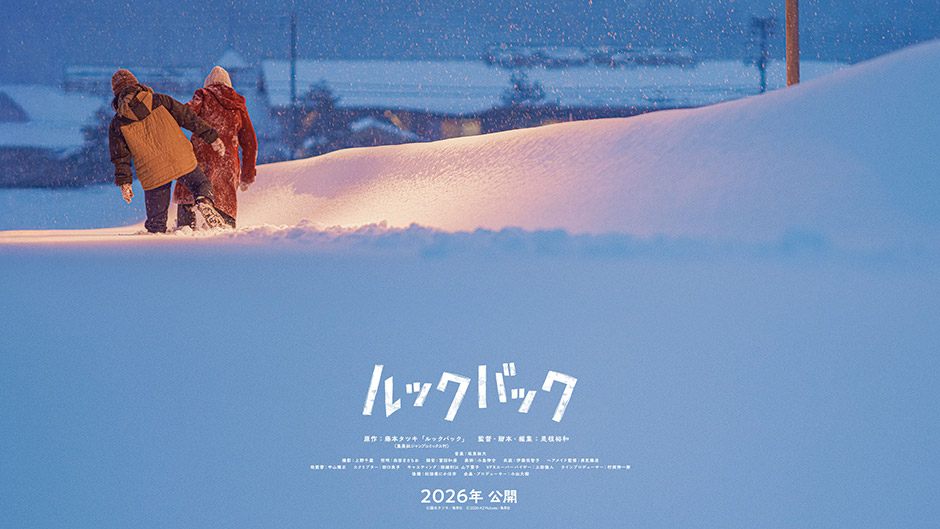 Look Back © Tatsuki Fujimoto / Shueisha © 2026 K2 Pictures・Shueisha
Several film funds were established in the 2000s, but the prevailing impression is that only a few can be considered successful. Times have changed, and the film production fund "K2P Film Fund I," launched in 2024 by K2Pictures Co., Ltd., is currently making its presence felt. Having received investments from the Development Bank of Japan, Inc. in 2025 and Tokyu Land Corporation in 2026, the fund is moving forward with live-action and animated productions and projects. Notable projects include Mag Mag, the directorial debut of Yuriyan Retriever, and Look Back (Live action), directed by Hirokazu Kore-eda.
As outlined earlier, in 2025 the Ministry of Economy, Trade and Industry (METI) established the “Five Principles of Entertainment and Creative Industry Policy” to support the global expansion of Japanese content. Building on this policy framework, the Ministry has introduced a set of concrete support measures.
It is worth noting that Japan's content support is structured differently from countries with a single coordinating ministry. The Agency for Cultural Affairs (Bunkacho), under the Ministry of Education, Culture, Sports, Science and Technology, has traditionally handled arts-focused grants and copyright matters, while METI now drives industrial and export-oriented programs. The two ministries operate in parallel, with METI's role expanding rapidly in recent years.
These include various grants and subsidies, such as the Agency for Cultural Affairs’ “Grant for the Promotion of Culture and the Arts.” In addition, METI has launched nine grant programs under the Content Industry Support Program, with applications scheduled to open at the end of March.
Content Industry Support Program Grants
| Category | Program | Support Type | Maximum Funding (JPY) |
|---|---|---|---|
| New IP Creation | Startup Support | Per applicant | 10M |
| New IP Planning Support | Per applicant | 100M | |
| Large-Scale Production | General Support | Per applicant | 1.5B |
| Location Attraction Support | Per project | 1.5B | |
| Distribution Platforms | Expanding Distribution Platforms (US, UK, Indonesia, India) |
Per applicant | 3B |
| Platform Development | Building Development Platforms | Per applicant | 100M |
| Overseas Expansion | Global IP Ecosystem Expansion (US, UK, Indonesia, India) |
Per project | 200M |
| Localization Support | Per applicant | 40M | |
| Promotion Support | Per applicant | 20M |
For programs requiring collaboration with overseas entities—namely Location Attraction Support, Expanding Distribution Platforms, and Support for Overseas Expansion—while cash rebates and tax credits for international co-productions are still under development, these measures are expected to benefit businesses in the United States, the United Kingdom, Indonesia, and India, which the Ministry of Economy, Trade and Industry has designated as priority countries.
On the other hand, small-budget independent films—which make up the majority of Japanese cinema—raise production funds through self-financing, crowdfunding, individual investors, and corporate sponsors.
Taking the 2024 smash hit A Samurai in Time as an example, it was produced with a budget of JPY 26 million (USD 162,907), comprising JPY 20 million (USD 125,313) in the director’s own funds and a JPY 6 million (USD 37,594) grant, and went on to generate over JPY 1 billion (USD 6.27 million) in box office revenue.
Distribution Climate
Film distribution companies hold the rights to both produced and acquired works and supply them to exhibition companies operating multiplexes (see data section for major players). Films generate revenue through a multi-window distribution model, in which theatrical release serves as the primary window, followed by streaming services and home video (DVD and Blu-ray) as the secondary window, and in-flight and onboard screenings as the tertiary window. Revenue from each window is managed by the distribution company for acquired titles, and by the lead company of the production committee for produced titles.
Top 9 Film Distributors by Annual Box Office
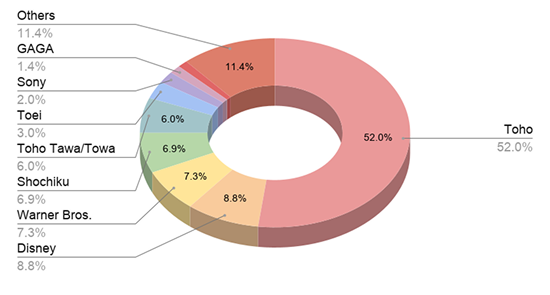
Note: As some Japanese films are distributed by foreign companies, this ranking is not limited to domestic companies
In 2025, the Japanese film industry was rocked by reports that Netflix, followed by Paramount Skydance, had moved to acquire Warner Bros. Discovery (Paramount Skydance ultimately secured the deal). Warner Bros. Japan, the Japanese subsidiary that had distributed Warner Bros. titles, ceased its theatrical distribution operations as of December 31. Since then, distribution of the company’s foreign productions (excluding Japanese films produced by the company) has been transferred to Toho-Towa, a member of the Toho Group. The company has also handled the distribution of Universal Pictures titles since 2007 and Paramount Pictures titles since 2015.
The number of foreign films released was 611. By region, North America accounted for 35%, Europe for 35%, and Asia for 30% of the total. Within the Asian segment, South Korean films had the highest number of releases, accounting for 38% of the regional total, followed by China at 27% and India at 13%.
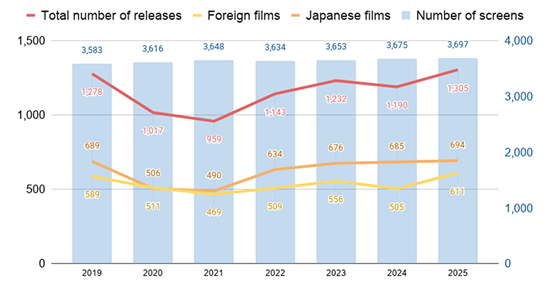
Number of Screens and Film Releases (2019-2025)
Theatrical Reach
ln 2025, the number of screens increased by 22 from the previous year to 3,697. The cinema complexes, listed in order of screen count, were Aeon Cinemas, TOHO Cinemas, United Cinemas/Cineplex, SMT (including MOVIX and Piccadilly). T-Joy, and 109 Cinemas. In terms of revenue, the two major chains, TOHO Cinemas and Aeon Cinemas, accounted for approximately 50% of the market, while smaller chains and art house theaters held a combined share of about 19%. However, these traditional theaters are gradually disappearing; in particular, the closure of Marunouchi TOEI, which had been Toei's flagship theater, was widely reported. While traditional theaters were closing, several cinema complexes with 6 to 9 screens opened in various locations, and three art-house theaters opened in Tokyo, Saitama, and Hokkaido.**
Top Cinema Chains (2025)**
| No. | Cinemas | No. of Branches and Screens | Market Share |
|---|---|---|---|
| 1 | Aeon Cinemas | 98 sites, 836 screens | 23% |
| 2 | TOHO Cinemas | 75 sites, 705 screens | 19% |
| 3 | United Cinemas / Cineplex | 41 sites, 385 screens | 10% |
| 4 | SMT (including MOVIX and Piccadilly) | 25 sites, 236 screens | 6% |
| 5 | T-Joy | 23 sites, 230 screens | 6% |
| 6 | 109 Cinemas | 20 sites, 185 screens | 5% |
| 7 | Others | 31% |
In 2023, many theater operators raised standard ticket prices from JPY 1,800 (USD 11.28) to JPY 2,000 (USD 12.53). In 2025, T-Joy announced a further increase to JPY 2,200 (USD 13.78), while Shochiku Multiplex Theaters raised prices to JPY 2,100 (USD 13.16).
Technology & Production Services
TOHO Studios opened Japan’s first post-production center within its studio premises capable of handling both Dolby Vision and Dolby Atmos—technologies that create high-quality visuals and sound—and performing quality checks on them.
Toei Zukun Laboratory Research Institute has further refined technologies such as Nameless Motion, a motion-pose system for background character production; the TOEI FCS facial capture system, which analyzes human expressions and applies them to CG characters; and virtual production technologies utilizing motion capture and LED walls, which have been transferred to the Tokyo Studio.
Shochiku Visual Center has launched a service utilizing its proprietary 3D audio technology, Audio Cube, to deliver immersive three-dimensional sound for sports broadcasting and the entertainment sector.
Kadokawa Daiei Studio is also collaborating with Sony PCL to advance virtual production for both domestic and international companies and creators.
All three companies are pursuing strategies that target not only the domestic market but also global markets.
Streaming Platforms & Digital Growth
Listing video-on-demand (VOD) and subscription services operating in Japan in order of market share, the top players are roughly Netflix, U-NEXT, Prime Video, Disney+, DAZN, Hulu, d Anime Store, TELASA, Lemino, FOD, and ABEMA Premium. The market size in 2025 is projected to be approximately JPY 601.7 billion (USD 3.77 billion), a 14.3% increase from the previous year.
While Netflix stands out in terms of growth rate, TELASA (over 2.3 million subscribers as of February 2026) and FOD (over 1.5 million subscribers as of August 2024) have also expanded their market share. Netflix reported that its subscriber base exceeded 10 million in 2024. Based on a projected market share of 26% in 2025, and considering its recent acquisition of exclusive streaming rights for the WBC, the number of subscribers is estimated to have grown over 12.6 million.
Top 5 Streamers by Market Share
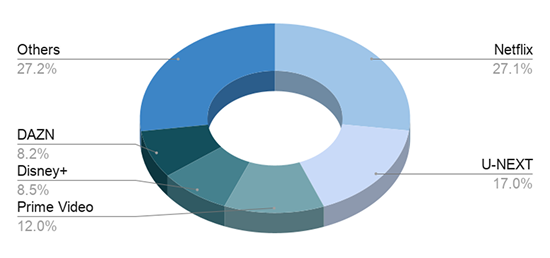
Source: Motion Picture Producers Association of Japan, Kinema Junpo, GEM Standard, Avanti Press
Commercial vs. Independent Balance
We define commercial films as those with relatively large production budgets and those that drove box office performance. There were approximately 145 such films, accounting for about 20% of the 694 films released.
Of these, 38 films exceeded JPY 1 billion (USD 6.27 million) in box office revenue—a figure often cited as the threshold for commercial success. The combined box office revenue of these 38 films totaled JPY 167.22 billion (USD 1.05 billion), representing 80% of the total box office revenue for Japanese films.
The total box office revenue for the remaining 656 films was JPY 40.34 billion (USD 252.76 million). The system for producing approximately 549 independent films faces significant challenges in terms of both fundraising and profitability. However, this group includes smash hits, highly artistic works, and films by young directors poised for future success.
- Note: USD conversions are based on an exchange rate of USD 1 = JPY 159.6 (March 2026)
Interview
with Takuya KAYAKI, Project Leader of GEMSTONE Creative Label, Toho Co., Ltd.

Takuya Kayaki joined Toho Co., Ltd. in 2018. After working in the Film Coordination and Corporate Planning departments, he is currently part of the Development Team. There, he produces a wide range of entertainment content, focusing on new business challenges beyond the realm of film. In 2023, he launched GEMSTONE Creative Label and, as project director, he is dedicated to supporting young creators.
At Toho, where box office performance remained strong in 2025, a new initiative is underway that hints at future possibilities. Driven by young employees from both production and non-production departments who voluntarily got onboard, the project allows them to participate directly in the creative process as producers. This initiative involves producing a short film omnibus aimed at developing talent for Toho’s future mainstream projects. We spoke with Takuya Kayaki to learn more about the experimental and ambitious spirit of this label.
Q. One of the label’s offerings, a short omnibus film GEMNIBUS vol.2, opened at TOHO Cinemas Hibiya on March 6, 2026, to sold-out screenings. I heard that while it was initially scheduled for a one-week limited run, an extended run was decided upon due to its popularity. Could you tell us what prompted you to launch GEMNIBUS?
A.Back in 2019, particularly in the U.S., there was a growing trend of YouTubers transitioning into film directors, and it was anticipated that this trend would eventually reach Japan, albeit a bit later. Against this backdrop, the ‘GEMSTONE Creators Audition’ was launched to discover young creators on YouTube, serving as the precursor to this project.
Q. Subsequently, the project was later renamed GEMSTONE Creative Label, evolving from an audition-based initiative into a production label. After a period of trial and error, it culminated in GEMNIBUS vol.1. The films released in theaters in 2024 were well-received, leading to an extended release. Could you tell us about the producers participating in this growing project, GEMSTONE Creative Label?
A.GEMSTONE Creative Label is comprised of employees who have been with the company for 10 years or less and who volunteered to join. While some are young producers from the Film Planning Department or TOHO Animation, others come from various departments, including Accounting and Finance, Business Management, and Legal Affairs. I believe that bringing together people with such diverse backgrounds fosters new perspectives and ideas, which in turn complement and strengthen our existing initiatives.
Q. Mr. Kayaki, while launching and overseeing GEMSTONE Creative Label, you collaborate closely with many young artists—including film directors, VFX artists, and musicians—to create new works. At the same time, you are dedicated to nurturing young producers within the company. I heard that during your university days, you were actually in the Faculty of Science and Engineering and had little connection to 'film.' You even described yourself as 'not what you’d call a movie buff.' That is a very intriguing background.
A.My decision to major in science and engineering was triggered by watching Top Gun and thinking, ‘Pilots are cool,’ and the fact that I worked part-time as a bartender during college was also influenced by Tom Cruise’s Cocktail. I also started fencing after watching Star Wars, and looking back, movies have always been at the turning points of my life. I’m naturally prone to getting bored easily, but one of the appeals of working at a film studio was that I could tackle different subjects with each project. At the same time, I feel that the expertise in technology—Kayaki’s original field of specialization—has become a strength within the company.
Q. I hear that one of the project’s goals is to create new Intellectual Property (IP).
A.In the future, I hope to create an IP on par with Godzilla. To achieve that, investing in creators is essential. I believe it’s important to look 10 or 20 years ahead and grow alongside the younger generation of creators.
Q. I heard GEMNIBUS plans to expand its global reach, including international film festival submissions. At the Fantasia International Film Festival, Director China Sui’s First Line (Vol. 1) and Shunta Seki’s Sonic Beat (Vol. 2) reportedly earned positive feedback for both their cinematic quality and the networking opportunities they created.
A.Toho has built a strong track record as a film distributor. It is on this foundation that the Content Business Development Office, where I work, can explore new opportunities while collaborating with existing businesses, and I believe that is our role. Ideally, we would like to maintain film as our core while expanding our reach across the broader entertainment industry.
I believe it is extremely important for the producers of major films to focus on their specific roles. That is why I hope people in my position can play a complementary role by exploring new possibilities for content and business ventures that extend beyond the realm of film.
 Sonic Beat © 2025 TOHO CO., LTD.
SEKIGUCHI Yuko
Writer, Film Journalist, Critic, Editor
After serving as Managing Editor of Kinema Junpo and Editor-in-Chief of Variety Japan, Yuko Sekiguchi established Avanti Plus Co., Ltd. Currently freelance. Served on the Ministry of Internal Affairs and Communications Intellectual Property Strategy Headquarters Content Licensing Council, Agency for Cultural Affairs Grant Review Committee, Agency for Cultural Affairs Film Promotion Consultation Panel, Corporate Mecenat Conference, international film festival juries, Japan Arts Council Film Festival Division Chief Examiner, Agency for Cultural Affairs Arts Selection Award Jury, Ministry of Education, Culture, Sports, Science and Technology Educational Video Review Panel, Kinema Junpo Best Ten Selection Committee, Mainichi Film Awards Jury, and Tokyo International Film Festival Selection Advisory Board. Works across newspapers, magazines, web, radio, television, and streaming platforms.