Title
THE A REPORT
2025 H2
 Mansour JAHANI
Independent Journalist
Mansour JAHANI
Independent Journalist
Updated on 15 May 2026
Overview
Following the record-breaking box-office performance of 2024, the second half of 2025 marked a sharp reversal for Iranian cinema. Toward the end of the first half of the year, the outbreak of the 12-day war between Iran and Israel forced cinemas across the country to shut down for 10 days, disrupted production pipelines, and triggered a steep decline in admissions that persisted through the end of the year. Following the reopening of theaters, however, comedy films played a significant role in reviving the Iranian box office.
In terms of participation in international film festivals, in the second half of 2025, Iran participated in prestigious international film festivals and events with the film It Was Just an Accident directed by Jafar Panahi and received awards.
The 42nd Tehran International Short Film Festival (TISFF), an OSCAR® qualifying festival approved by the Academy of Motion Picture Arts and Sciences, was held from October 19 to 24, 2025, at the Iran Mall Cinema Complex in Tehran, with the aim of identifying and introducing selected short works at the national and international levels, with the aim of creating a flow and constructive competition between filmmakers and honoring the creativity of young filmmakers, as well as screening short films by Iranian and international filmmakers.
The Fajr International Film Festival, which is among the top 14 FIAPF-accredited festivals, held its 43rd edition in the literary and historical city of Shiraz from November 26 to December 3, 2025, with the participation of Iranian and international films across Competition sections including the International Competition, the Eastern Vista Competition, and the Vision Competition, which is dedicated to directors’ first and second films, as well as the Broken Olive Competition, and Out of Competition sections including the Educational Section, Dar al-Fonun Workshops, masterclasses, and the Bazaar Section. Nuri Bilge Ceylan, a renowned Turkish screenwriter and director, served as the jury president for the International Competition.
The 19th International Documentary Film Festival of Iran, widely recognized as “Cinema Verité” was held with the support from DEFC (Documentary, Experimental & Animation Film Center) of Iran, with the aim of supporting creative documentary cinema, strengthening cultural dialogue, and developing capacities for documentary film production, screening, and criticism, as well as screening films by Iranian and international documentary filmmakers in competitive and non-competitive sections from December 10 to 16, 2025 at the Mellat Cinema Campus in Tehran.
The number of moviegoers in the first eight months of 2025 decreased to 16 million, from 20 million in the same period in 2024. It is noteworthy that while overall box office revenue this year was higher than last year due to increased ticket prices, the actual number of viewers has fallen by nearly four million.
Top 10 Domestic Films in Iranian Box Office (H2 2025)
You can scroll left and right to view the content.
| No. | Title | Director | Country | Genre | Gross (IRR) |
Gross (USD) |
Production Company |
Distribution Company |
|---|---|---|---|---|---|---|---|---|
| 1 | The Man with Glasses | Karim Amini | Iran | Comedy | 1.83T | 1.74M | Amerian Film | Amerian Film |
| 2 | The Old Bachelor | Oktay Baraheni | Iran | Drama | 1.65T | 1.57M | Babak Hamidian | Amerian Film |
| 3 | The Mr. Leech | Mehran Ahmadi | Iran | Comedy | 1.19T | 1.13M | Mehran Ahmadi | Mehregan Film |
| 4 | Woman and Child | Saeed Roustayi | Iran | Drama | 1.01T | 0.96M | Jamal Sadatian | Goodfellas |
| 5 | Yooz | Reza Arzangi | Iran | Animation | 0.82T | 0.78M | Soure Cinema Organization | Bahman Sabz Institute |
| 6 | Constantinople | Karim Amini | Iran | Comedy | 0.78T | 0.74M | Aminreza Chalabianlu | Shayesteh Film |
| 7 | The Misfits | Hossein FarahBakhsh | Iran | Comedy | 0.51T | 0.49M | Abdollah AliKhani | Parsa Film |
| 8 | The Crooked Cocoon | Hatef Alimardani | Iran | Comedy | 0.46T | 0.44M | Hatef Alimardani | Filmiran |
| 9 | Cloture | Soheyl Movaffagh | Iran | Comedy | 0.42T | 0.40M | Amerian Film | Amerian Film |
| 10 | Saddam | Pedram Pouramini | Iran | Comedy | 0.39T | 0.37M | Mojtaba Rashvand | Amerian Film |
Note: Calculations are based on an estimated exchange rate of 1 USD ≈ 1,050,000 IRR
Production Landscape
Since film production has faced numerous fluctuations and interruptions following Israel's 12-day war against Iran, and production costs have skyrocketed, experts have raised concerns about the cinema's content portfolio.
The Iranian cinema industry has faced serious challenges in H2 2025. Despite the limited success of a few comedies at the box office, industry estimates suggest that the majority of releases in the second half of 2025 were unable to recoup their costs; therefore, the return on investment has become a major problem for producers.
Considering that the production cost of a feature film in Iran is estimated to exceed USD 600,000, it is evident that over 90 percent of released films have failed to break even.
Experts believe the main reasons for this situation are changing audience tastes, declining quality of productions, easy access to alternative media, and film piracy. These factors have combined to push Iranian cinema into one of its most difficult economic periods.
In the second half of 2025, 100 feature films applied for production licenses from the Iranian Cinema Organization’s Production Supervision Department. This total includes 43 social dramas, 21 comedies, 9 war and Sacred Defense films, 11 mystery/detective films, and 16 films in other genres such as history, sports, thriller, and fantasy.
Also, 158 short films, including 43 films in Tehran and 115 films in different provinces of Iran, have received production licenses. 67 documentary films, including 11 films in Tehran and 56 films in different provinces of the country, have also received production licenses.
In the H2 2025, 35 documentary films and 12 animated films were produced at the DEFC of Iran, a subsidiary of the Iranian Cinema Organization affiliated with the Ministry of Culture and Islamic Guidance.
In the Art and Experience Cinema Group—which screens artistic, experimental, and independent films—the second half of 2025 saw the production of 44 documentaries (comprising 26 shorts, 15 semi-length, and 3 feature-length films) along with 13 short animated films.
In the H2 2025, more than 400 short films were produced by filmmakers across Iran, and 50 films were made by students and graduates of the Iranian Youth Cinema Association, some of which premiered at the Tehran International Short Film Festival.
The Iranian Center for the Intellectual Development of Children and Adolescents, which produced the short film In the Shadow of the Cypress which won the Oscar for Best Animated Short Film in 2025, has produced almost no films in the second half of 2025.
Financing Models
The “Farabi Cinema Foundation” affiliated with the Ministry of Culture and Islamic Guidance of Iran has been introduced as the national institution of Iranian cinema as a facilitating, standardizing, leading and innovative institution in the field of providing capital, production, distribution and expanding global markets for Iranian cinema. In the field of content, by publishing and promoting the discourse of the Islamic Revolution through professional, committed, religious, revolutionary and humane cinema, it has increased the share of the cinema economy in both the country's GDP and global markets, and by developing adjacent industries, it will be the largest player in the region's cultural industries.
One of the requirements for the development of the cinema industry is to provide sustainable resources for it, as well as to develop the industry's financial and economic models. In recent years, with the emergence of new financial instruments such as venture funds, the development of capital markets, crowdfunding, etc., the need to develop the financial and economic instruments and structures of cinema is felt more than ever. Reducing the reliance of film production on government budgets and using new investment methods will be among Farabi's important programs.
Launching venture funds, launching an investment fund, launching crowdfunding, managing private sector partnerships, and attracting capital for the production of cinematographic works are some of these types of measures. Also, developing markets and increasing business interactions with new partners such as online distribution platforms, distribution offices, and making optimal use of the capacity of Iranian chambers of commerce and commercial offices in other countries, which, in addition to the cultural dimension, will strengthen commercial cooperation between Iranian cinema, are other measures of the Farabi Iranian Cinema Foundation.
At Farabi, there is no fixed formula for determining the costs of cinematographic works in a uniform manner; therefore, the center enlists the help of expert consultants, mainly consisting of cinema production managers, who, by examining the scripts, determine the costs as well as the budget required for each work.
At “Farabi Cinema Foundation”, justice does not mean equal distribution of budgets, but rather the correct and optimal allocation of resources to the production of works that will help the filmmaking complex achieve its expected goals.
The budget of the “Farabi Cinema Foundation” has varied over the years and is mainly provided by the Iranian Cinema Organization. However, some economic institutions, such as the Oil Company, have also occasionally supported the “Farabi Cinema Foundation” in financing film productions. This year, due to the special conditions resulting from the aftermath of the imposed war in the country, resources and budgets have become much more limited, and therefore no budget has yet been allocated to the Farabi Cinema Foundation.
Having a production license is a necessary condition for receiving support from the “Farabi Cinema Foundation”, but it is not a sufficient one, as a production license only indicates that the filmmakers have the ability to produce films and that their script complies with regulations and bylaws without crossing red lines. Investment by the “Farabi Cinema Foundation” must also align with the foundation’s goals and demonstrate audience appeal. Therefore, having a production license alone cannot be considered a guarantee of a film’s success.
In the current inflationary conditions in Iran, it is not possible to set a fixed figure for production. In state-run cinema, the factors of production are different from those in private cinema. Platforms have increased costs, especially in the field of acting, for example, the cost of actors' salaries reaches about 40% of the total costs of a film.
Without government support for cinema, genre diversity will decrease, and some genres, such as “war movies”, will disappear completely, because private cinema tends more toward comedy.
Distribution Climate
No. of Domestic Feature Films Released
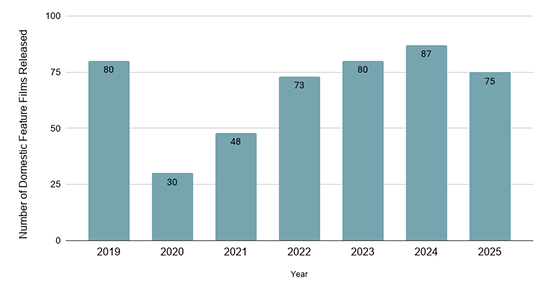
According to the “Samfaa” section of the Cinema City website, which operates under the supervision of the Iranian Cinema Organization and presents statistics on movie ticket sales at the Iranian cinema box office, a total of 60 domestic films were screened in Iranian cinemas during the second half of 2025, including 40 new films and 20 titles that continued their theatrical run from the first half of the year. Overall, 75 domestic films were released in 2025, although only a limited number achieved significant box office success. Meanwhile, comedies continued to serve as the driving force of the box office, accounting for a large share of total sales.
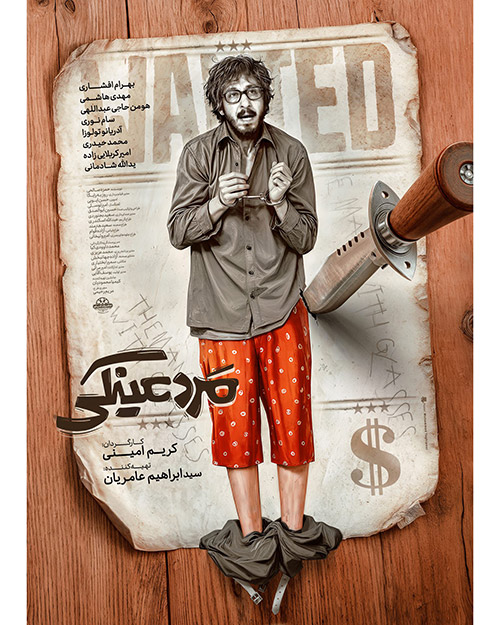 The Man with Glasses © Amerian Film
The comedy film The Man with Glasses was the highest-grossing film, grossing over USD 1.74 million. The film sold over 2.3 million tickets in 766 theaters and averaged 40 viewers per screening.
In second place was the non-comedy film The Old Bachelor directed by Oktay Baraheni, which performed impressively with sales of over USD 1.57 million. The film attracted over two million viewers in 739 theaters and set a record for the highest theater occupancy with an average of 45 viewers per screening.
Total ticket sales for the top three films in the second half of 2025 reached about six million. However, this figure is not directly comparable to the more than 14 million tickets recorded by the top three films in 2024, as the latter reflects full-year performance. Even with this difference in scope, the figures still suggest a notable and concerning decline in cinema audiences in 2025.
In the second half of 2025, the film The Man with Glasses directed by Karim Amini and starring Bahram Afshari, Mehdi Hashemi, Hooman Haji Abdollahi, Sam Nouri, and Adriano Toloza, as well as the film The Old Bachelor directed by Oktay Baraheni and starring Leila Hatami, Hamed Behdad, Hasan Pourshirazi, Mohammad Valizadegan, Mohammad-Reza Davoudnejad, and Babak Hamidian, were among the most successful films at the box office.
The film The Old Bachelor, whose smuggled version was leaked online, was quickly released on an official internet platform to compensate for the damages. However, it was seized there a few days later. Despite selling 60,000 tickets and the fact that a high-quality free version is available, the issue regarding its continued online release has not yet been resolved.
Top Distributors in Iran (H2 2025)
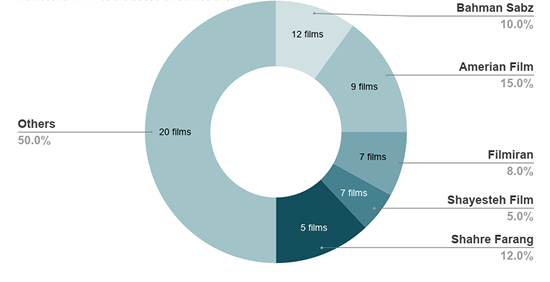
Market share figures are based on admissions.
In the “Art and Experience Cinema Group”, which is dedicated to screening artistic, experimental, and independent films by Iranian and foreign filmmakers, and where valuable and non-commercial films are presented; in the second half of 2025, a total of 47 films, including 29 feature films, 8 documentaries, and 10 short films, were screened, and 3 films were also distributed online through platforms.
Theatrical Reach
A comparison with previous years indicates that Iranian cinema experienced a marked decline in both sales and audience attendance in 2025. The sharp drop in theatrical performance, combined with audience fragmentation and the relative dominance of low-quality comedies, has weakened the overall box office landscape. The children’s and teen genres have also failed to achieve commercial success, with their limited successes largely driven by the individual appeal of specific titles rather than broader market trends.
Looking at the state of Iranian cinema in the fall quarter of 2025, it presents a worrying picture of box office and audience. Although cinema was known as a relatively inexpensive form of entertainment for households in previous years, sales data show that this entertainment industry has faced a significant decline in popularity this fall.
This decline in audience is related to several factors. The “unfavorable economic situation of the country” has put severe pressure on households and reduced the purchasing power of cultural entertainment. The increase in ticket prices has affected families' decision to go to the cinema. In addition, cold weather, air pollution, and the spread of influenza have also played a role in reducing audience interest.
Another issue is the repetitiveness of comedy formulas. Comedies still hold a large share of the top 10 grossing films, but they have lost their former power to attract audiences. Higher-grossing films like The Mr. Leech and Yooz show that the genre still has its audience, but other comedies with clichéd jokes are unable to save the box office.
The sales gap between top-grossing films has also narrowed, and no dominant effect is seen at the box office. At the same time, the expansion of film productions in the home theater network and the increase in film screening platforms could be another reason for the decline in sales and cinema audiences.
December, traditionally considered as the golden period for cinema and a key window for both producers and audiences, recorded the lowest attendance among all comparable months this year. Total admissions reached only 1,874,000, representing a 54% decline compared to December 2024 and a 45% decline compared to December 2023. Monthly box office revenue likewise amounted to just USD 1.4 million. Even high-profile titles such as The Crooked Cocoon, Constantinople, Mr. Leech, Cloture, and Tehran 57 failed to reverse the trend. This situation shows that the problem of cinema this month is not a lack of films, but a decline in audience willingness to attend theaters.
The majority of Iranian cinemas are dedicated to films produced domestically; that is, in principle, foreign or non-Iranian films are not shown in Iranian cinemas and are usually screened as single screenings and very, very special.
In recent years, Iranian cinema has faced one of its deepest crises in terms of audience. Statistics show that, after a brief post-pandemic recovery, cinemagoing in 2025 has deteriorated again.
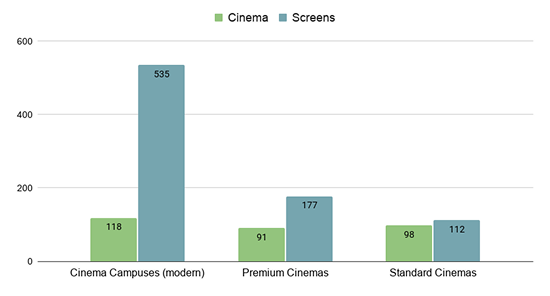
Number of Cinema and Screens (2025)
Technology and Production Services
The technology and services sector in Iran’s film industry plays an increasingly important role today for several key reasons: the advancement of filmmaking technologies, including editing, visual effects (VFX), and audio systems, which has improved production quality while reducing costs and production time; the expansion of digital distribution and streaming platforms; the facilitation of independent and short-form production; and the growing importance of cultural exports and international engagement.
Hardware equipment and technologies include professional cameras and lenses, lighting and sound equipment, and filming and recording studios — as well as software and software technologies, specialized services, and VR (virtual reality) and AR (augmented reality).
Therefore, this ecosystem is a value chain that consists of equipment provision, training, production, specialized services, distribution, and financial support, each of which plays a key role in producing high-quality and competitive films.
In the second half of 2025, the Iranian film industry is experiencing significant developments in the field of technology and production services, which are especially evident in the fields of virtual production, artificial intelligence, and digital realities. The use of artificial intelligence technology by filmmakers indicates the attention to new technologies in the film production process.
In 2025, the Iranian cinema industry is making notable progress in several areas of production, including virtual production studios and LED stages. Studios such as Studio Farda in Tehran provide filmmakers with opportunities to produce high quality films using advanced equipment, including Blackmagic URSA Mini cameras, professional lighting systems, and high quality microphones. By offering a wide range of services, these studios enable filmmakers to produce projects at reasonable costs within a professional environment.
Also, “dedicated sound stages”, “open areas and open-air studios” and “virtual production facilities” are used in some film projects in Iran to create digital scenes and special effects. These facilities, using advanced technology, allow the creation of high-quality digital environments and allow filmmakers to produce complex scenes at lower costs. The use of this equipment in historical films greatly aids the production process.
The Iranian film industry is witnessing the presence of leading and innovative companies in various fields of technology and production services, including; “Nikrad Cinema” Industry Designers, “D Iranian Cinema Design and Development”, “Zigorat Stage Construction” a pioneer in digital cinema servers, “Tajhiz Gostar” Tahmourt Company, “Pirouz Gostar” Cinema Technology Development”, “Resaneh Fekr Farda”, “Tanin Andazan Royaye Sedaa” and “Fam Nogher Film” Sound Recording Laboratory, “Aseman Sepehr's Hypothetical Line” and “Majd Cinematic Technology Development” Center - Majd DiLab.
Streaming Platforms and Digital Growth
Digital platforms have expanded alongside the rise of online streaming services and social networks, allowing Iranian films to reach international audiences more easily.
One of the most significant challenges facing Iran’s film industry is distribution. The country’s distribution capacity remains limited and lags behind its production output. In the second half of 2025 alone, 60 films were released, while an estimated 150 to 200 films were produced. As a result, a substantial number of completed films fail to secure theatrical release and are instead pushed directly to VOD platforms.
Many professionals working in the platform sector originally transitioned from the film industry. Online streaming platforms combine digital communication infrastructure with audiovisual content production. In this field, there are three key platforms: “Filimo”, “Filimnet” and “Namava”, and of course a large number of small platforms. More than 500 platforms have received operating licenses from SATRA (The Organization for the Regulation of Comprehensive Audio and Video Media in Cyberspace of Iran).
Naturally, these three platforms have more than 90% of the market share. Currently, there is no accurate and transparent figure for the activity of these platforms; but “Filimo” has more than 50% of the Iranian online market share.
In Iran, platforms are regarded as an important driver of employment, investment security, and growth in audiovisual and series production. They also serve as a major source of entertainment for families and the wider public. More than 2,000 people are directly employed in the sector, while approximately 10,000 others work indirectly in project based roles. The expansion of domestic streaming platforms is also believed to have reduced audiences for foreign satellite television channels, further strengthening trust in these platforms as production and distribution companies.
In today's circumstances, the cinema economy is tied to platforms, and the ambiguities and uncertainties in this area must be resolved to create greater prosperity and security in this field.
Iranian cinema officials have consistently emphasized the importance of platforms in the contemporary world and society’s need for them, as well as the need for convergence and the utilization of all the capabilities of the film industry. They believe that the activities of home theater networks help increase the country's employment capacity and cultural space.
Platforms play a tangible role in creating excitement and entertainment, as well as employment and business prosperity for Iranian cinema professionals. They are considered an important component of the image industry, and serious attention should be paid to this domestic sector and its national and indigenous productions.
International Co-Production
The Iranian film industry has held a special place in the global cinema scene for decades. Over the years, Iranian films have won the admiration of critics and cinema enthusiasts for their distinctive styles, deep narratives, and focus on social and human issues.
One of the most prominent features of Iranian cinema is the consistent presence of its works at prestigious international festivals. Films such as Taste of Cherry directed by Abbas Kiarostami, A Separation and The Salesman, directed by Asghar Farhadi; and The Circle and Taxi, directed by Jafar Panahi are prominent examples of this industry.
Films by Iranian directors have won major awards at prestigious festivals such as Cannes, Berlinale, Venice, the Oscars, and the Golden Globes, establishing Iran as a country with an artistic, independent, and original cinema.
In global rankings, although Iran faces limitations in terms of budget and facilities compared to countries with large and popular film industries, it holds a strong position in the field of art and storytelling. Many critics and film scholars regard Iran as one of the main centers of independent and artistic cinema.
In Iran, there is no direct public funding for international co-productions, but institutions supported by the Iranian Cinema Organization have opportunities to collaborate on co-production projects in the fields of feature films, documentaries, and animation.
Given that the Iranian Cinema Organization is an official governmental institution, it has signed memoranda of understanding on cinematic cooperation with neighboring Islamic and friendly countries in order to expand cultural and cinematic collaboration.
The booklet of the Iranian Cinema Association states under the heading “Joint Productions”: “Exporting the culture of the revolution, Islam, and Iran, and strengthening the bonds between friendly states and nations around shared heritage and interests, requires the expansion of cinematic relations, including the implementation of joint productions.”
Based on this, the priorities of the Cinema Vice-President for joint production with other countries have been announced as follows: “the ECO region and the Nowruz cultural area, the Islamic world, the Asian continent, Africa, Latin and South America, and other countries of the world.”
Mansour JAHANI
Independent Journalist
In these years, Mansour Jahani as a journalist specializing in independent cinema has cooperated with great Iranian filmmakers and supported them in the media. From the late and great Abbas Kiarostami to Asghar Farhadi, Jafar Panahi, Mohammad Rasoulof, Bahman Ghobadi, etc. Mansour Jahani, as an independent journalist and reporter, has covered international Film Festivals in Cannes, Berlin, Venice, San Sebastian, Thessaloniki, London, Karlovy Vary, Tallinn, Locarno, Busan, Tokyo, Toronto, IDFA, etc. In 2023, 2024 and 2025, he participated as a judge in the voting of the American magazine IndieWire at the Cannes Film Festival and selected the best films.