Title
THE A REPORT
2025 H2
 Kevin MA
Film Festival Consultant, Translator
Kevin MA
Film Festival Consultant, Translator
Updated on 12 May 2026
Overview
In 2024, actor Louis Koo, who is also a producer and the current president of Federation of Hong Kong Filmmakers, said publicly that 2025 would be a “harsh winter” for the Hong Kong film industry. Not only was his prediction proven correct, even he had no idea how difficult things would be for both the industry and the city at-large in the second half of 2025.
Continuing the trend from the first half of the year, scores of people still travel across the border to the neighboring city of Shenzhen in Mainland China during weekends and holidays for cheaper recreational activities, hurting Hong Kong’s entertainment and restaurant industries. As the government cut down on spending due to its budget deficit, benefits such as public healthcare and other programs were cut, while unemployment rose to a three-year high of 3.8%. Citizens continued to control their spending as well, remaining selective about what to watch in cinemas. However, they did show up for tentpole films such as F1: The Movie, Japanese animation smash Demon Slayer: Kimetsu no Yaiba - Infinity Castle, Disney’s Zootopia 2 and local period fantasy Back to the Past.
 Back to the Past © One Cool Film Production Limited
To make things worse, late November saw the city in collective grief when a catastrophic fire killed 168 people and destroyed seven out of eight buildings of a residential estate in the neighborhood of Tai Po. Filmgoing dropped drastically throughout the month of December, while events across the city, from school Christmas parties to the city’s New Year’s Eve fireworks, were canceled out of respect for the victims. 20th Century Fox’s Avatar sequel was also delayed from its mid-December slot to early January because of fire being featured prominently in the film. As a result, box office for the 2025 Christmas holiday was down by a shocking 36% from the previous year, according to figures by Hong Kong Motion Picture Industry Association (MPIA). Overall theatrical revenue in Hong Kong fell another 15.79%, continuing a downward trend that began all the way back in 2019.
Also continuing the trend from the first half of the year, films by Hong Kong directors continued to underperform in the mainland China market (which is experiencing its own problems with struggling box office revenue outside of popular slots), resulting in mainland China investors scaling back on financing co-productions by Hong Kong filmmakers.
Top 10 Films in Hong Kong Box Office (2025)
You can scroll left and right to view the content.
| No. | Title | Director | Country | Genre | Gross (HKD) |
Gross (USD) |
Production Company |
Distribution Company |
|---|---|---|---|---|---|---|---|---|
| 1 | Demon Slayer: Kimetsu no Yaiba - Infinity Castle | Haruo Sotozaki | Japan | Animation | 97.6M | 12.48M | Ufotable | Sony Pictures |
| 2 | F1: The Movie | Joseph Kosinski | USA | Drama | 69M | 8.82M | Apple Studios | Universal Pictures |
| 3 | Zootopia 2 | Jared Bush, Byron Howard | USA | Animation | 64.7M | 8.27M | Walt Disney Animation Studios | Walt Disney Studios Motion Pictures Company |
| 4 | Ne Zha 2 | Yu Yang | China | Animation | 64.1M | 8.20M | Chengdu Coco Cartoon, Beijing Enlight Media, Beijing Enlight Pictures | Emperor, Intercontinental, Sil-Metropole |
| 5 | Mission: Impossible - The Final Reckoning | Christopher McQuarrie | USA | Action | 53.8M | 6.88M | Paramount Pictures | Paramount Pictures |
| 6 | Lilo & Stitch | Dean Fleischer Camp | USA | Sci-Fi, Comedy | 30.1M | 3.85M | Walt Disney Company | Walt Disney Studios Motion Pictures Company |
| 7 | Jurassic World: Rebirth | Gareth Edwards | USA | Adventure | 30M | 3.84M | Universal Pictures | Universal Pictures |
| 8 | Thunderbolts* | Jake Schreier | USA | Superhero | 23.9M | 3.06M | Marvel Studios | Walt Disney Studios Motion Pictures Company |
| 9 | A Minecraft Movie | Jared Hess | USA | Fantasy, Comedy | 22M | 2.81M | Warner Brothers | Universal Pictures |
| 10 | Chainsaw Man - The Movie: Reze Arc | Tatsuya Yoshihara | Japan | Animation | 18.5M | 2.37M | MAPPA | Sony Pictures |
Top 10 Domestic Films in Hong Kong Box Office (2025)
You can scroll left and right to view the content.
| No. | Title | Director | Country | Genre | Gross (HKD) |
Gross (USD) |
Production Company |
Distribution Company |
|---|---|---|---|---|---|---|---|---|
| 1 | Another World | Tommy Ng | Hong Kong | Animation | 15.4M | 1.97M | Point Five Production | Edko Films |
| 2 | The Way We Talk | Adam Wong | Hong Kong | Drama | 13.6M | 1.74M | Gift of Nothing Limited, One Cool | One Cool, Edko Films |
| 3 | Peg O’ My Heart | Nick Cheung | Hong Kong | Horror | 13.3M | 1.70M | Star Talent Production, United Filmmakers Organisation | Golden Scene |
| 4 | Hit N Fun | Albert Mak | Hong Kong, Mainland China | Comedy | 13.1M | 1.68M | Ovation Entertainment, One Cool, Entertaining Power | Edko Films |
| 5 | Sons of the Neon Night | Juno Mak | Hong Kong, Mainland China | Crime, Drama | 12.3M | 1.57M | One Cool, Sil-Metropole, J.Q. Pictures | 13cc |
| 6 | My Best Bet | Andy Lo | Hong Kong | Comedy | 11.9M | 1.52M | Local Productions, Brilliant Idea Group, Ruijing Jiashi Film Production | Mei Ah, Intercontinental Films |
| 7 | Back to the Past | Ng Yuen-fai, Jack Lai | Hong Kong, Mainland China | Fantasy | 11.7M | 1.50M | One Cool, Huace, China Star | One Cool, Intercontinental Films |
| 8 | Golden Boy | Joe Chan | Hong Kong | Drama | 10.1M | 1.29M | Sky Power Entertainment Culture, One Cool, Emperor | Emperor Motion Pictures |
| 9 | Vital Signs | Cheuk Wan-chi | Hong Kong | Drama | 9.45M | 1.21M | One Cool Film | One Cool Film, Edko Films |
| 10 | Under Current | Alan Mak | Hong Kong, Mainland China | Crime | 6.8M | 0.87M | Emperor Motion Pictures | Emperor Motion Pictures |
Production Landscape
While the 2025 edition of the annual film industry report by the Cultural and Creative Industries Development Agency (CCIDA) (formerly Create Hong Kong) has yet to be published at the time of writing, it is quite telling that at least seven of the local titles that were released in the second half of 2025 were not shot within the past two years. While the 2024 edition reported that 18 films went into production in 2024, that number is expected to be lower in 2025 when the report is eventually released later this year.
Overall, only 331 local productions received wide commercial theatrical release in all of 2025.
- 1 This differs from the Hong Kong Film Awards list of releases, which disqualified four films without explanation, and also includes mainland productions made by Hong Kong talents and films that were screened late in the year for award eligibility
Figure of Domestic Feature Films Released (2019-2025)
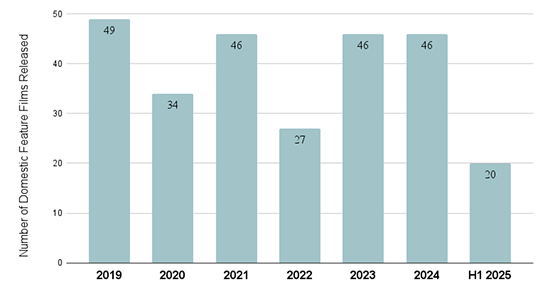
The only silver lining is that because of Hong Kong’s nature as a hyper-commercial film industry, local productions offered a fairly diverse range of stories, from comedies like Hit N Fun to dramas like Vital Signs and action films like Atonement.
Because of the dismal state of the industry at large, the production landscape has not changed very much in the second half of 2025. The industry’s major players – namely One Cool Films, Edko Films, Mei Ah, Universe, MM2 Hong Kong and Entertaining Power – continued to produce or release films in the second half of the year, but most commercial productions now seek government support before receiving a greenlight from investors in order to mitigate financial risk, while new filmmakers rely on government-backed schemes to fund their first feature films. However, financial secretary Paul Chan did not outline any new financing scheme for the film industry aside from the existing Film Development Fund in his budget for 2026, and FDF has been slow in pushing new schemes forward.
Being a small metropolis, finding physical production spaces has always been one of the biggest challenges facing Hong Kong film productions. Not only is there a lack of space dedicated to film and television production (aside from Shaw Studios in the eastern corner of the city), the public also generally see film productions that occupy public spaces as a nuisance in a city that barely had enough space to begin with. Clashes between understaffed film productions hoping to maintain secrecy by blocking public access and passersby hoping to catch a glimpse of celebrities with their phone cameras are extremely common.
Financing Models
Within private financing, there are currently two primary methods for films in Hong Kong – co-production with mainland China investors or purely local funding. As mentioned before, the former has been scaled back due to disappointing commercial performance in the mainland. However, purely local productions—almost entirely mid-to-low-budget projects—have followed the Taiwan model of relying on government subsidies in order to mitigate financial risk.
Since 2007, the government has injected HKD 2.9 billion (USD 370.84 million) into the Film Development Fund to help fund productions as well as other film-related projects (such as the Hong Kong Film Awards and the Asian Film Awards). The Hong Kong Film Development Council’s Film Production Financing Scheme offers up to 40% of a film’s budget or a maximum of HKD 9 million (USD 1.15 million) for a film budgeted at less than HKD 60 million (USD 7.67 million). Meanwhile, the latest version of the Film Production Financing Scheme grants 40% of a film’s budget or a maximum of HKD 10 million (USD 1.28 million) for a film budgeted between HKD 8 million (USD 1.02 million) to HKD 25 million (USD 3.20 million).
Since the FDF’s inception, at least 75 productions have received funding support either through the various stages of the Film Production Financing Scheme or the Film Production Grant Scheme. However, the FDF has not publicly announced funding for any new project or schemes since April 2025, though its website has been updating regularly about delegation visits to overseas film festivals, and funding for local film events like the Asian Film Awards and the Hong Kong International Film Festival.
In the second half of 2025, Hong Kong saw eight Hong Kong-mainland China co-productions released in cinemas, while eight other local releases either listed the Hong Kong government as a co-investor or received funding under CCIDA schemes. One other film, The Remnant, was funded by the Federation of Hong Kong Filmmakers.
For example, Measure in Love is a project under the FDF’s Directors’ Succession Scheme, which offers a subsidy for projects that pair seasoned filmmakers as producers for films by new directors, though it received funding from Taiwan companies.
Continuing a new trend seen in the first half, the second half of 2025 saw more filmmakers seeking alternative funding for their films. Director Herman Yau, who has made countless big-budget blockbuster films in both Hong Kong and the mainland, reportedly fully self-funded We’re Nothing at All, a drama about an investigation into a deadly bus bombing. The film was initially planned for a Christmas release, but it was delayed due to the Tai Po blaze in November. Director Philip Yung also told the press that he took out loans to pay for his Lunar New Year comedy The Snowball on a Sunny Day, although he did not specify how much he invested.
In addition, the second half of 2025 saw more Hong Kong co-productions with non-mainland Chinese companies. For example, MM2 Hong Kong’s Road to Vendetta is a co-production with Japanese company Rights Cube, and Tracy Choi’s Girlfriends (which had its premiere at the 2025 Busan International Film Festival) received funding from Taiwan and Thailand.
Distribution Climate
Not unlike most territories in the world, foreign releases far outnumber local releases in Hong Kong. The MPIA did not provide statistics for the total number of films released in 2025 at the time of writing, but their 2023 report indicated that the ratio of local to foreign releases is roughly 15–20% to 80–85% on average.
Market Share by Countries (2024)
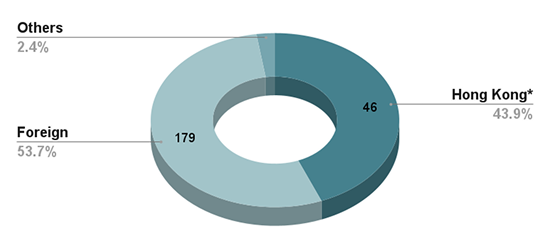
* Includes Hong Kong-China Mainland co-productions
Note: The market share is based on revenue, not the number of titles
Note: The market share is based on revenue, not the number of titles
In Hong Kong, most major US studios – Universal, Disney, Paramount and Sony Pictures – have local distribution arms for their own films, but WarnerMedia shut down their Hong Kong theatrical unit in 2021 and passed the distribution of their films to Universal’s Hong Kong arm. The company recently announced a similar move in Japan, passing theatrical distribution work to local firm Toho Towa in a similar sub-licensing agreement.
For independent and non-Hollywood foreign releases, Edko Films continued their domination of the market, thanks to market penetration provided by their Broadway Cinema chain as well as their two film channels on OTT operator Now TV. Although they were less prolific in the second half of 2025, Intercontinental Films, who also owns the MCL cinema chain and is a subsidiary of entertainment conglomerate Esun Holdings, is still a major distributor of foreign films in Hong Kong. Golden Scene, who also runs a four-screen boutique cinema, also remains very active as a distributor of arthouse titles from both Asia and Europe.
Almost all of Hong Kong’s cinema chains are operated by film distributors. In addition to Intercontinental and Edko with MCL Cinemas and Broadway Cinemas, respectively, Emperor Entertainment Group runs the Emperor Cinema chain, Mandarin Motion Pictures run the Cinema City chain, and Sil-Metropole Organization runs the rapidly expanding Cine-Art House chain.
As I wrote in the report for the first half of 2025, One Cool Films, despite being one of Hong Kong’s top production outfits, generally passes their biggest releases to distributors with theatrical operation. Both of their major second-half releases—Good Game and Back to the Past—were handled by Intercontinental, taking advantage of their MCL cinema chain.
Top 3 Cinema Chains
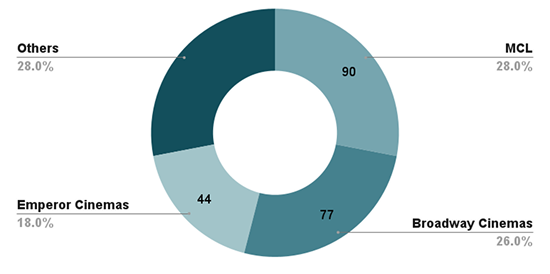
segment size represents market share, while the figures indicate the number of screens.
Note: The data is of H1 2025
Note: The data is of H1 2025
Other smaller distributors in Hong Kong include Neofilms and Medialink, which mostly distribute Japanese animation; 13cc, formerly A Really Happy Film and Distribution Workshop, who distributed Juno Mak’s long-awaited Sons of the Neon Night; First Distributors, which distributes two to three French titles per year; and Megaton Entertainment, which handles mostly Korean titles. However, 2025’s two largest Japanese anime titles – Demon Slayer: Kimetsu no Yaiba - Infinity Castle and Chainsaw Man - The Movie: Reze Arc were released locally by worldwide distributor Sony Pictures rather than a local distributor.
Theatrical Reach
The biggest news in Hong Kong’s exhibition sector was the wave of closures that hit the industry in the first half of 2025. According to local media reports and data provided by the government, the total number of cinemas in Hong Kong has only fallen from 294 screens in 62 cinemas in 2020 to 264 screens in 52 cinemas at the moment.
In the first seven months of 2025, Hong Kong saw ten cinemas shutter (many of them from the Golden Harvest cinema chain, which decided to exit the exhibition section). However, Sil-Metropole’s Cine-Art House cinema chain and Bestar—both with funding that can be traced back to mainland China—took over the operation of five shuttered cinemas as part of their rapid expansions (the former took over one more in early 2026). Sunbeam, who lost their iconic theater complex in North Point, took over Golden Harvest Whampoa.
Responding to the wave of cinema closures in the Legislative Council last July, Rosanna Law, Hong Kong’s Secretary for Culture, Sports and Tourism, admitted that the exhibition sector has encountered difficult challenges due to changes in audience habits and high operation costs, but she emphasized that there are cinemas in all 18 of Hong Kong’s districts, and the government has helped the sector promote cinema-going by financially supporting the Cinema Day and 1st October Movie Fiesta events, which saw cinemas offering heavily discounted tickets to the general public. However, the two events have seen decreasing attendance in more recent editions (though they did not release figures for the October 2025 edition of the latter event).
The second half of 2025 did have multiple blockbusters that attracted audiences to cinemas. Demon Slayer: Kimetsu no Yaiba - Infinity Castle set a new record as the highest-grossing animated film of all time in Hong Kong, while F1: The Movie was a word-of-mouth hit that did especially well in premium format cinemas such as IMAX and 4DX. Zootopia 2 also brought family audiences out of Disney+ and back to the cinemas, even during the period of collective mourning following the Tai Po blaze.
Despite the generally gloomy state of things, there were also bright spots for local films. Local animated fantasy Another World – which took seven years to produce – was able to build word-of-mouth on the back of its successful premiere at the Annecy International Animation Film Festival, becoming the highest-grossing local animated film of all-time. Boxing drama Golden Boy, which was shelved since it finished production in 2019, ultimately grossed a respectable HKD 10 million (USD 1.29 million) thanks to praise for star Louis Cheung, who invested his own money to complete the long-delayed film’s post-production.
 Another World © Point Five Creations Limited
One Cool’s Back to the Past, a long-awaited continuation to the iconic 2001 TV series A Step Into the Past that featured one of star Louis Koo’s most popular roles, was the event Hong Kong film that the industry desperately needed, setting a new record for the biggest opening day ever for a local film with HKD 11.7 million (USD 1.50 million) on its December 31st opening day. If one needs an indication to see how dismal things were for Hong Kong films, that single-day gross was enough to land the film on 7th place of 2025’s highest-grossing local films.
However, as mentioned in the overview, government-supported concessionary tickets and event films have not stopped the decrease of box office revenue in Hong Kong. With more cinema closures being rumored in the first half of 2026 and very few local event films outside the lucrative Lunar New Year holiday, things do not seem to be looking up for the theatrical sector in 2026.
Technology and Production Services
Despite its size and population density, Hong Kong has a well-developed production ecosystem thanks to its extensive experience with film production. One Cool Group has been the industry leader in the past decade, with production equipment rental as well as large post-production offices that offer comprehensive production and post-production services in both Hong Kong and Thailand.
There are also boutique firms that offer post-production services, with Pica Pica leading the way for smaller independent productions. There are also industry-standard facilities for sound mixing and other post-production services, but some Hong Kong filmmakers prefer to do post-production in places such as Thailand, which offers larger facilities for a more cost-effective price.
Meanwhile, Shaw Studios, located in the satellite town of Tseung Kwan O on the east side of the city, has been promoting their production services both locally and abroad. The 92,000-square-meter facility offers production offices, backlot studios and even a large cinema that can double as a Dolby Atmos-enabled sound mixing stage. In terms of special effects, while early industry pioneers Centro and Menfond are long gone, the sector is now led by Free-D Workshop, vfxNova, FATface and other small boutique studios. However, larger productions still turn to foreign companies in South Korea, Taiwan or Thailand for more complex computer graphics.
However, as mentioned in previous sections, Hong Kong’s dense population means that there isn’t enough physical space to create additional production spaces, which is why many large-scale productions tend to film in mainland China, where there is space to construct large-scale sets at lower cost. The possibility of constructing new large-scale production spaces in Hong Kong is unlikely in the foreseeable future as real estate remains the most valuable commodity in a small city like Hong Kong.
Like the rest of the world, especially Asia, the Hong Kong film industry is also actively looking to take advantage of progress in artificial intelligence. In addition to One Cool Group’s 45-second proof-of-concept video for their new In-Content Domain Adaptive Video Generation system and Google’s Veo 2, director Daniel Chan (Triad, Sifu Vs Vampires) recently released a proof-of-concept video for an AI feature film, saying that he turned to the technology because he was unable to secure funding for the project via traditional production means. Director Mabel Cheung also employed AI technology to create 1880s Hong Kong for her latest project The Butterfly Bone. At least one other local filmmaker has recently shared on social media that he hopes to produce a film using AI technology in the footsteps of mainland China auteur Jia Zhangke. There has also been increased use of AI technology on TV and in advertisements. While the Labour Union of Dubbing of Hong Kong – representing Hong Kong’s voice artists – recently released a statement denouncing local companies using their voices to train AI technology without their permission, a lack of legislation restricting the use of AI technology means the curiosity for AI technology will likely grow for the foreseeable future.
Streaming Platforms and Digital Growth
According to the new Global Entertainment and Media Outlook 2025–2029 published last August by PricewaterhouseCoopers, Hong Kong’s OTT market has seen a rapid rise in recent years. As of 2024, the industry has grown to USD 490 million, and the company forecasts a compound annual growth rate (CAGR) of 4.6% to reach USD 613 million by 2029. However, Hong Kong’s OTT revenue CAGR for 2020 to 2029 is below neighboring markets Malaysia and Indonesia at 4.59% versus 10.34% and 11.59%, respectively, meaning that Hong Kong’s OTT market has less room to grow than its neighboring regions.
Also worth noting is that Hong Kong’s streaming market, as competitive as it appears, is dominated by foreign players Netflix and Disney+. While local streaming players are led by PCCW’s Viu (an extension of their OTT subscription service Now TV) and TVB’s MyTVSuper (the streaming arm of free-to-air broadcaster TVB), the two American streaming services continue to dominate both market share and public awareness. PCCW, through their OTT Now TV service, has attempted to take back some of the market share by exclusively releasing award-nominated foreign arthouse titles through their newly launched Now True channel, which also has a streaming component. Oscar-nominated drama If I Had Legs I’d Kick You, Irish film Kneecap, British film The Salt Path and Korean films Firefighters and Big Deal are some of the titles that skipped theatrical and went directly to Now True.
Nevertheless, streaming and OTT are not considered a major source of revenue for Hong Kong film companies because of the city’s small market size. Since Cantonese is also not considered a widely spoken language for the global streamers (compared to Mandarin Chinese, at least), they also offer far less for Hong Kong content in comparison to content from Korea, Japan, Taiwan or mainland China. As a result, there are far fewer titles from Hong Kong released globally on streaming, although Edko and Emperor do sell their titles to be streamed locally on Disney+.
Nevertheless, the Film Development Fund launched a Content Development Scheme for Streaming Platforms in 2024, which awards up to HKD 5.7 million (USD 728,900) to a maximum of four winning teams for the development of mini-series designed to be broadcast on streaming platforms. The ten shortlisted projects in phase one—chosen from 50 eligible projects—include those by seasoned veterans such as Lawrence Lau, Peter Ho-sun Chan, Soi Cheang and Derek Yee, showing that filmmakers are still hoping streaming could offer an alternative for the Hong Kong film industry. However, no further announcement for the scheme has been made since the shortlisted projects were revealed in March 2024.
One ambitious project that was meant for streaming but ended up on a different path is Peter Chan Ho-sun’s She’s Got No Name. The expensive project was first announced in 2022 as The Murderer, one of the first five streaming series under Chan’s newly-launched Changin’ Pictures banner. However, Chan’s company announced the project again as a theatrical feature in 2024. After its premiere in Cannes that same year, Chan expanded and split up the film into two parts, with the first part released in mainland China and Hong Kong last July. However, its underwhelming box office performance now puts the theatrical prospect of part two under uncertainty. The winding path of the project proves that even a growing giant like streaming doesn’t guarantee as much success as creators hope it would.
International Co-Production
Since the early 2000s, the Hong Kong film industry has mainly relied on mainland China as co-production partner due to market size and favorable terms set out by the Closer Economic Partnership Arrangement, which allows for Hong Kong co-productions to be released as local films. This has resulted in many Hong Kong filmmakers seeking directorial opportunities in the mainland in the past two decades.
However, as mainland audiences now prefer films by mainland China filmmakers over those by Hong Kong filmmakers, the demand for Hong Kong-mainland co-productions have been gradually dwindling in the past several years. After a Hong Kong producer mentioned on social media that mainland Chinese investors are scaling down on Hong Kong productions, local media also reported that big-budget co-produced action films like New Police Story 2 has been shelved until further notice.
Meanwhile, Hong Kong filmmakers have been looking elsewhere for co-production opportunities. One Cool released their second Malaysian production, Behind the Shadows, last July, and they have produced at least two more films in Malaysia in 2025. As mentioned before, MM2 Hong Kong’s action film Road to Vendetta is a co-production with Japanese company Rights Cube, both Girlfriends and Measure in Love received funding from Taiwan, and animated hit Another World received funding from as far as the Middle East.
Also, the Hong Kong Film Development Council has launched both the Film Financing Scheme for Mainland Market and the Hong Kong-Europe-Asian Film Collaboration Funding Scheme (HKEA). The former offers HKD 10 million (USD 1.28 million) to films by Hong Kong filmmakers that are successfully released theatrically in both Hong Kong and Mainland China, encouraging companies on both sides to invest more in Hong Kong filmmakers. Meanwhile, the latter offers a maximum of HKD 9 million (USD 1.15 million) to two Hong Kong co-productions with Europe and Asia, respectively. Two projects—Mabel Cheung’s The Butterfly Bone and Ko Chi Sum’s Kung Fu Juniors—have already received funding for the Mainland China market scheme, while no updates have been announced for the HKEA.
- Note: All figures are converted using an exchange rate of USD 1 = HKD 7.82
- [1] https://www.pwchk.com/en/industries/telecommunications-media-and-technology/publications/entertainment-and-media-outlook-2025-2029.html
Kevin MA
Film Festival Consultant, Translator
Formerly a film industry journalist and English editor, Kevin has been the Hong Kong Consultant of the Udine Far East Film Festival since 2023. He has been doing translation work for film companies and writing work for film organizations in the region for over 15 years.
Source: Hong Kong Box Office Limited