Title
THE A REPORT
2025 H2
 SUN Yanbin
Beijing Film Academy Associate Professor
SUN Yanbin
Beijing Film Academy Associate Professor
Updated on 12 May 2026
Overview
China’s Film Industry in H2 2025: Trends and Challenges
In H2 2025, key indicators of China's film market showed a general improvement. The industry pivoted towards a "quality-over-quantity" approach with animation and war films delivering exceptionally strong performances. The market's business model evolved from a sole reliance on box office revenue to prioritizing the development of the copyright economy. Actively guided and encouraged by the state, technology is deeply integrated into the film value chain. The capital market showed signs of recovery, and the innovative "Film+" concept became a defining keyword for understanding the industry in H2 2025.
Full-year statistics for 2025 indicate that the total output value of China’s film industry chain reached CNY 817.25 billion (USD 119.4 billion), with a box office multiplier of 1:15.77, among the highest globally. Film-driven consumption across catering, transportation, retail, tourism, derivatives, and festival exhibitions amounted to CNY 339.09 billion (USD 49.5 billion).
However, the industry continues to face challenges, including sluggish box office growth, an insufficient supply of high-quality content, over-reliance on major holiday release schedules, an aging audience demographic, and a decline in regular moviegoers.
In H2 2025, the highest-grossing domestic films were all released during the summer (July-August) and National Day holiday (October) periods. Six Chinese films—Dead to Rights, 731, Nobody, The Shadow's Edge, The Lychee Road, and The Volunteers: Peace at Last—secured spots in the H2 top ten. The market in November and December was primarily sustained by imported films. Zootopia 2 topped the H2 box office chart with USD 580 million in China, surpassing its USD 420 million gross in North America.
Overall, the second half of 2025 marked China's film industry's entry into a new phase of high-quality development. The "Film+" model has significantly expanded the industry's boundaries, boosting confidence across the sector and among investors. Moving beyond a singular focus on box office figures, a consensus has emerged among government bodies and industry practitioners to explore innovative practices within a broader film ecosystem, empowered by technology.


731 © Changchun Film Studio Group Co. Ltd., et al.
Nobody © Shanghai Film Infinity
Top 10 Films in Chinese Box Office (H2 2025)
You can scroll left and right to view the content.
| No | Title | Director | Country | Genre | Gross (CNY) |
Gross (USD) |
Production Company |
Distribution Company |
|---|---|---|---|---|---|---|---|---|
| 1 | Zootopia 2 | Jared Bush, Byron Howard | USA | Comedy, Animation | 4.02B | 0.59B | Walt Disney Animation Studios | China Film Co., Ltd., Huaxia Film Distribution Co., Ltd. |
| 2 | Dead to Rights | Shen Ao | China | History, War | 3.02B | 0.44B | China Film (Wuxi) Film Production Co., Ltd., Super Lion, Yuye (Shanghai) Cultural Media Co., Ltd., China Film Co., Ltd. | China Film Co., Ltd., Super Lion |
| 3 | 731 | Zhao Linshan | China | History, War | 1.94B | 0.28B | Changchun Film Studio Group Co., Ltd., Poly Film Investment Co., Ltd., HY Media | HY Media |
| 4 | Nobody | Yu Shui | China | Animation, Comedy | 1.72B | 0.25B | Shanghai Animation Film Studio, Film Infinity (Shanghai) Culture and Technology Development Co., LTD., Shanghai Xiao Mubiao Film and Television Culture Media Co., Ltd. | MaoYan Movie |
| 5 | The Shadow's Edge | Larry Yang | China | Action, Crime | 1.27B | 0.19B | iQIYI Pictures, Tao Piao Piao, Beijing Hairun Pictures Co., Ltd. | Tao Piao Piao, Damai Entertainment Culture Co., Ltd. |
| 6 | Avatar: Fire and Ash | James Cameron | USA | Sci-Fi, Action | 0.77B | 0.11B | 20th Century Fox Film Corporation, 20th Century Studios | China Film Co., Ltd., Huaxia Film Distribution Co., Ltd., 20th Century Fox Film Corporation |
| 7 | The Lychee Road | Da Peng | China | Historical Drama, Comedy | 0.69B | 0.10B | Aimmedia Pictures, Tianjin Maoyan Weiying Culture Media, Beijing Cheer Entertainment | Tianjin Maoyan Weiying Culture Media |
| 8 | Demon Slayer: Kimetsu no Yaiba - Infinity Castle | Sotozaki Haruo | Japan | Animation, Action | 0.68B | 0.10B | Aniplex Co., Ltd., Shueisha, Ufotable | China Film Co., Ltd., Huaxia Film Distribution Co., Ltd. |
| 9 | The Volunteers: Peace at Last | Chen Kaige | China | War | 0.64B | 0.09B | China Film Co., Ltd., China Film Creative Co., Ltd., August First Film Studio | China Film Co., Ltd., Tianjin Maoyan Weiying Culture Media |
| 10 | Jurassic World: Rebirth | Gareth Edwards | USA | Action, Adventure | 0.57B | 0.08B | Universal Pictures, Amblin Entertainment | China Film Co., Ltd. Beijing Domestic Film Distribution Branch, Huaxia Film Distribution Co., Ltd. |
Top 10 Domestic Films in Chinese Box Office (H2 2025)
You can scroll left and right to view the content.
| No | Title | Director | Country | Genre | Gross (CNY) |
Gross (USD) |
Production Company |
Distribution Company |
|---|---|---|---|---|---|---|---|---|
| 1 | Dead to Rights | Shen Ao | China | History, War | 3.02B | 0.44B | China Film (Wuxi) Film Production Co., Ltd., Super Lion, Yuye (Shanghai) Cultural Media Co., Ltd., China Film Co., Ltd. | China Film Co., Ltd., Super Lion |
| 2 | 731 | Zhao Linshan | China | History, War | 1.94B | 0.28B | Changchun Film Studio Group Co. Ltd., Poly Film Investment Co., Ltd., HY Media | HY Media |
| 3 | Nobody | Yu Shui | China | Animation, Comedy | 1.72B | 0.25B | Shanghai Animation Film Studio, Film Infinity (Shanghai) Culture and Technology Development Co., LTD., Shanghai Xiao Mubiao Film and Television Culture Media Co., Ltd. | MaoYan Movie |
| 4 | The Shadow's Edge | Larry Yang | China | Action, Crime | 1.27B | 0.18B | iQIYI Pictures, Tao Piao Piao, Beijing Hairun Pictures Co., Ltd. | Tao Piao Piao, Damai Entertainment Culture Co., Ltd. |
| 5 | The Lychee Road | Da Peng | China | Historical Drama, Comedy | 0.69B | 0.10B | Aimmedia Pictures, Tianjin Maoyan Weiying Culture Media, Beijing Cheer Entertainment | Tianjin Maoyan Weiying Culture Media |
| 6 | The Volunteers: Peace at Last | Chen Kaige | China | War | 0.64B | 0.09B | China Film Co., Ltd., China Film Creative Co., Ltd., August First Film Studio | China Film Co., Ltd., Tianjin Maoyan Weiying Culture Media |
| 7 | The Legend of Hei 2 | Gu Jie, Mtjj | China | Fantasy, Adventure | 0.53B | 0.08B | Beijing Qianwanjian Culture & Media, Beijing HMCH Animation Technology Co., Ltd., COL Group Co., Ltd., Maoyan Movie | Shanghai Maoyan Movie, Beijing Qianwanjian Culture & Media |
| 8 | Row to Win | Ma Lin | China | Comedy, Family | 0.46B | 0.07B | Shanghai Tingdong Film Co., Ltd., Shanghai Maoyan Movie, China Film Co., Ltd. | Shanghai Maoyan Movie |
| 9 | The Stage | Chen Peisi | China | Comedy | 0.41B | 0.06B | Beijing Huan Shi Xi Culture Media Co., Ltd., Huanxi Media Group Limited, Tao Piao Piao | Shanghai Maoyan Movie |
| 10 | Dongji Rescue | Fei Zhenxiang, Guan Hu | China | History, War | 0.40B | 0.06B | Beijing the Seventh Yinxiang Culture Co., Ltd., Tao Piao Piao, Pearl River Film Group Co. | Shanghai Tao Piao Piao, Beijing the Seventh Yinxiang Culture Co., Ltd., Damai Entertainment Culture Co., Ltd. |
Production Landscape
Output Decline, Strong Performances from Animation & War Films, Increased Government Support
Market Share of Films with Box Office over CNY 5 million
by Countries and Regions (H2 2025)
by Countries and Regions (H2 2025)
*Sourse: Maoyan Professional Edition
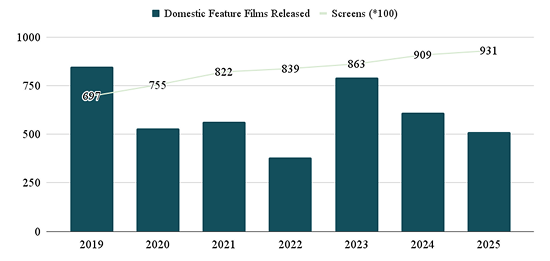
Output Volume: A total of 284 films were released in China during the second half of 2025, comprising 217 domestic films and 67 imported films. Twenty-eight films surpassed the CNY 100 million mark at the box office, including 17 Chinese films, 9 U.S. films, and 2 Japanese films. For the full year of 2025, 764 films received distribution permits, including 511 features. This represents year-on-year decreases of 12.49% and 16.5%, respectively, with output falling to levels seen a decade ago.
Genres: Film genre diversity remained robust. The top ten grossing films in H2 2025 spanned animation, history, war, action, crime, sci-fi, comedy, and adventure. Among these, animation and war films stood out for their exceptional market performance.
Animations accumulated a total box office of CNY 7.776 billion (USD 1.14 billion), accounting for 35.83% of the total H2 box office. Zootopia 2, Nobody, and Demon Slayer: Kimetsu no Yaiba - Infinity Castle were the top three earners in this genre. Marking the 80th anniversary of the victory in the Chinese People's War of Resistance Against Japanese Aggression and the World Anti-Fascist War, war and historical films achieved remarkable commercial success, grossing a combined CNY 6.481 billion (USD 947 million). Dead to Rights, 731, and The Volunteers: Peace at Last led this category, with films like Dongji Rescue, Gezhi Town, and Escape from The Outland also crossing the CNY 100 million threshold.
Animations accumulated a total box office of CNY 7.776 billion (USD 1.14 billion), accounting for 35.83% of the total H2 box office. Zootopia 2, Nobody, and Demon Slayer: Kimetsu no Yaiba - Infinity Castle were the top three earners in this genre. Marking the 80th anniversary of the victory in the Chinese People's War of Resistance Against Japanese Aggression and the World Anti-Fascist War, war and historical films achieved remarkable commercial success, grossing a combined CNY 6.481 billion (USD 947 million). Dead to Rights, 731, and The Volunteers: Peace at Last led this category, with films like Dongji Rescue, Gezhi Town, and Escape from The Outland also crossing the CNY 100 million threshold.
Furthermore, the crime-action film The Shadow's Edge, sci-fi adventures Avatar: Fire and Ash and Jurassic World: Rebirth, and the historical comedy The Lychee Road also ranked among the top ten grossing films of H2.
In the non-commercial sphere, art-house films such as Resurrection, The Sun Rises on Us All, After Typhoon, and Girl, along with documentaries like ShenZhou 13 and Mountains and Rivers Bearing Witness, achieved notable box office results, critical acclaim, and international awards.
Infrastructure: Film production infrastructure continued to be upgraded in key hubs including Beijing, Shanghai, Qingdao (Shandong), Wuxi (Jiangsu), and Hengdian (Zhejiang). In the realm of virtual production, new facilities such as the Chongqing Yongchuan Sci-Tech Film Studio, the Shanghai Technology Film District's AI Creation Ecosystem Center, the Deqing Bocai AI Virtual Film Base in Zhejiang, and the Zhouzhuang Digital Production Studio in Jiangsu were launched, creating a network of "future studios."


and the Deqing Bocai AI Virtual Film Base in Zhejiang.
Incentives & Support: In response to the Chinese government's call to expand domestic demand and boost consumption, the China Film Administration (CFA) and local governments, in partnership with industry enterprises, implemented movie-viewing subsidies to incentivize ticket purchases.
Opportunities and Challenges: New opportunities arose from the government's emphasis on film's role in driving cultural consumption. In H2, the CFA launched initiatives like "Travel China Through Films," "Learn Science Through Films," "Savor Food Through Films," "Tour Alongside Films," and "Visit Markets Alongside Films." Concurrently, both government and market players placed high importance on applying "new quality productive forces" to the film industry. These two trends present significant opportunities for growth. Conversely, the shortage of high-quality film supply remains a persistent challenge constraining the industry's development.
Financing Models
Capital Market Recovery and the "Film+" Investment Stimulus
Funding Source: Major studios remain the primary funding source for film projects. Financing for commercial films is typically structured through resource pooling among enterprises with strong capabilities in content production, distribution, theatrical exhibition, and talent management.
Key players include state-owned enterprises like China Film Group Corporation (CFGC), Shanghai Film Group, and Changchun Film Studio Group Co. Ltd; private companies such as Wanda Film Holding Co., Ltd., Ruyi Films, Enlight Media, and Hengdian Entertainment Co., Ltd.; and independent film company holding core creative talent, such as Beijing Yitong Legend Film Culture Co., Ltd, Beijing Happy Film Industry Co., Ltd, Yuye (Shanghai) Cultural Media Co., Ltd, and The City Pictures. Notably, platforms with online distribution and marketing reach, including Maoyan Movie, Tao Piao Piao, and Damai Entertainment Holdings Limited, have also joined the production of numerous high-profile projects.
For low-to-medium budget art films, funding channels include self-financing, government grants, project market investments, and in-house studio support, with government subsidies and awards accounting for a significant share. For instance, art film The Lost Daughter received major financial support and awards from both the central government and the Chongqing municipal government.
Cash Rebates & Subsidies: In H2 2025, local governments further intensified their subsidy programs for film production. Shandong and Liaoning provinces introduced policies offering up to CNY 10 million per project for films on major themes or of exceptional quality. Xiamen issued 11 measures providing annual incentives of up to CNY 5 million for film enterprises and up to CNY 5 million for key film productions. Chongqing invested over CNY 100 million to attract film companies, projects, and talent for local shooting and post-production.
New Cooperation & Trends: The booming derivative economy fueled by animated hits like Ne Zha 2, Nobody, and Zootopia 2 has demonstrated the vast potential of the "Film+" economy, leading to new trends in film financing. Technology companies, cultural tourism enterprises, designer toy brands, and sports firms have begun investing in film projects. Notable examples include the designer toy company Pop Mart, which launched its own film studio and licensed the film adaptation rights of its LABUBU intellectual property (IP) to Sony Pictures. Similarly, 52TOYS has deepened its cooperation with film studios. Technology companies like ByteDance and ZTE have become involved in AI applications and virtual reality (VR) film production.
Distribution Climate
Domestic Films Account for 66% as Market Welcomes More Imported Films
Distribution Structures: China's film distribution system comprises two distinct segments: domestic films and imported films. For domestic films in H2 2025, eight companies distributed the top ten highest-grossing films: CFGC, Super Lion Culture, HY Media, Maoyan Movie, Tao Piao Piao, Damai Entertainment, Qianwanjian Culture Communication, and the Seventh Art Pictures. Maoyan Movie, leveraging its online ticketing platform channels, led the market by distributing 16 films that grossed a combined CNY 6.158 billion. CFGC ranked second, distributing 9 films with a total box office of CNY 4.038 billion. Internet-based film companies like Maoyan, Damai, and Tao Piao Piao hold a distinct market advantage. Super Lion Culture and HY Media are professional distribution firms, while Qianwanjian and the Seventh Art Pictures are integrated production-distribution companies.
For imported films, only CFGC and Huaxia Film Distribution Co., Ltd. are licensed to import and distribute foreign films. In H2 2025, CFGC distributed 45 new imported films, and Huaxia distributed 24. The two companies co-distributed major titles such as Zootopia 2 and Avatar: Fire and Ash.
Top 6 Distributors’ Market Share (H2 2025)
You can scroll left and right to view the content.
| No | Distributor | No. of Films Released | Gross (CNY) |
Gross (USD) |
Market Share Percentage |
|---|---|---|---|---|---|
| 1 | Maoyan Movie | 16 | 6.16B | 0.90B | 28.38% |
| 2 | China Film Co., Ltd | 9 | 4.04B | 0.59B | 18.61% |
| 3 | Beijing Super Lion Culture Group | 3 | 3.07B | 0.45B | 14.17% |
| 4 | HY Media | 3 | 1.95B | 0.29B | 8.99% |
| 5 | Damai Entertainment Holdings Limited | 7 | 1.76B | 0.26B | 8.11% |
| 6 | Tao Piao Piao | 8 | 1.44B | 0.21B | 6.63% |
Domestic vs. Foreign Market Share: In the second half of 2025, China’s box office reached CNY 21.7 billion, approximately USD 3.17 billion. Zootopia 2 grossed CNY 4.02 billion, accounting for 55% of the total box office revenue from imported films in H2 and significantly boosting their overall share. Other imported films crossing the CNY 100 million mark included Avatar: Fire and Ash, Demon Slayer: Kimetsu no Yaiba - Infinity Castle, Jurassic World: Rebirth, Now You See Me: Now You Don't, The Bad Guys 2, Final Destination: Bloodlines, and Predator: Badlands.
Policies and Regulations: The distribution of domestic films operates under market competition rules. However, the market access for distributing imported films remains restricted, handled exclusively by the two state-owned distribution companies. To encourage the exhibition of high-quality films, the government provides corresponding distribution subsidies. At the same time, it actively promotes "split-line distribution" (targeted releases in specific cinema chains or regions) to support the distribution of art-house films, documentaries, and regional movies, thereby maintaining market vitality. Furthermore, the government has adjusted its import policies, increasing the volume of foreign film acquisitions to enrich market supply.


Theatrical Reach
High-Tech Auditoriums Gain Popularity; Cinemas Explore Innovative Operations
Screens & Circuit Structure: By the end of 2025, the number of cinemas generating box office revenue in China reached 13,856, a net increase of 646 (up 4.9%). The total number of urban screens stood at 93,187, a net increase of 2,219.
Figure of Domestic Films and Screens (2019-2025)
*Sourse: Yin Hong and Sun Yanbin, 2025 China Film Industry Memo
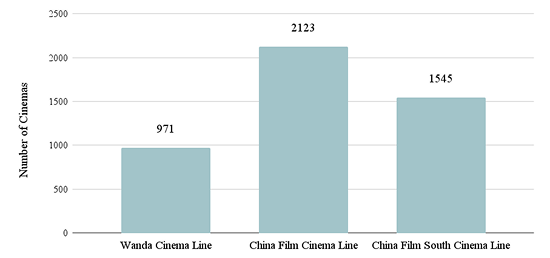
In H2 2025, Wanda Cinema Line, China Film Cinema Line, and China Film South Cinema Line ranked as the top three circuits, holding a combined market share of 38.34%. Wanda Cinema Line maintained its position as the nation's top circuit for the 18th consecutive year, operating 971 cinemas and capturing a 17.15% market share in H2.
Top 3 Cinemas in China (H2 2025)
*Sourse: Maoyan Professional Edition
High-specification premium large format (PLF) auditoriums demonstrated a significant competitive advantage, contributing 9.4% of the annual box office—well above the 7% average of the past decade—with an average of 24.6 admissions per show, the highest in five years.
Box Office Performance: China's total box office in 2025 exceeded USD 7.5 billion, representing a year-on-year increase of 21.95%. This growth outpaced the global average of 8%. As the world's second-largest film market, China trailed only North America (USD 8.771 billion), showcasing a strong recovery.
Ticket Price: Influenced by market supply and demand dynamics, as well as national subsidy policies during key release periods, average ticket prices declined for the second consecutive year, falling to CNY 41.9 (USD 6.12) in 2025.
Audience Trends: First, the number of occasional viewers (seeing one film per year) increased, while the base of regular, frequent moviegoers shrank. The annual per capita viewing frequency was 1.94. Viewers who watched only one film per year accounted for 59% of the audience, while the proportion watching four or more films annually decreased significantly. Second, the audience demographic continued to age. Viewers under 25 fell to 15% of the total, less than half the 39% share recorded between 2017 and 2019, indicating a significant loss of younger viewers.
Conversely, viewers aged 40 and above accounted for 23%, becoming a core demographic. Third, female viewers constituted 60% of the audience, with young women being the most active segment. The senior demographic also showed increasing market potential. Attracting younger audiences will remain a major challenge for China's film industry in the foreseeable future.
Conversely, viewers aged 40 and above accounted for 23%, becoming a core demographic. Third, female viewers constituted 60% of the audience, with young women being the most active segment. The senior demographic also showed increasing market potential. Attracting younger audiences will remain a major challenge for China's film industry in the foreseeable future.
Surveys indicate that despite competition for online entertainment from short dramas and short videos, theatrical moviegoing remains a dominant form of offline leisure activity for residents.
Innovative Cinema Operations: In response to evolving audience demands, many cinemas are upgrading projection equipment and creating new consumption scenarios and experiences. Cinemas are shifting their business logic, utilizing a "Cinema+" strategy to revitalize their physical spaces and enhance their "experiential" and "social" functions. They are diversifying their screening content and business operations to increase non-box office revenue, such as live broadcasting sports events and concerts, or screening stage plays. For example, Beijing launched 12 "Cinema New Space" venues, exploring integrated models combining film with technology, cultural tourism, and social interaction to activate full-day operations and maximize the cultural value of cinema spaces.
Technology and Production Services
Rapid Development in AI, Virtual Production, and LED Technology
Breakthroughs occurred across multiple key technology areas, including AI, virtual production (VP), and high-definition LED screens. The China Film Administration actively supports the development of new technologies and consumption scenarios involving AI, VR films, digital assets, and LED displays.
In AI applications, companies like Western Film Group Co. Ltd, Changjiang Film Group, Yangtze River Film Group Co. Ltd, CFGC, as well as streaming platforms iQiyi, Tencent Video, and Alibaba, are actively exploring AI's application in film production, restoration, distribution, and marketing. In 2025, the utilization rate of AI technology in Chinese film and television projects exceeded 30%.
High-tech format projection systems represented by CINITY LED advanced rapidly. In December, CFGC released the world's first LED mastering standard, the CINITY LED Digital Cinema Distribution Master and Packaging Technical Requirements. Avatar: Fire and Ash became the first Hollywood imported film released in the CINITY LED 3D high frame rate format. Dual mastering centers in Beijing and Los Angeles have produced CINITY LED versions for 133 films.
Virtual reality (VR) film production technology developed swiftly. A total of 28 VR films were produced in 2025, including notable titles like Nobody: Roaming with You and Chang An, creating new cinematic experiences through VR technology. The first cinema-based, seated-viewing VR auditorium opened at the Oscar Jinrongdao Cinema in Zhengzhou, and the first dedicated VR cinema, 798 Chaowei Shijie, was announced in Beijing. Institutions involved in developing VR film technical standards, content creation, distribution, exhibition, cinema operation, ticketing systems, and hardware R&D include China Research Institute of Film Science & Technology, Xi'an Film Studio, Beijing 798, Henan Media Group's "Da Xiang Yuan," Hangzhou Wuzhi, Shenzhen Mopon, PICO, and Hunan Yezi Technology.


while the right shows the experience venue in 798 Chaowei Shijie.
Streaming Platforms and Digital Growth
Short Dramas Witness Explosive Growth
Dominant OTT Platforms: China’s long-video sector is dominated by Tencent Video, iQIYI, Youku, Mango TV, and Bilibili, which rank as the top five platforms. Tencent Video accounts for approximately 32% of the market, iQIYI 30%, Youku 23%, while Mango TV, Bilibili, and other platforms together make up the remaining 15%. According to Q3 financial reports, Tencent Video had 114 million paid subscribers, and Youku had 281 million users. Among these platforms, iQIYI achieved a profit of CNY 640 million (USD 93.5 million) in 2025, marking four consecutive years of operational profitability, with total revenue of CNY 13.47 billion (USD 1.97 billion) in H2 2025. Membership and advertising represent the primary revenue streams for streaming platforms. In 2025, membership services contributed 59.1% of total streaming revenue. User demographics are similar across major platforms: users under 35 accounted for 62.2% at Tencent Video, 58.7% at iQIYI, 87.2% at Youku, and 69.6% at Mango TV.
Top 5 Streamers (H2 2025) *Unit: 100 million
| No | Name | Monthly Active Users* | Market Share |
|---|---|---|---|
| 1 | Tencent Video | 3.5 | 32% |
| 2 | iQiyi | 3.25 | 30% |
| 3 | Youku | 1.74 | 23% |
| 4 | Mango TV | 2.58 | - |
| 5 | Bilibili | 3.76 | - |
Note:
- The market share is calculated based on revenue and not on the number of monthly active users.
- The data is compiled from financial reports of parent companies across various platforms
- The market share is calculated based on revenue and not on the number of monthly active users.
- The data is compiled from financial reports of parent companies across various platforms
Long-video platforms have intensified efforts to develop high-quality local content. In 2025, the four major platforms released 268 new drama series, representing a year-on-year increase of 11.7%. Tencent Video’s exclusive content accounted for as high as 78.2%. In terms of genres, contemporary, urban, and romance titles have formed a stable and consistent audience base.
Looking ahead, streaming platforms will focus on improving content quality, enhancing membership and advertising services to consolidate their core domestic business, while accelerating expansion into overseas markets and experiential services. They will also leverage AI to build a diversified content ecosystem.
In 2025, the number of films distributed on streaming platforms increased. iQIYI offered more than 500 films, while Tencent Video and Youku each provided over 200 films. Streaming platforms have become the most important distribution channel for Chinese films after theatrical release. For some filmmakers, revenue from streaming platforms exceeds that from theatrical box office.
In the second half of 2025, the short drama sector experienced explosive growth, with a rising number of premium productions financed with over CNY 1 million. ByteDance’s Hongguo Short Drama, Hema Theater, and Fanhua Theater ranked as the top three short drama platforms, collectively capturing more than 95% of the market. In 2025, 33,000 micro-dramas were released domestically, reaching nearly 700 million users, with market size exceeding CNY 100 billion—doubling the figure from 2024.
To further boost consumption driven by micro-dramas, the government is formulating the Regulations on the Development and Administration of Micro-Dramas and implementing a “Micro-Drama+” initiative to integrate the sector with culture, tourism, sports, agriculture, and other industries.
International Co-Production
Active International Exchanges, Leveraging Films to Boost Inbound Tourism
Projects & Treaties: According to official data, 17 Chinese-foreign co-productions were registered for project approval in H2 2025. The majority were co-productions with Hong Kong. Additionally, there were one or two film projects each with France, the UK, Singapore, India, Malaysia, Russia, Japan, and the US. Four co-productions were released in H2 2025. Two were with Hong Kong: The Shadow's Edge grossed CNY 1.266 billion in China and USD 191 million globally (with 7.33% from overseas), and Under Current grossed over CNY 30 million. Others included the US-China animated feature Tom and Jerry: Forbidden Compass and the China-Russia film Red Silk grossed USD 7.982 million in Russia, outperforming its USD 1.819 million gross in China.


Under Current © Emperor Motion Pictures
Red Silk © China Film Co., Ltd, et al.
Tom and Jerry: Forbidden Compass © China Film Co., Ltd, et al.
International Cooperation & Festivals: To strengthen film exchange and cooperation with Macau, a Framework Agreement on Film Industry Cooperation between the China Film Administration and the Secretariat for Social Affairs and Culture of the Macau Special Administrative Region Government was signed in December. On the other hand, influenced by changing international relations, China decided to postpone the release of Japanese films starting November 17. Meanwhile, improving relations with South Korea laid the groundwork for future film cooperation.
In the second half of 2025, China hosted several international film festivals, including the Shanghai Cooperation Organization (SCO) Film Festival (themed on technology), the 12th Silk Road International Film Festival, and the 7th Hainan International Film Festival. Nepal and Belarus joined the Belt and Road Film Industry Cooperation Platform, expanding its membership to 40 countries.
In the second half of 2025, China hosted several international film festivals, including the Shanghai Cooperation Organization (SCO) Film Festival (themed on technology), the 12th Silk Road International Film Festival, and the 7th Hainan International Film Festival. Nepal and Belarus joined the Belt and Road Film Industry Cooperation Platform, expanding its membership to 40 countries.
Promoting Chinese Films Abroad & Inbound Tourism: Throughout 2025, China actively promoted its films in the international market, organizing 48 events across 42 countries, screening 263 films over 407 showings. Furthermore, leveraging film as a vehicle for cultural soft power, the CFA and other bodies launched the "Travel China Through Films" campaign. This initiative utilizes films to showcase China's scenery, cuisine, and lifestyle to audiences in North America, Latin America, Europe, and Africa, aiming to attract international tourists to visit China.
- Note: All figures are converted using an exchange rate of USD 1 = CNY 6.845
SUN Yanbin
Beijing Film Academy Associate Professor
Working at Beijing Film Academy since 2016, leading research on Chinese film industry and world film industry, has authored the monograph An Introduction to the Chinese Film Industry, which systematically analyzes the development history and current status of China's film industry.
Note: For certain categories, only the first few entries are displayed for readability; the remainder are omitted