Title
THE A REPORT
2025 H2
 REN Hao Jheng
Researcher
REN Hao Jheng
Researcher Taiwan Creative Content Agency
(TAICCA)
Updated on 12 May 2026
Overview
Unlike the first half of 2025, when overall box office performance was relatively flat, the second half of the year was driven by international blockbuster hits such as Demon Slayer: Kimetsu no Yaiba - Infinity Castle and Zootopia 2, alongside strong box office performances by local films. As a result, Taiwan’s annual theatrical box office surpassed TWD 8 billion, marking a post-COVID high. However, similar to global trends, amid increasing competition from streaming and social platforms, theatrical box office revenue has not yet returned to the pre-pandemic annual average of TWD 10 billion.
In the second half of 2025, Taiwanese local films experienced a significant box office surge. From August to January 2026, five domestic films each surpassed TWD 100 million in box office revenue, representing the strongest market performance for local films in the past decade. These titles spanned multiple genres—including action, horror, and drama—demonstrating considerable diversity. Among them, 96 Minutes, which depicts a high-speed rail train bombing crisis, grossed TWD 207 million, making it the highest-grossing Taiwanese film of 2025. The film is also a rare example of a home-grown disaster action film, showcasing the local film industry’s growing technical capabilities and commercial potential.
 96 Minutes @ WOWING Entertainment Group
Top 10 Films in Taiwanese Box Office (2025)
You can scroll left and right to view the content.
| No | Title | Director | Country | Genre | Gross (TWD) |
Gross (USD) |
Production Company |
Distribution Company |
|---|---|---|---|---|---|---|---|---|
| 1 | Demon Slayer: Kimetsu no Yaiba - Infinity Castle | Haruo Sotozaki | Japan | Animation | 846M | 27M | Aniplex, Crunchyroll, Shueisha, Toho Pictures, Ufotable | Muse Communication |
| 2 | Zootopia 2 | Jared Bush, Byron Howard | US | Animation | 643M | 20M | Walt Disney Animation Studios, Walt Disney Pictures | The Walt Disney Company (Taiwan) |
| 3 | F1: The Movie | Joseph Kosinski | US | Action | 573M | 18M | Apple Original Films, Monolith Pictures, Jerry Bruckheimer Films, Plan B Entertainment, Dawn Apollo Films | Warner Bros. (F.E.) Inc. Taiwan Branch (U. S. A.) |
| 4 | Mission: Impossible - The Final Reckoning | Christopher McQuarrie | US | Action | 453M | 14M | Paramount Pictures, Skydance Media, TC Productions | Paramount Films of China, Inc. Taiwan Branch (U.S.A.) |
| 5 | Avatar: Fire and Ash | James Cameron | US | Action | 301M | 9M | 20th Century Studios, Lightstorm Entertainment, TSG Entertainment | The Walt Disney Company (Taiwan) |
| 6 | Jurassic World: Rebirth | Gareth Edwards | US | Action | 299M | 9M | Universal Pictures, Amblin Entertainment, Dentsu | Universal Picture Corporation of China Taiwan Branch (U.S.A.) |
| 7 | Chainsaw Man - The Movie: Reze Arc | Tatsuya Yoshihara | Japan | Animation | 260M | 8M | Mappa, Shueisha | Sony Pictures Releasing Taiwan Corporation Taiwan Branch (U.S.A.) |
| 8 | Detective Conan The Movie: One-Eyed Flashback | Katsuya Shigehara | Japan | Animation | 215M | 7M | TMS Entertainment | Proware Multimedia International |
| 9 | 96 Minutes | Tzu-Hsuan Hung | Taiwan | Crime | 207M | 7M | Wowing Entertainment Group, Flash Forward Entertainment | Wowing Entertainment Group |
| 10 | Gatao: Big Brothers | Hung-i Yao, Jui-Chih Chiang | Taiwan | Action | 189M | 6M | Chocolate Film Entertainment | Vie Vision Pictures |
Top 10 Domestic Films in Taiwanese Box Office (2025)
You can scroll left and right to view the content.
| No | Title | Director | Country | Genre | Gross (TWD) |
Gross (USD) |
Production Company |
Distribution Company |
|---|---|---|---|---|---|---|---|---|
| 1 | 96 Minutes | Tzu-Hsuan Hung | Taiwan | Crime | 207M | 7M | Wowing Entertainment Group, Flash Forward Entertainment | Wowing Entertainment Group |
| 2 | Gatao: Big Brothers | Hung-i Yao, Jui-Chih Chiang | Taiwan | Action | 189M | 6M | Chocolate Film Entertainment | Vie Vision Pictures |
| 3 | Mudborn | Meng-Ju Shieh | Taiwan | Horror | 101M | 3M | Gift Pictures | Vie Vision Pictures |
| 4 | A Foggy Tale | Yu-Hsun Chen | Taiwan | Family | 77M | 2M | Mandarin Vision | Activator |
| 5 | Lovesick | Fu-Hsiang Hsu | Taiwan | Romance | 63M | 2M | Sequoia Entertainment, Lovesick Co. | Sony Pictures Releasing Taiwan Corporation Taiwan Branch (U.S.A.) |
| 6 | Invisible Nation | Vanessa Hope | Taiwan | Documentary | 38M | 1M | 100 Chapters Entertainment, Double Hope Films | Swallow Wings Enterprise |
| 7 | A Chip Odyssey | Hsiao Chu-Chen | Taiwan | Documentary | 36M | 1M | CNEX Studio Corporation, Shang Shan Yi Cultural Studio | Activator |
| 8 | Haunted Mountains: The Yellow Taboo | Tsai Chia-Ying | Taiwan | Thriller, Suspense | 30M | 0.9M | The Tag-Along Co. | Vie Vision Pictures |
| 9 | Taiwan Unsung Hero | Charlie Chu | Taiwan | Documentary | 21M | 0.7M | Studio Gene Young 3D Image | Activator |
| 10 | Organ Child | Hsueh-Bin Chieh | Taiwan | Action | 19M | 0.6M | Sky Films Entertainment | Sky Films Entertainment |
- Average ticket price: approx. TWD 293 (≈ USD 9.2, at 1 USD = 32 TWD)
Production Landscape
Taiwan releases approximately 50 domestic films each year, the vast majority of which are feature films. In 2025, a total of 52 Taiwanese films were released, including both feature-length and short films, slightly lower than the 57 titles released in 2024. Notably, beyond the success of feature films, three documentary films—A Journey with Invisible Friends, Taiwan Unsung Hero, and A Chip Odyssey—each surpassed TWD 10 million in box office revenue, marking a rare achievement for documentary theatrical releases. All three works reflect themes of Taiwanese identity and resilience in adversity, demonstrating the market potential of documentaries centered on specific social or cultural themes.
No. of Domestic Feature films and Screens (2019-2025)
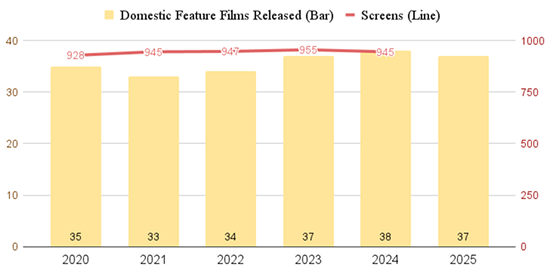
Only films first released in that year are incluted.
Taiwan’s film production and distribution sector is primarily composed of small and medium-sized enterprises. Many companies are either personal production companies established by directors or producers, or a single-purpose production entity created for a specific film project. Companies with capital under TWD 50 million account for 87.93% of production companies and 82.23% of distribution companies, respectively. Due to the relatively small scale of most production companies, financing is heavily dependent on government subsidies and co-investment structures. Feature films and animation projects typically operate at mid-range production budgets of TWD 30–50 million, while documentaries are generally low-budget productions ranging from TWD 5–10 million. In terms of narrative themes, family-themed films dominate, followed by the romance genre.
Overall, Taiwan lacks large-scale production companies with substantial output capacity. Producing two to three films annually is already considered a high level of productivity. Among the current industry players, MandarinVision, Sky Films Entertainment, Rise Pictures and Renaissance Films (under producer David Tang), Chocolate Film Entertainment and WOWING Entertainment, known for the Gatao and The Rope Curse franchise films, are among the more prolific production companies. Major production facilities include Central Motion Picture Corporation and Aaron Film Studio, while leading post-production companies include Taipei Postproduction and Full Shine Digital Cinema. Prominent visual effects studios include The White Rabbit Entertainment, Moonshine Studio, Wwwind Studio, and Reno Studios, which are considered key players in Taiwan’s VFX industry. As technological and capital barriers decrease, a number of emerging small and mid-sized post-production and VFX companies, such as Timeline Studio and Film Tailor Studio, have also risen in recent years.
Financing Models
Cultural content investments from the National Development Fund administered by TAICCA (Taiwan Creative Content Agency) constitute a major source of financing for Taiwanese films. TAICCA has introduced equity investments and co-established content funds to encourage private capital participation in the film and television sector. Examples include MyStory Entertainment, jointly established with Taiwan SECOM, as well as the Taiwan–Korea Entertainment and Cultural Content Fund, established in 2025 in collaboration with CJ ENM, telecom operator Far EasTone Telecom, and Liann Lih Technology (TVBS Group). TAICCA also partnered with Far EasTone and Fubon Cultural Creative to establish the Far EasTone Creative Entertainment Fund.
In addition to TAICCA’s financial solutions, Taiwan’s film industry primarily relies on investment from industry players. Major investors such as CMC Entertainment and MyStory Entertainment, production and distribution companies like MandarinVision and Sky Films Entertainment, entertainment companies such as GCEstar, and distributor 66CC, which is backed by Hong Kong investment and includes its joint venture 16CC with Taiwanese production company Atom Cinema. Aaron Film Studio is also among the key investors in the sector.
In recent years, private film and television investment funds have also emerged as new financing sources. For example, the Tomorrow Together Capital, established in 2023 and initiated by GrX Studio, received capital injections from Eastern Broadcasting Company (EBC) and Taiwan Mobile, and has since invested in multiple Taiwanese films. Meanwhile, Thunder Entertainment fund, established in 2025, was among the investors of the film A Foggy Tale, which surpassed TWD 100 million at the box office.
Government subsidies also represent one of the primary financing sources for Taiwanese films. Approximately 30% of films each year receive funding from the Ministry of Culture, while local governments—including Taipei, Taichung, and Kaohsiung—operate their own film subsidy programs. In order to expand the scale of Taiwan’s film market, the Ministry of Culture introduced the ‘International Flagship Category’ under its feature film subsidies program, providing grants of up to TWD 100 million per project. The first batch of funded projects was announced in January, with three films selected: Daughter of Nectar (甘露水), Call of Lobster (瘋狂蝦夫), and The Odd Three Madame Tiger (變形者集結:虎姑婆), receiving TWD 70 million to TWD 80 million each in production grants.
Regarding tax incentives, amendments to the “Development of the Cultural and Creative Industries Act” were enacted in 2023. Investments in film development, production, and distribution now qualify for tax deductions. Corporate investors may deduct 20% of their investment from corporate income tax over a five-year period, with an annual deduction cap of 50% of the payable tax. Individual investors who invest more than TWD 500,000 may receive a 50% deduction on personal income tax, with a maximum deductible amount of TWD 3 million.
Distribution Climate
Overall, the Taiwanese film market remains dominated by Hollywood studios. In 2025, U.S. films generated TWD 4.20 billion in box office revenue, accounting for 52.17% of the total market share. Against this backdrop, the Taiwanese theatrical market continues to be led by major Hollywood distributors, including Disney, Warner Bros., Universal Pictures, Sony Pictures, and Paramount Pictures. Disney, driven by blockbuster titles such as Zootopia 2 and Avatar: Fire and Ash, generated TWD 1.56 billion in box office revenue in 2025, accounting for nearly one-fifth of the total box office market.
Top 5 Distributors' Market Share (2024)
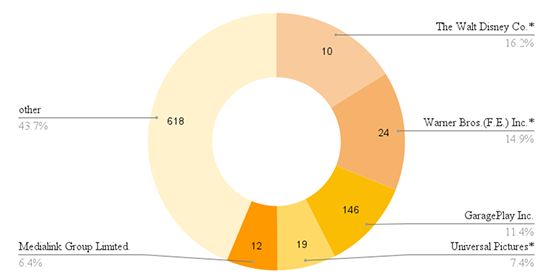
*Taiwan Branch
Note:
- The data are from 2024 and are not up to date; they are for indicative purposes only.
- Market share is based on revenue, not the number of titles.
Note:
- The data are from 2024 and are not up to date; they are for indicative purposes only.
- Market share is based on revenue, not the number of titles.
Beyond Hollywood studios, Japanese animated films have achieved remarkable success in Taiwan in recent years. Consequently, local distributors specializing in Japanese animation have also benefited significantly from the strong box office performance of these titles. For example, Taiwanese distributor Muse Communication achieved TWD 844 million and TWD 144 million in box office revenue respectively from Demon Slayer: Kimetsu no Yaiba - Infinity Castle and Attack on Titan: THE LAST ATTACK, resulting in a market share of 12.61%.
Historically, Taiwanese films have accounted for around 15% of the annual box office market share, while in 2025 local films generated TWD 946 million, representing 11.75% of the total market. Taiwanese films rely primarily on domestic distributors, including Activator, Sky Films Entertainment, and Vie Vision Pictures. Over the past three years, these distributors have each released more than ten Taiwanese films, with Activator distributing over twenty titles. In 2025, Vie Vision Pictures distributed two films that each surpassed TWD 100 million in their box office revenue—Gatao: Big Brothers and the horror film Mudborn. This resulted in TWD 371 million in total box office revenue and a 4.60% market share, making Vie Vision one of the most remarkable distributors of Taiwanese films.
It is also worth noting that Sunshine Women’s Choir, released on the final day of 2025 and adapted from the Korean film Harmony, has already surpassed TWD 700 million in box office revenue, including earnings carried over into 2026, setting a new record for Taiwanese films. The investors of Sunshine Women’s Choir include stakeholders across the film value chain, such as distributor 16CC, LS TIME and venue operator Showtime Cinemas. Investment companies under Vieshow Cinemas Chairman Charles Wang and telecom company Taiwan Mobile, which operates an OTT platform, are also among the list of investors. This reflects the increasing vertical collaboration across production, distribution, and venue sectors.
 Sunshine Women’s Choir @ 11cc films
Taiwanese online gaming company WANIN International has also been actively expanding into the film and television sector in recent years. In addition to investing in projects through WANIN Visual, the parent group acquired a stake in Vieshow Cinemas, Taiwan’s largest multiplex chain, in 2024 and became its largest shareholder. The company aims to establish a fully integrated value chain covering investment, production, distribution, and exhibition.
Theatrical Reach
Taiwan does not impose restrictions on the distribution or exhibition of foreign films, but the quota restriction against Chinese films up to ten theatrical releases per year is the only exception. Regarding cinemas, the expansion of multiplex chains has slowed, and several theaters have closed, resulting in a decline in the number of cinema screens. In 2024, Taiwan had 945 cinema screens nationwide, representing a minor decrease of 10 screens compared with 2023.
Taiwan’s theatrical market is dominated by multiplex cinema chains. According to the 2024 data, 80.63% of screens belong to chain theaters. Cinemas are primarily concentrated in metro areas, with nearly 40% of screens located in Taipei and surrounding densely populated municipalities. Compared with 2024, total cinema attendance in 2025 reached 27.42 million admissions, representing an approximately 20% increase from 22.92 million admissions in 2024. This indicates a recovery in theater attendance driven by popular domestic and international titles. For Taiwanese films specifically, admissions increased from 2.63 million in 2024 to 3.55 million in 2025, a growth rate that exceeds the overall market average and reflects the strong consumer demand for domestic films in 2025.
Top 3 Cinema Chains in Taiwan
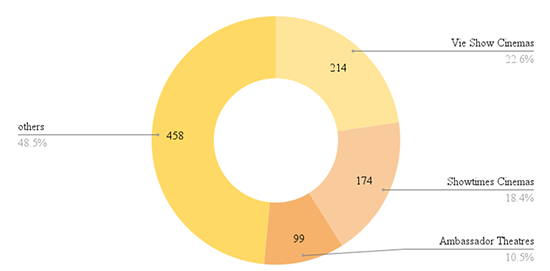
The data are from 2024 and are not up to date; they are for indicative purposes only.
Regarding ticket prices, movie ticket prices in Taiwan have shown a steady upward trend in recent years, with the average ticket price reaching approximately TWD 293 in 2025. In addition to inflation, this trend is related to multiplex chains’ continued investment in premium large-format auditoriums, offering enhanced audiovisual experiences to attract audiences to cinemas. For example, Showtime Cinemas, Taiwan’s second-largest cinema chain, opened a new multiplex at the Taipei Dome complex in 2025, where half of the auditoriums feature premium formats such as ULTRA 4DX, SCREENX, Dolby Vision + Atmos, and Remmi Chair seating systems. Tickets for the ULTRA 4DX auditorium are priced at TWD 690, making it the most expensive cinema experience in Taiwan.
Technology and Production Services
According to the 2024 data, Taiwan’s post-production and visual effects (VFX) industry generated approximately TWD 600 million in total revenue, with feature films representing the primary source of income, followed by television content. Historically, VFX work typically began after principal photography was completed. In recent years, however, with the increasing number of film genres requiring VFX, studios have shifted toward integrating VFX planning during the pre-production stage to ensure that visual effects align with the film’s aesthetic and narrative requirements. Consequently, the share of VFX costs within total production budgets has increased.
With the Ministry of Culture’s continuous efforts to subsidize the use of digital VFX and virtual production technologies, most domestic productions complete their post-production VFX work within Taiwan, creating a positive feedback loop for the local production ecosystem. In recent years, virtual production has become an increasingly common production methodology in the international film industry. But adoption of high-cost VFX remains limited, considering the relatively modest budget of most Taiwanese films. The film 96 Minutes, which grossed TWD 207 million in 2025, represents a technological milestone in Taiwanese film history, having extensively implemented LED-based virtual production and Previs (pre-visualization) technologies.
Meanwhile, with the rapid advancement of AI technologies, some Taiwanese film companies have begun incorporating AI into their production workflows. Most applications currently occur during the development and pre-production stages, such as script analysis and project development planning. AI applications are also gradually expanding into post-production VFX workflows to reduce production time and costs. For instance, the White Terror–themed film A Foggy Tale, which also achieved strong box office performance in 2025, utilized AI combined with computer animation to generate atmospheric fog effects and digital aging effects for actors.
Streaming Platforms and Digital Growth
Netflix is the most widely used streaming platform in Taiwan. According to TAICCA’s survey, approximately 65.2% of users accessed Netflix in 2024, followed by YouTube and iQIYI, while Disney+ ranked fourth. Usage of local Taiwanese streaming platforms remains relatively low. Licensing fees from streaming platforms represent one of the primary revenue streams for Taiwanese films, in addition to government subsidies and theatrical box office income. For some domestic films with moderate theatrical performance, streaming licensing revenue may even exceed theatrical box office revenue.
Top 5 Streamers
You can scroll left and right to view the content.
| Name | Usage rate | Subscription Fee Range (USD) |
Subscription Fee Range (TWD) |
|
|---|---|---|---|---|
| 1 | Netflix | 65.2% | 9.05–14.36 | 290–460 |
| 2 | YouTube (Premium) | 62.5% | 6.21–14.95 | 199–479 |
| 3 | iQIYI | 27.6% | 7.49–9.99 | 240–320 |
| 4 | Disney+ | 25.7% | 8.90–10.46 | 285–335 |
| 5 | LINE TV | 22.4% | 7.49–14.98 | 240–480 |
Note:
- Data on OTT platforms in Taiwan are limited to usage rates, based on a TAICCA consumer trends survey.
- The subscription fees presented on the table are the monthly subscription fees of each platform, based on available information
- LINE TV and KKTV merged in November last year. This data survey was conducted prior to the merger of the two platforms, while the subscription fee is based on the new plan following the merger.
- Data on OTT platforms in Taiwan are limited to usage rates, based on a TAICCA consumer trends survey.
- The subscription fees presented on the table are the monthly subscription fees of each platform, based on available information
- LINE TV and KKTV merged in November last year. This data survey was conducted prior to the merger of the two platforms, while the subscription fee is based on the new plan following the merger.
International streaming platforms such as Netflix and Disney+ currently do not invest directly in Taiwanese films and primarily acquire distribution rights, though the number of titles acquired remains limited. On Netflix last year, two local film performances are worth mentioning. Gatao: Big Brothers continued the franchise’s strong performance across both theatrical and streaming platforms. Another example was the crime-action film Organ Child, which tells the story of a recently released father seeking revenge against an organ-trafficking syndicate that abducted his daughter, achieving only modest theatrical results. However, after its Netflix release in October, the film quickly climbed to No. 3 on the Global Non-English Movies chart, becoming a notable surprise hit.
Overall, local streaming platforms continue to acquire the majority of Taiwanese film titles. Telecom companies that operate streaming services—including Chunghwa Telecom, Far EasTone Telecommunications, and Taiwan Mobile—have not only continued to license Taiwanese films for their platforms but have also actively expanded their investments in content production in recent years.
International Co-Production
TAICCA continues to support international co-productions through its Taiwan’s International Co-funding Program 2.0, investing in projects that incorporate Taiwanese elements in both content and production. In addition, in 2025 TAICCA launched the Taiwan Stories on the World Stage Program, which provides development funding of up to TWD 6 million for film producers collaborating with international partners during the feature film screenplay development stage.
In 2025, TAICCA also signed an MOU with Korean production company Studio Dragon to facilitate Taiwan–Korea co-productions. Under this partnership, the BUBBLE: Teen Romance Feature Co-Development Program was launched this year to select Taiwanese teen romance film projects. Selected projects will be co-developed with producers from Studio Dragon, with the aim of incubating Taiwanese teen romance films with international market potential. Additionally, during the 2025 TCCF, TAICCA announced another MOU with Japanese film company K2 Pictures, establishing cooperation in content investment, co-production, and business expansion.
Furthermore, GrX Studio, which has been actively expanding into the SEA market, announced last year a strategic partnership with Thai production company Transformation Films in collaboration with Lots Home Entertainment. Over the next three years, the partners plan to jointly invest USD 1.5–2 million to produce three to five projects, while also cultivating emerging creative talents. This initiative reflects Taiwan’s broader strategy of leveraging international co-investment and co-production to enter the global market.
REN Hao Jheng
Researcher / Taiwan Creative Content Agency (TAICCA)
Researcher at the Taiwan Creative Content Agency (TAICCA), specializing in film and television industry analysis and policy development insights.
This article was written by Ren Hao Jheng, Department of Research and Strategy, TAICCA, with contributions from:
- Bill Sung, Executive Vice President, Cai Chang International
- Chia-Chi Lin, Founder, Moonshine Studio
- Shawn Chuang, General Manager, My Story Entertainment