Title
THE A REPORT
2025 H2
 Patti LAPUS
Producer
Patti LAPUS
Producer
 Dodo DAYAO
Writer, Director, Producer
Dodo DAYAO
Writer, Director, Producer
Updated on 12 May 2026
Overview
The Philippine film landscape in late 2025 is defined by a "multi-hyphenate" workforce and a strategic pivot toward global competitiveness. A hallmark of this era is professional fluidity, where practitioners rotate between television, cinema, and advertising to navigate the industry's fluctuating production cycles. This adaptability has become vital as the Eddie Garcia Law (EGL), a regulation governing working hours and safety standards in the Philippine entertainment sector, enters its second year of implementation; while the statute has normalized labor standards, its quantifiable impact has contributed to a more contracted domestic release schedule.
The back half of 2025 saw production volume sustained primarily by the festival circuit, notably the VMX Film Festival and the Metro Manila Film Festival. Despite significant cultural buzz and extended theatrical runs, revenue remains conservative, hindered by high ticket pricing. However, the digital landscape is booming; a surge in 5G adoption has transformed the Philippines into a primary Asian streaming market, supported by major soundstage investments and the prestigious designation of Quezon City as a UNESCO Creative City of Film.
Buoyed by the FDCP’s "Big Picture" roadmap and the "Pinoy Oscars Pursuit" program, the sector is leveraging aggressive government subsidies to bridge the gap between local development and international recognition. By combining social protections for workers with high-tech infrastructure, the industry is transitioning from a localized ecosystem into a sophisticated, export-ready creative hub.
Top 10 Foreign Films In Philippines Box Office (2025)
You can scroll left and right to view the content.
| No. | Title | Director | Country | Genre | Gross (PHP) |
Gross (USD) |
Production Company |
|---|---|---|---|---|---|---|---|
| 1 | The Conjuring: Last Rites | Michael Chaves | USA | Horror, Thriller | 456.08M | 7.60M | New Line Cinema |
| 2 | Final Destination: Bloodlines | Zach Lipovsky & Adam B. Stein | USA | Horror, Thriller | 444.07M | 7.40M | New Line Cinema |
| 3 | Demon Slayer: Kimetsu no Yaiba - Infinity Castle | Haruo Sotozaki | Japan | Animation, Action | 384.06M | 6.40M | Aniplex |
| 4 | Wicked: For Good | Jon M. Chu | USA | Fantasy, Musical | 312.14M | 5.20M | Universal Pictures |
| 5 | The Fantastic Four: First Steps | Matt Shakman | USA | Action, Adventure | 262.70M | 4.38M | Marvel Studios |
| 6 | Avatar: Fire and Ash | James Cameron | USA | Sci-Fi, Action | 255.92M | 4.26M | 20th Century Studios |
| 7 | Lilo & Stitch | Dean Fleischer Camp | USA | Animation, Adventure | 246.41M | 4.11M | Walt Disney Pictures, Rideback |
| 8 | Jurassic World: Rebirth | Gareth Edwards | USA | Action, Adventure | 223.90M | 3.73M | Universal Pictures |
| 9 | How to Train Your Dragon | Dean DeBlois | USA | Animation, Adventure | 214.05M | 3.57M | DreamWorks Animation |
| 10 | Thunderbolts* | Jake Schreier | USA | Action, Adventure | 189.85M | 3.16M | Marvel Studios |
Production Landscape
The landscape of the Philippine film industry was the subject of a comprehensive 2025 analysis, encapsulated in a significant study titled, The Big Picture: Roadmap for the Future of the Film Industry of the Philippines. This research was undertaken by Olsberg-SPI (SPI), a renowned creative industries consultancy commissioned by the Film Development Council of the Philippines (FDCP), the country's national film agency.
A crucial component of this study was an industry-wide survey designed to map out the professional engagement and employment sectors of its respondents. The findings provided a clear delineation of the major areas of employment within the creative sector. The study revealed that the primary employment sectors for respondents were concentrated across four main areas:
- Television (61%): The broadcast sector represents the single largest area of employment for film industry professionals, underscoring the vital role of television production in sustaining the creative workforce.
- Feature Film (55%): While the industry is often defined by its cinematic output, the percentage indicates that a majority of professionals are also actively involved in the production of feature-length films.
- Commercials (37%): The advertising production sector provides a substantial source of work, serving as a critical economic pillar for many industry practitioners.
- Documentary (30%): A significant portion of the workforce is engaged in non-fiction filmmaking, reflecting a healthy sector dedicated to factual and journalistic content.
These statistics collectively illustrate the diverse and multifaceted nature of professional engagement within the Philippine creative sector, highlighting that most individuals work across multiple platforms to sustain their careers.
Areas of Content Creation in the Philippines (Olsberg SPI, 2025)

The Philippine film industry is characterized by a high degree of professional versatility and sectoral cross-pollination. Data reveals that the traditional notion of a specialist working exclusively within a single domain is an exception rather than the rule. A substantial majority of film professionals—an estimated 69% of all crew members surveyed—are actively engaged in more than one sector of the industry. This trend of professional flexibility is further underscored by the fact that 42% of the workforce operates in three or more different sectors.
Consequently, only a minority of the workforce, approximately one-third of the survey respondents, reported working exclusively within a single sector. This significant trend extends beyond sectoral engagement and is also strongly evident in professional roles. More than half (55%) of the individuals surveyed identify as multi-role professionals, routinely taking on responsibilities and executing duties across two or more distinct occupational roles within a production.
This pervasive multi-tasking and multi-sectoral engagement is a defining characteristic of the Philippine film ecosystem, highlighting a robust tendency for adaptability, versatility, and resourcefulness among its professionals. This adaptability likely stems from a combination of factors, including the need to secure consistent employment across fluctuating production cycles and the often-leaner staffing structures common in local film production, which necessitates individuals possessing a broad skillset. The resulting workforce is highly dynamic, capable of pivoting between different types of projects, production scales, and creative demands.
Additionally, acclaimed film critic and researcher John Tawasil reported in his 2025 Present Confusion Year in Review - Philippine Cinema Favorites that a total of 197 mid- and feature-length films were released. These films premiered across various platforms, including cinemas, streaming services, and film festivals.
According to Tawasil, the Philippine film industry in 2025 saw minor contraction alongside minor advancement. Fiscal conservatism by established entities marginally reduced the volume of film releases. However, released films frequently garnered substantial audience engagement, translating into commercial sustainability and non-festival theatrical engagements—a potential resurgence of local cinema-going culture. This revival was aided by an experimental strategy to reduce ticket prices to pre-pandemic levels. Films like the drama Sunshine and the rom-com I Remember You enjoyed extended runs, indicating sustained demand. Despite this, the sector did not reach pre-pandemic financial heights; the highest-grossing film, Meet, Greet & Bye, peaked just above PHP 250 million, falling short of historical records.
A major logistical shift occurred in the independent film festival circuit when the Cinemalaya Independent Film Festival was forced to move from August to October due to unforeseen fiscal constraints. This change created an unprecedented clustering of major festivals in the year's second half, positioning Cinemalaya near Sinag Maynila Film Festival (late September), the inaugural CineSilip Film Festival (late October, organized by VMX), and the QCinema International Film Festival (Mid-November). This concentration significantly biased the distribution calendar, causing the number of local film premieres in the second half of 2025 to escalate to over 1.7 times the first half's volume, creating a highly competitive, enriched environment.
Financing Models
Since 2020, the Philippine government has intensified its commitment to the cinema sector, disbursing over PHP 533 million in financial assistance to date. This strategy aims to stimulate high-quality domestic production while positioning the Philippines as a competitive destination for international filming.
According to the 2025 Olsberg-SPI study, fiscal year 2024 represented a peak in this investment trajectory.
- Primary Incentive Programs: PHP 127 million was granted through the Film Location Incentive Program (FLIP), the International Co-production Fund (ICOF), and the ASEAN Co-production Fund (ACOF)
- Local Pipeline Support: An additional PHP 39 million was channeled through CreatePHFilms, focusing on script development, post-production, and marketing for local projects
Public Funding provided by the FDCP (Olsberg SPI, 2025)
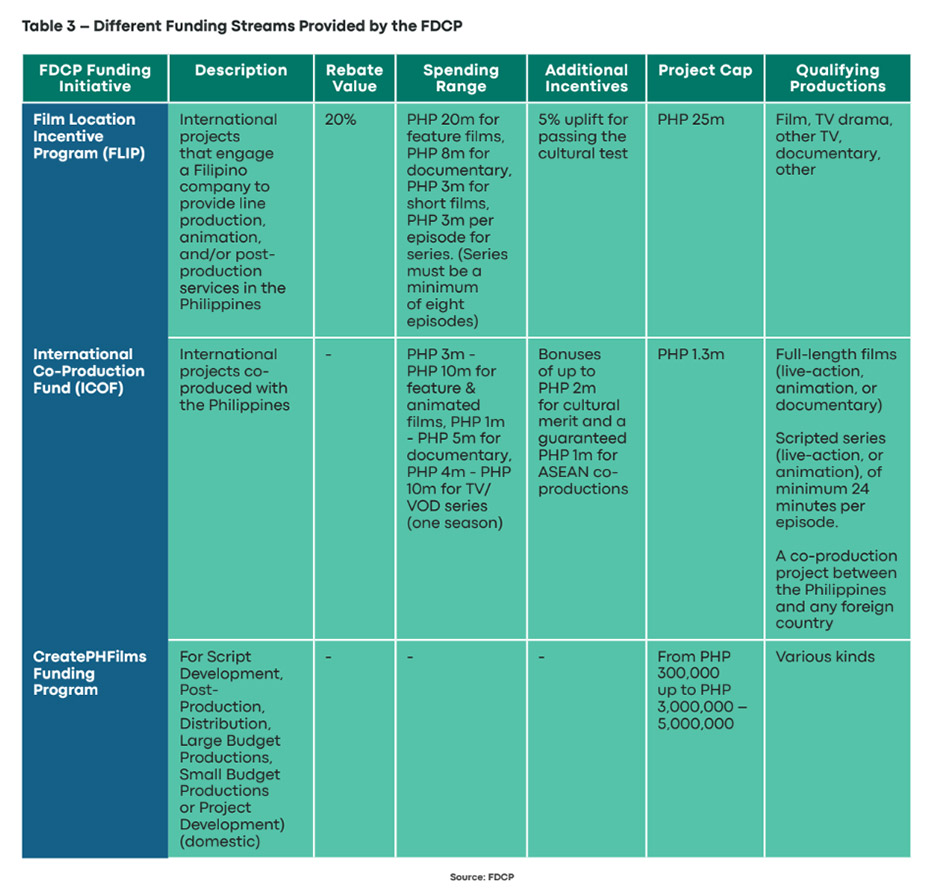
Beyond the FDCP, a diverse array of funding initiatives supports film projects across the Philippines, targeting filmmakers at various career stages and production phases (Olsberg SPI, 2025):
Support for Emerging Filmmakers
- Sine Kabataan: Offers PHP 200,000 grants to young filmmakers (aged 18 to 23) for short films addressing specific social issues, with additional awards for categories like Best Director and Best Screenplay.
- Student Film Assistance Program: Provides grants ranging from PHP 30,000 to PHP 50,000 to college students in good academic standing for their thesis film projects.
Programs for Established Filmmakers and Industry Development
- Cinemalaya Funding Program: Offers up to PHP 500,000 to Cinemalaya alumni whose films are in the post-production stage.
- QCinema Production Grants: Provides PHP 500,000 for short film projects (narrative fiction, animation, or experimental) by Southeast Asian Filipino filmmakers at the script development stage.
- NCCA Grant Programs: Funds a wide range of activities, including festivals, film education seminars, post-production, and skills training workshops, with grants between PHP 50,000 and PHP 200,000. Eligible applicants include individuals, NGOs, local government units, and state universities and colleges that meet the program criteria.
Regional Initiatives
- Bacolod Film Festival: Awards PHP 300,000 to ten selected filmmakers who are residents and registered voters of Bacolod City, supporting short films of any genre or Filipino languages with English translation.
Collectively, these targeted financial support programs aim to strengthen the Philippine film industry by developing new talent, promoting regional filmmaking, and supporting projects at multiple stages of the creative process.
There was a surge in support for Filipino filmmakers through specialized grants and prizes. The Puregold CinePanalo Film Festival focused on “Winning Stories of Life,” offering both mainstream and student categories. In its Full-Length Category, 7 filmmakers each received PHP 3 million, with Salum by TM Malones winning Best Picture, followed by notable films such as Tigkiliwi (Jury Prize), Olsen’s Day, and Journeyman. In the Student Short Category, 25 finalists each received PHP 150,000, with Champ Green by Clyde Cuizon Gamale winning Best Short Film, alongside other notable entries including Uwian, Sine-Sine, and Dela Cruz, Juan P.
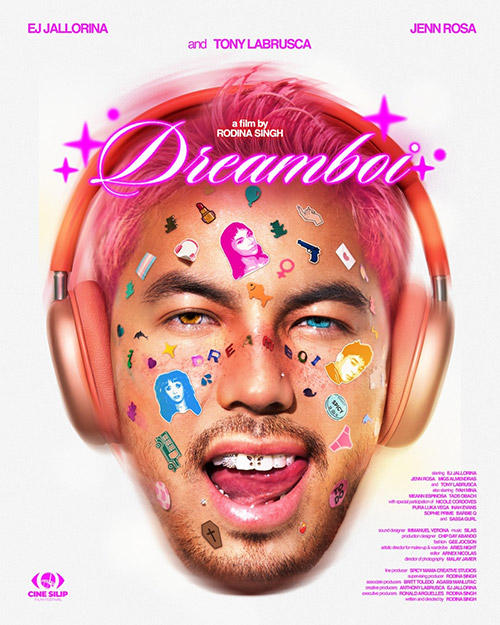
Meanwhile, the CineSilip Film Festival, launched in October 2025, provided a platform for more mature, experimental, and bold storytelling. The inaugural edition selected seven official entries from over 100 submissions and awarded them following the festival run. Dreamboi received Best Picture and an additional Audience Choice Award, earning a total of PHP 350,000. Other top awards included Pagdaong (PHP 200,000) and Haplos sa Hangin (PHP 100,000), reflecting the festival’s emphasis on distinctive and boundary-pushing cinema.
The festival’s biggest winner, Dreamboi (directed by Rodina Singh), became the center of a national conversation regarding censorship and queer representation when it initially received an X rating prior to its festival premiere. This however led to sold-out screenings at Ayala Malls Cinemas, proving once again that controversy can be a powerful marketing tool in the Philippine indie scene.
International festival circuits remain a viable tributary for Philippine films, particularly independent films, and the notable titles in the latter half of the year include Some Nights I Feel Like Walking, which won several awards at the 2025 ASEAN International Film Festival, the controversial documentary Food Delivery which won at the Doc Edge Awards 2025 in New Zealand in the Tides of Change category and the short film Agapito, which made it to the Cannes 2025 slate.
Distribution Climate
The distribution environment in the latter half of the year remains largely consistent with the first. Hollywood retains its dominance, theatrical pipelines are still vulnerable, and streaming platforms continue to be strong. For independent films, festivals remain the most effective channel for reaching audiences.
The Philippine market is best understood as three distinct distribution channels:
- Traditional Theatrical System: This segment is still primarily dominated by Hollywood and studio-backed films.
- Streaming Landscape: This saw significant growth, with the local streamer VMX surpassing all international Subscription Video On Demand (SVOD) services in local subscriber count, with the exception of Netflix.
- Diaspora Distribution: This targets the approximately 10 million Overseas Filipino Workers (OFW), a highly loyal and premium audience segment accessible via dedicated platforms such as iWant.
As of this report, the top five distributors in 2025, according to Vitrina.ai, are:
- Star Cinema (ABS-CBN Film Productions)
- Viva Films/Viva International
- GMA Pictures
- Columbia Pictures Philippines (Sony Pictures Releasing)
- Warner Bros. Philippines
Rounding out the top ten are Disney Philippines, Universal Pictures Philippines, Regal Entertainment/Regal Films, Solar Entertainment, and VMX.
Collectively, these companies dominated the 2025 theatrical market, highlighting the continued reliance of the Philippines on Hollywood content pipelines. This trend often marginalizes independent and purely local distributors, although occasional exceptions, such as the independently produced or festival-supported titles Sunshine, Food Delivery, and Open Endings, manage to break through.
Streamers operate as a parallel distribution system. VMX, however, warrants special focus due to its unique distribution logic. Unlike traditional companies that are studios with a streaming division, VMX is fundamentally a streaming-first production and distribution operation. This model has enabled it to build the largest SVOD subscriber base among domestic platforms in the Philippines while maintaining aggressive production output.
Tawasil's Year-End Review 2025 (2026) indicated that out of 197 films, 108 received a cinematic release, which includes 65 standard theatrical runs and 43 film festival screenings. The remaining 89 films premiered on streaming services, either via a subscription model or as a pay-per-view option. VMX accounted for the majority of these streaming full-length features, releasing 62 films, while other services released the rest.
Number of 2025 PH film Releases (Tawasil, 2026)

2025 NON VIVAMAX STREAMING TITLES

Source: John Tawasil (used with permission)
Theatrical Reach
High demand for Filipino film content exists within the Philippines, with SPI's research (2025) indicating that 67% of respondents reported medium or high demand. However, audience growth is being restricted by prohibitive ticket pricing.
In MJ Felipe’s post-mortem report on the 2025 Metro Manila Film Festival (MMFF), high movie ticket prices were identified as a main contributing factor to the low attendance at the festival. Gross receipts fell nearly PHP 100 million (USD 1.67 million) short of the previous year.
Currently, regular cinema tickets average PHP 400 (USD 7), while premium screenings can cost PHP 600 (USD 10) or more. The rise in ticket prices is driven by multiple factors, including inflation and rising operational costs. This pricing is widely considered by the public and the industry to be the reason for the year's decline in box office revenue, a sentiment confirmed by MMFF Overall Chairman Atty. Don Artes. The SPI study (2025) notes: “This is very high relative to daily wage levels (~PHP 600), reducing affordability and cinema-going frequency for the general public. To mitigate these challenges and improve audience attendance for local films, efforts have been made both by the FDCP and by local councils, including waiving the 10% entertainment tax for screenings of local films for three years and publishing guidelines to move release dates, adding a minimum theatrical window of one week and reducing ticket prices for students.”
In the month before the MMFF, a handful of films were released that not only garnered buzz but made relatively significant box office: Petersen Vargas’ Some Nights I Feel Like Walking, Jerrold Tarog’s historical drama Quezon, GMA Films’ horror anthology KMJS Gabi Ng Lagim The Movie and Lino Cayetano’s cop-noir Salvageland.
Rodina Singh’s trans drama Dreamboi, which was part of CineSilip Film Festival, initially received an X rating from the local review board MTRCB (Movie and Television Review and Classification Board), but the controversy may have been its own self-sufficient tangential marketing campaign. When the rating was eventually changed from X to R-18, Dreamboi went on to make the most money in the festival and took home a slew of awards including Best Picture and Best Director.
A handful of Cinemalaya films—Open Endings, Warla and Child No. 82—likewise became minor box office successes during the festival. While the attendance at the MMFF was lower than 2024 and the big moneymaker was still a Vice Ganda dramedy Call Me Mother, it had a lot of traction and even extended its run for a couple more weeks.
The Philippine film industry ended 2025 with both critical and commercial success, often with productions exploring non-traditional subgenres. The unconventional sports drama Sunshine, which addresses the theme of abortion, received critical acclaim, earning the 2025 Crystal Bear and being the only Filipino film on Letterboxd's Top-Rated 2025 Films (Purnell, 2026). A major commercial success was Star Cinema's family drama Meet, Greet & Bye, directed by Cathy Garcia-Sempana, which grossed PHP 260 million (USD 4.33 million) globally (Sabio, 2025) and was the domestic box office standout for the whole of 2025 (Box Office Mojo, 2025).

Meet, Greet & Bye © Star Cinema
Technology and Production Services
Despite having a tech services ecosystem that is relatively more modest than those of regional economies such as Thailand and South Korea, the Philippines continues to actively expand and enhance its ecosystem and infrastructure.
Technology, in recent months, has helped circumvent some of the labor and scheduling pressures introduced by the EGL. Access to more advanced technologies and equipment has also made local productions globally competitive.
The physical production capacity of the Philippine film industry is concentrated among a select group of key players, segmented into three principal categories:
-
Studio and Sound Stage Facilities
Studio offerings are bifurcated between large-scale, professional stages (e.g., ABS-CBN Studios), which cater to high-budget projects, and smaller, more cost-effective venues (e.g., Shooting Gallery Studios, Bigfoot Studios, The Factory Studios), which primarily serve independent and commercial shoots.
Historically, the industry has relied heavily on location shooting, with limited reliance on sound stage facilities. As a result, ABS-CBN Studios has remained the country’s only internationally competitive sound stage complex. This situation is poised for significant change, however, following Birns & Sawyer's March 2025 announcement of a USD 17 million investment dedicated to constructing a new, state-of-the-art complex in Clark City. This development is expected to substantially enhance capacity and potentially attract a greater volume of international projects. The existing smaller studios currently suffice for the majority of domestic requirements. - Post-Production and Technical Facilities This critical sector is responsible for transforming raw footage through specialized services, including color grading, sound design, visual effects (VFX), and final mastering. Prominent facilities in this space encompass Unitel Straightshooters, Optima Digital, Underground Logic, Central Digital Lab, and Narra Post-Production Studios. These entities service both local and international clientele, consistently meeting global quality standard.
- Equipment Rental and Technical Suppliers The sustained availability of professional-grade cameras, lighting, and grip equipment is essential for industry operations. This market is dominated by major rental vendors such as CMB Films and G Film Rentals, which furnish comprehensive inventories and technical support, thereby guaranteeing that local productions maintain access to modern, high-quality technical gear.
The Philippine film industry, as detailed in the FDCP Roadmap (Olsberg SPI, 2025), boasts a "highly experienced" workforce. This expertise largely stems from self-taught skills and extensive on-the-job training, making the personnel highly adaptable to diverse and rapidly evolving industry environments.
However, skill gaps, particularly in technical domains, remain a concern. Areas like lighting, equipment familiarity, and post-production workflows exhibit notable gaps in expertise, which can pose challenges for international co-productions. The FDCP has identified this as a critical growth area, prioritizing training programs aimed at elevating the national workforce to meet global standards.
Separately, while the ethical debate surrounding generative AI is less intense locally than elsewhere, its use has significantly increased over the last six months, primarily for pre-visualization and storyboarding in the advertising sector. It is anticipated that this technology will soon be integrated into the lexicon of film and television production.
Streaming Platforms and Digital Growth
In digital distribution, VMX and Viva One maintained dominance in original local streaming content. However, 2025 introduced novel, independent, and specialized streaming services. These entrants cultivated niche audiences by addressing specific regional or artistic demographics. Bisayaflix, for instance, targeted Visayan-speaking audiences with original content, servicing a historically underserved market. Star Sinemax furnished an artistic counterpoint, championing auteur-driven, experimental, or complex cinematic endeavors, often using the same high-profile talent. This expansion diversified the streaming ecosystem, benefiting both creators and consumers.
In a report by the Philippine Star (2025), Netflix maintains its lead in the Philippine video-on-demand (VOD) market with a 29% share but Amazon’s Prime Video is rapidly closing the gap. Prime Video surged to 22% by the end of September, up from less than 20% at the start of the year. Trailing behind are HBO Max (13%), Hayu (9%), and Disney Plus (8%).
The growth reflects a booming industry projected to hit USD 421 million by 2026—a 49% increase from 2024. This surge is largely fueled by the widespread adoption of 5G technology. While Netflix dominates through sheer volume (5,900+ titles) and strategic broadband partnerships with providers like Globe and Converge, Prime Video is gaining ground by leveraging its position as a value-added feature within the broader Amazon e-commerce ecosystem.
International Co-Production
As studios become more risk-averse and gravitate towards more conservative content, international co-production has become an even more vital and viable avenue for independent productions, particularly those with riskier themes and narratives, to find financing.
In November 2025, QCinema opened their annual QCinema Project Market, which hosts both Filipino and Southeast Asian projects. This was the third year of the market but more crucially, it was the first after Quezon City was designated as a UNESCO Creative City of Film.
To further bridge the gap between development and production, the FDCP launched IsaPelikula on 15 November 2025, a comprehensive project providing mentorship and seed funding outside of the primary 2024 study allocations. This initiative features an incubation phase for script development and a Match Funding component where the FDCP matches secured private investment up to PHP 10 million per project.
Additionally, the newly revitalized Film Academy of the Philippines (FAP), now operating under the Department of Trade and Industry, has expanded its mandate to include the Pinoy Oscars Pursuit (POP) program. This initiative provides the first substantial national funding dedicated specifically to international award campaigns.
- Elite Campaign Grants: The program offers a maximum of USD 427,540 for the country’s official Oscar entry.
- Milestone Incentives: Significant financial rewards are triggered by industry success, such as PHP 8 million for the country nominee and up to PHP 5 million if a film secures a North American distributor.
- Diversified Support: FAP now provides grants for documentaries and shorts aiming for Oscars, as well as films vying for the Golden Globes, BAFTAs, and Independent Spirit Awards.
- Festival Activation (POP 1): To attract distributors, FAP provides up to PHP 600,000 for films in major competitions (Cannes, Venice, Berlinale) to cover essential publicity, trade ads, and premiere receptions.
In 2025, this robust framework supported a high-profile slate of global contenders:
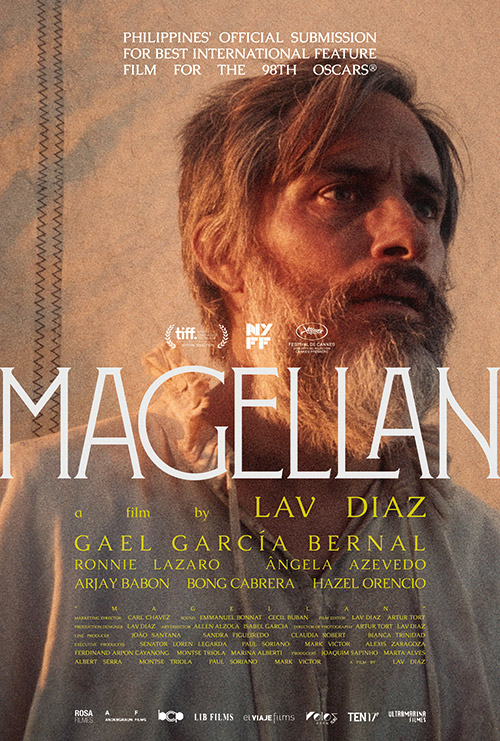
- Best International Feature: Lav Diaz’s Magellan
- Best Documentary: Baby Ruth Villarama’s Food Delivery
- Best Live-Action Short: Don Eblahan’s Vox Humana
This concerted effort underscores the government's recognition of the cultural and economic importance of a vibrant and globally connected domestic film industry. By combining production subsidies and aggressive campaign funding, Filipino stories now have additional funding sources to compete at the highest global levels.
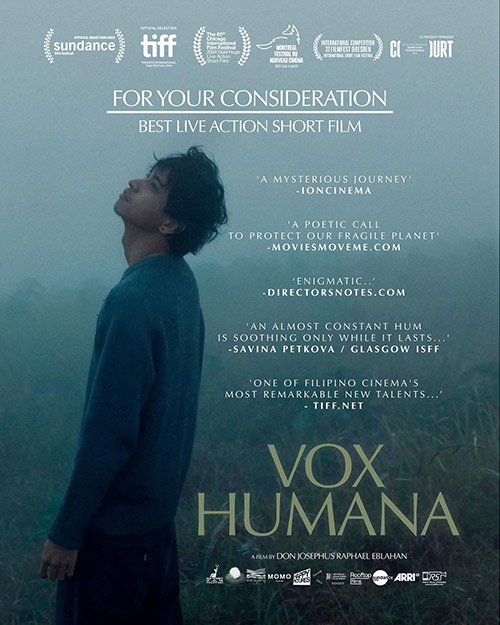
Vox Humana © Daluyong Studios
Conclusion
Despite a general prognosis of an industry "at a loss" (Wang, 2025), the close of 2025 reveals a landscape in the midst of a painful but necessary evolution. While figures like FDCP Chairman Jose Javier Reyes candidly acknowledge public fatigue toward repetitive tropes and production quality, the "staggering surge" of creativity in the short film and independent sectors suggests the problem is not a lack of vision, but of distribution.
The success of cultural exports like Sunshine, Food Delivery, and Some Nights I Feel Like Walking, alongside festival breakouts like Cinemartyrs and Sisa, proves that Filipino cinema remains a vital international force. More importantly, their local theatrical traction hints that domestic audiences are beginning to wean themselves off formulaic content in favor of more challenging narratives. As mainstream producers lean into fiscal conservatism, new funding lifelines and the designation of Quezon City as a UNESCO Creative City of Film offer a critical counter-balance.
Ultimately, the current struggle mirrors historical cycles of the 1950s and 70s—a period of transition rather than terminal decline. As FAP Director General Paolo Villaluna notes, “the industry is struggling, but it’s also evolving, and that does not mean death.” It is signaling not an end, but a transformation into a more resilient, globally integrated, creative industry.
Patti LAPUS
Producer
Patti Lapus, a Filipino producer and alumna of the University of the Philippines Film Institute, is the Co-Founder and CEO of Monsoon Projects Inc., a boutique film production company she established with filmmaker Dodo Dayao.
Her career began in 2016 as a freelance line producer, notably contributing to the Philippine casting for the Palme d’Or winner, Triangle of Sadness. She then served as COO and Head of Production at Epicmedia from 2020 to 2024.
Patti has a strong commitment to industry development and welfare. She is a founding member and former Co-Chairperson of Inter-Guild Alliance, which pioneered COVID protocols for the Philippine audiovisual industry. She also served as President of the New Asian Producers Network (Napnet) in 2025.
Academically, she is a graduate of programs such as NAFF Fantastic Film School, Full Circle Lab, and Busan Asian Film School’s International Film Business Academy, where she was awarded the Busan Film Commission Award. She is also a certified Intimacy Coordinator (IPA, Los Angeles) and a Film Industry Consultant for the Film Academy of the Philippines.
Her career began in 2016 as a freelance line producer, notably contributing to the Philippine casting for the Palme d’Or winner, Triangle of Sadness. She then served as COO and Head of Production at Epicmedia from 2020 to 2024.
Patti has a strong commitment to industry development and welfare. She is a founding member and former Co-Chairperson of Inter-Guild Alliance, which pioneered COVID protocols for the Philippine audiovisual industry. She also served as President of the New Asian Producers Network (Napnet) in 2025.
Academically, she is a graduate of programs such as NAFF Fantastic Film School, Full Circle Lab, and Busan Asian Film School’s International Film Business Academy, where she was awarded the Busan Film Commission Award. She is also a certified Intimacy Coordinator (IPA, Los Angeles) and a Film Industry Consultant for the Film Academy of the Philippines.
Dodo DAYAO
Writer, Director, Producer
Dodo Dayao is a filmmaker and screenwriter primarily known for his expertise in Philippine genre cinema. His debut feature, Violator (2014), and his second feature, Midnight in a Perfect World (2020), garnered international acclaim at festivals such as Karlovy Vary, Neuchâtel, and Fantasia. A prolific collaborator, Dodo has penned scripts for directors like Khavn, John Torres, and Dan Villegas (Cattleya Killer). His work is characterized by a haunting blend of horror, surrealism, and sharp sociopolitical undercurrents. He is currently in post-production for his short She’s Leaving home, and developing his third feature, Dear Wormwood.
Dodo is the Co-Founder and Chief Creative Officer of Monsoon Projects Inc., a boutique film production company he founded with producer Patti Lapus.
Dodo is the Co-Founder and Chief Creative Officer of Monsoon Projects Inc., a boutique film production company he founded with producer Patti Lapus.
Source
- FDCP – The Big Picture: Roadmap for the Future of the Film Industry of the Philippines
- Vitrina.ai – Top Film Distribution Companies in Philippines | 2026
- 2025 Present Confusion Year in Review - Philippine Cinema Favorites
- ABS-CBN – MMDA to discuss lowering movie ticket prices for MMFF 2026
- ABS-CBN – 2025 RECAP: Movies that made waves in PH cinemas this year
- Philstar – Netflix still leads Philippines market, but Prime Video closes in
- FDCP – FDCP OFFICIALLY OPENS APPLICATIONS FOR ISAPELIKULA
- Rolling Stone Philippines – In 2025, The State of Philippine Cinema is as Exciting as it is Confusing
- Philstar – ‘Sunshine’ among highest-rated Letterboxd films in 2025
- ABS-CBN – 2025 RECAP: Movies that made waves in PH cinemas this year
- Box Office Mojo –Philippines Box Office For 2025
Note:
- USD conversion based on USD 1 = PHP 60.01 (March 2026)
- Discrepancies may exist between chart data and report figures based on different statistical sources and calculation methods