Title
THE A REPORT
2025 H2
 Amarsanaa BATTULGA
Critic, Programmer, Researcher at Nanjing University
Amarsanaa BATTULGA
Critic, Programmer, Researcher at Nanjing University
Updated on 12 May 2026
Overview
The year 2025 marked the 90th anniversary of Mongolia’s film industry, which dates back to the establishment of both the Mongol Kino national studio and the People’s Cinema in 1935. A wide range of film festivals, academic conferences, filmmaking competitions, and other celebratory events took place to commemorate the milestone. Among the most notable highlights is the current administration’s designation of October 11 as the National Film Day, formalizing an annual occasion to celebrate Mongolia’s cinematic heritage.
Although it boasts a relatively long history, the Mongolian film industry continues to face persistent structural challenges. These include chronic funding shortages, the absence of clear and robust policy regulation, inadequate infrastructure, and the lack of skilled human resources.
At the same time, the exhibition sector has shown signs of resilience. Over the past two years, cinemas have completed their post-pandemic recovery, with theatrical admissions surpassing pre-pandemic levels. However, this recovery has coincided with a broader shift in distribution patterns. Streaming has become the dominant mode of consumption, with only an estimated 10 to 20 percent of local productions receiving theatrical releases, while the majority debut directly on IPTV and OTT platforms.
How H2 2025 releases have fared in cinemas is not clear yet as their admission numbers are incomplete at the time of writing. The website Kinosan.mn tracks admission numbers for local theatrical releases with a top 40 list. Their list, however, is not yet up to date. For example, the biographical drama Tatar is not displayed on the chart despite being one of the most successful films of the year.
Top 5 Imported Films in Mongolian Box Office (2025)
You can scroll left and right to view the content.
| No. | Title | Director | Country | Genre | Admissions | Production Company |
|---|---|---|---|---|---|---|
| 1 | Avatar: Fire and Ash | James Cameron | USA | Sci-Fi, Action | 206,998 | Lightstorm Entertainment, 20th Century Studios |
| 2 | Zootopia 2 | Jared Bush, Byron Howard | USA | Animation, Comedy | 154,222 | Walt Disney Animation Studios |
| 3 | Demon Slayer: Kimetsu no Yaiba - Infinity Castle | Haruo Sotozaki | Japan | Animation | 81,824 | Ufotable |
| 4 | A Minecraft Movie | Jared Hess | USA | Fantasy, Adventure, Comedy | 71,353 | Legendary Pictures, Mojang Studios, Vertigo Entertainment, On the Roam |
| 5 | Jurassic World: Rebirth | Gareth Edwards | USA | Action, Sci-Fi | 58,459 | Universal Pictures, Amblin Entertainment |
Top 5 Domestic Films in Mongolian Box Office (2025)
You can scroll left and right to view the content.
| No. | Title | Director | Country | Genre | Admissions | Production Company |
|---|---|---|---|---|---|---|
| 1 | In Da House 3 | Amartuvshin Tsolmon | Mongolia | Comedy, Crime, Action | 201,800 | SkyMedia |
| 2 | Hard Times (Tsuvuun Tsag) | Bat-Ulzii Osor, Tamir Bat-Ulzii | Mongolia | History, Drama | 161,038 | Fantastic Production |
| 3 | Lady (Busgui) | Bazarsad Lkhagva | Mongolia | Biography, Drama | 140,378 | Mongol Film Group |
| 4 | Tatar | Batdelger Byambasuren | Mongolia | Drama, Music, Biography | 108,862 | Aranjin Pictures, Tatar |
| 5 | Waiting Room (Huleeh Uruu) | Jargalsaikhan Batdorj | Mongolia | Drama, Romance | 106,583 | Hulegu Pictures, Favway |
Production Landscape
In 2025, Mongolia’s film industry saw the production and theatrical release of a total of 33 domestic feature films. While this number suggests a relatively steady level of output, the lack of transparent and comprehensive industry data continues to limit detailed analysis. Mongolian cinemas report attendance figures but do not disclose box office revenues, making a precise quantitative assessment of market performance difficult. To make matters worse, these numbers aren’t announced for the vast majority of titles, and no viewership data is announced by the IPTV and OTT platforms. Producers and filmmakers have no way of verifying how many tickets for their films are being sold or how many times they are being played on streaming platforms. Simply put, they have no choice but to accept the figures given to them by the exhibitors. While this may sound absurd, this arrangement has long been accepted in the industry.
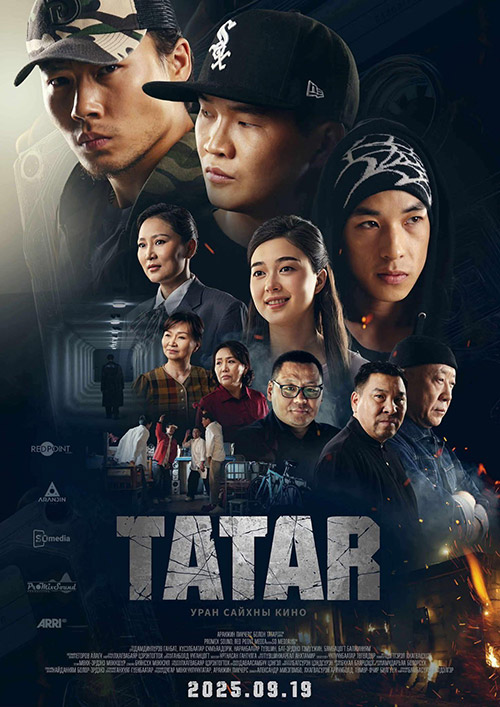
The most prominent success story of the second half of 2025 is Tatar, a biographical drama centered on a popular hip-hop group of the same name, which has emerged as one of the year’s standout hits. The film has had a total of 108,862 admissions across cinemas, currently ranking 15th on the all-time box office list. Other notable performers, whose total admissions numbers aren’t yet known, include Rule of Money or Mungunii Durem (11,282 admissions on opening weekend), Exit 3: The End or Garts 3: Tugsgul (11,067 admissions on opening weekend), Shalz (7,114 admissions on opening weekend), which is directed by Amarsaikhan Baljinnyam, who also stars as the protagonist. The success of these films displays a pattern in which films tied to established stars, directors, or existing fan bases tend to dominate the domestic box office.

The Muralist © Wonder People Production
Developments in the arthouse sector remain few but notable in H2 2025. One highlight is The Muralist, the latest project by Sengedorj Janchivdorj—known for his award-winning The Sales Girl (2021) and Silent City Driver (2024), the latter of which was Mongolia’s submission to the 98th Academy Awards for Best International Feature Film—continues its journey on the festival circuit following its premiere at the Tallinn Black Nights Film Festival where it won the NETPAC Award. However, such projects remain exceptions rather than indicators of a broader development in the arthouse domain.
The Mongolian National Film Council reports that there are 82 film studios and productions operating in 2025, with a total of 507 film workers. These include small independent studios focusing on documentaries and feature films, large companies producing commercial films and TV series, and IPTV studios whose productions are usually shown exclusively on their own platforms.
In 2024, the research report Overview on Current State of Mongolian Film Industry and the Film Specialists was published. It is the result of extensive mixed-method research conducted by the Institute of Social Research under the National University of Mongolia and was funded by UNESCO. According to the results of this research project, human resource development continues to be a critical concern in Mongolia’s film industry. Seven universities offer programs and courses in film-related creative practices. However, an estimated 70 percent of surveyed respondents expressed dissatisfaction with the current state of professional training. Key issues mentioned include inadequate technical facilities, limited access to modern film equipment, poorly equipped studio spaces, and the absence of standardized curricula. Moreover, industry practitioners frequently cite the lack of advanced post-production services, particularly in visual aspects, as a major bottleneck. As a result, many productions are compelled to outsource key stages of post-production to companies abroad, increasing costs and complicating production timelines.
Ultimately, the report concluded that in order to sustainably develop the film industry, it is necessary to expand the domestic market and increase the support of government policy.
Financing Models
Arguably, financing remains the most significant structural challenge for Mongolian filmmakers. In the same report mentioned above, “investment and financial support” was identified as the most problematic stage of the film production cycle, cited by approximately 59.7 percent of respondents.
In practice, Mongolian films are financed through a patchwork of sources. These include self-funding, studio funds, private investors, corporate sponsorship, and, at times, backing from politicians or political parties, reflecting the informal and often personalized nature of funding networks. International co-production partners also play an important role for select projects, particularly those aiming for festival circulation. In 2025, a notable development was the selection of Zoljargal Purevdash (director of If Only I Could Hibernate, the first Mongolian feature at Cannes) and Lkhagvadulam Purev-Ochir (director of City of Wind, the first Mongolian feature at Venice) for the “Next Masters Support Program,” an initiative that builds on the Talents Tokyo platform to support emerging Asian filmmakers. Their respective projects, Sane Mother and The Vision of Lonely Mountains, received development grants.
Policy support mechanisms, however, remain limited in both scope and effectiveness. The Business Entity/Corporate Income Tax Law includes a provision that allows companies to receive a one percent tax deduction for funding arts and cultural initiatives. While this measure is intended to incentivize private sector investment in film, its actual impact appears minimal at the moment, with little evidence to suggest that it has significantly expanded the funding pool available to filmmakers.
Public financing schemes likewise face practical obstacles. The loan program administered by the Mongolian National Film Council requires projects to have already secured at least 30 percent of their total budget before becoming eligible. In addition, these loans are distributed through commercial banks, meaning that applicants must satisfy standard banking requirements such as collateral. For many filmmakers—particularly independent producers—these conditions render the loans effectively inaccessible, limiting their practical usefulness and highlighting the need for policy reform that better reflects industry realities.
Distribution Climate
The distribution landscape in Mongolia remains highly concentrated. The market continues to be led by Bloomsbury Mongolia, a Korean-owned distributor handling the “Big Five” Hollywood studio titles (Warner Bros, Sony Pictures, Disney Pictures, Paramount, Universal Pictures), alongside Filmbridge, which focuses on releases from smaller Hollywood studios. Smaller players like Lotus Pictures distribute the occasional Korean and Chinese titles. Other companies, such as Digital Content LLC, have increasingly shifted their focus away from theatrical distribution toward IPTV and OTT platforms, following the trail of audience shifts for better profit.
This shift is mirrored on the exhibition side. According to industry estimates, only around 10 to 20 percent of domestic productions secure theatrical releases, while the majority premiere directly on digital platforms. As a result, theatrical screens are overwhelmingly dominated by foreign imports, particularly Hollywood blockbusters and Korean commercial films. Arthouse and independent international films have virtually no access to theatrical distribution in Mongolia. Instead, such titles are primarily introduced through film festivals, where organizers and programmers source films directly from international sales agents rather than relying on local distributors. There are four international film festivals: the Golden Ger International Film Festival in May for short films, the new government-run Kharkhorum International Film Festival in July, the Beyond the Blue Sky International Queer Film Festival in August, and the Ulaanbaatar International Film Festival, which is the largest and longest-running event that concluded its 17th edition last October.
There are still no local distributors for domestic films. Given the small market size and the current structure of the industry, production companies often manage their own distribution arrangements. At the same time, there is little evidence of vertical integration between production, distribution, and exhibition.
One emerging trend in 2025 is the growing practice of theatrical re-releases, including both older classics and relatively recent titles. Films such as F1: The Movie and Memories of Murder have returned to cinemas in response to audience demand. Notably, this demand is often gauged through social media engagement, with distributors and exhibitors using online surveys and polls to determine programming decisions. While still limited in scale, this development points to a more interactive and audience-responsive approach to distribution.
Theatrical Reach
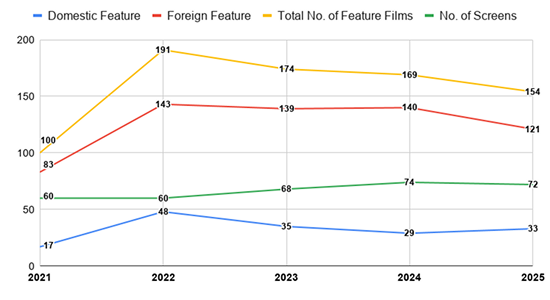
In 2025, a total of 154 feature films were released theatrically in Mongolia, of which 121 were foreign titles and 33 were domestic productions. Although there’s a huge imbalance between these numbers, the admissions figures indicate that local titles enjoy an even, if not more, market share than imported ones.
Figure of Theatrically Released Films & Screens (2021-2025)
The exhibition landscape underwent notable changes in the second half of 2025. Most significantly, the closure of Urgoo 2—as a result of a legal battle which exposed that Urgoo was paying as little as USD 2.2 per square meter to the government property that it rented—reduced screen capacity in central Ulaanbaatar and Urgoo 1&5 (a confusingly named single branch) introduced IMAX Laser projection, a first in the country. Currently, there are two IMAX screens in Mongolia, both owned by the largest exhibitor Urgoo. Following the incorporation of Soyombo and Gegeenten cinemas into its network in H1 2025, Tengis Cinema is estimated to have increased its market share from 18.8 percent to 26.7 percent.
As of December 2025, Mongolia had a total of 16 operating cinemas, 12 of which were located in Ulaanbaatar, highlighting the continued geographic concentration of theatrical infrastructure in the capital. Efforts to expand exhibitions beyond the city remain limited but ongoing. The opening of Urgoo 8 in Murun in 2024, realized in collaboration with the already existing Blue Pearl theater, represents one such attempt to extend theatrical access to regional audiences. Such initiatives to co-use one venue for two purposes (theater and cinema) are likely to proliferate in the countryside in the next few years, according to exhibition industry insiders.
Overall admissions reached approximately 1.6 million tickets sold in 2025, including around 1.3 million adult tickets and 314,000 children’s tickets, according to the Mongolian National Film Council. However, the reliability of these figures is subject to some uncertainty. Admission numbers are typically reported by film producers themselves (who receive these numbers from the cinemas, without any means to verify them), who voluntarily submit their data to the Cinema Management Association for public announcement on their Facebook page. While the Association conducts basic verification, it does not, and indeed cannot, independently audit the figures, raising ongoing concerns about standardization and accuracy in box office reporting. The cinemas also report their admissions numbers to the Film Council on a weekly basis (less often, in practice) but the latter also has no means of verifying these figures.
Figure of Cinema Chains, No. of Screens & Seats (2025)
You can scroll left and right to view the content.
| No. | Name | No. of Branches | No. of Screens | No. of Seats |
|---|---|---|---|---|
| 1 | Urgoo | 6 | 25 | 4156 |
| 2 | Prime Cineplex | 4 | 20 | 1870 |
| 3 | Tengis | 3 | 15 | 2601 |
| 4 | Hunnu Cinema | 1 | 4 | 976 |
| 5 | Cinema Next | 1 | 7 | 670 |
| 6 | Gobi Cinema | 1 | 1 | 98 |
Institutional Developments
The Mongolian National Film Council (MNFC) entered a new phase of its institutional development in 2025. Following the completion of the inaugural members’ three-year term, all eleven council positions were renewed, save for the council chairperson position of Undral Choimpog who has been appointed to lead the council for another term.
During its first three years, the MNFC primarily focused on introducing Mongolian film industry to international audiences and promoting Mongolia as a filming location for international productions. In its current term, the Council has begun to place greater emphasis on supporting the exhibition of local films for global audiences. This shift in strategic priorities is aimed at strengthening the country’s and its filmmakers’ global visibility. Towards this goal, the MNFC has organized the Mongolian Film Project Pitches on four occasions, held across Mongolia, France, and South Korea, with a total of 31 participating projects. These events aim to connect Mongolian filmmakers with international partners and funding opportunities. In parallel, the Council has hosted Mongolian Film Days twice, both domestically and in South Korea, showcasing a total of 13 films. More recently, the MNFC has increasingly oriented its activities toward regional collaboration within Asia. Efforts such as the organization of Mongolian Film Days in Busan, along with ongoing discussions with partners in Uzbekistan, the Philippines, and Indonesia, indicate a strategic pivot toward building stronger intra-Asian networks.
One of the Council’s most ambitious domestic initiatives is the development of a real-time box office data collection system. Designed to be integrated into cinema software nationwide, the system would allow for transparent tracking of both admissions and revenue figures—potentially resolving long-standing issues around data reliability. However, although completed, its implementation has encountered resistance. All the cinema chains have accepted to introduce the system except for Urgoo. Industry speculation suggests that concerns over financial transparency, including possible tax evasion implications, may be behind this refusal. If successfully implemented, the system would mark a significant improvement from the current practice of reporting admissions alone based on unverifiable data.
The MNFC has also taken steps toward strengthening regulatory frameworks. In 2025, it initiated the development of a standardized age classification system for theatrical releases, publishing a draft regulation, soliciting public feedback, and convening stakeholder discussions. In terms of international production, Mongolia continues to attract a modest number of foreign projects. In 2025, the MNFC granted 26 filming permits to international productions. Remarkably, none of these were for narrative feature films; only two were documentary projects, while the rest consisted of television programs and commercial advertising. This pattern points to underlying structural limitations, particularly the lack of comprehensive infrastructure and one-stop production services, that may be discouraging larger-scale feature film productions from choosing Mongolia as a filming destination.
Streaming Platforms and Digital Growth
The rapid expansion of streaming platforms has become one of the most defining shifts in Mongolia’s film and media landscape in recent years. Accelerated by the COVID-19 pandemic, IPTV and OTT services have increasingly competed with cinemas for audiences.
According to data from one major platform, a total of 148 new local titles were added to IPTV/OTT services in 2025. While not comprehensive—since it does not include exclusive releases on different platforms—this figure nonetheless proves telling of current trends. Of these titles, 125 were produced in 2025, indicating a high level of current production activity tailored specifically for digital release. Only seven titles originated as theatrical releases before transitioning to secondary markets, while the overwhelming majority—118 films—were produced as direct-to-OTT content. These numbers are particularly significant when contrasted with the total number of domestic theatrical releases in 2025 which was 33. In terms of genre distribution, comedy dominates with 62 titles (42 percent). Family and children’s content take up 24 percent with 35 titles, and a notable segment of adult-oriented erotic content comprises 15 percent with 22 titles. These patterns suggest a strong orientation toward easily consumable, high-demand genres suited to home viewing environments.
Several structural factors contribute to this shift toward digital-first production. Exhibitors, for their part, prioritize technical precision, emphasizing that “if there is a mistake in the film when it is released, the audience will never see it as a mistake of the cinematographer [but that of the cinema].” But hastily-made domestic productions don’t always meet the technical requirements of the cinemas. Also, filmmakers cite the non-standardized requirements set by each cinema as one reason for their preference towards streaming. But the biggest reason undoubtedly is a shift in audience consumption habits since the pandemic. As such, filmmakers and producers are seeing OTT as the main recoupment route. Although theatrical admissions have exceeded pre-pandemic numbers, streaming has become the mainstay with only about 10 to 20 percent of all local content theatrically released in cinemas.
International Co-Production
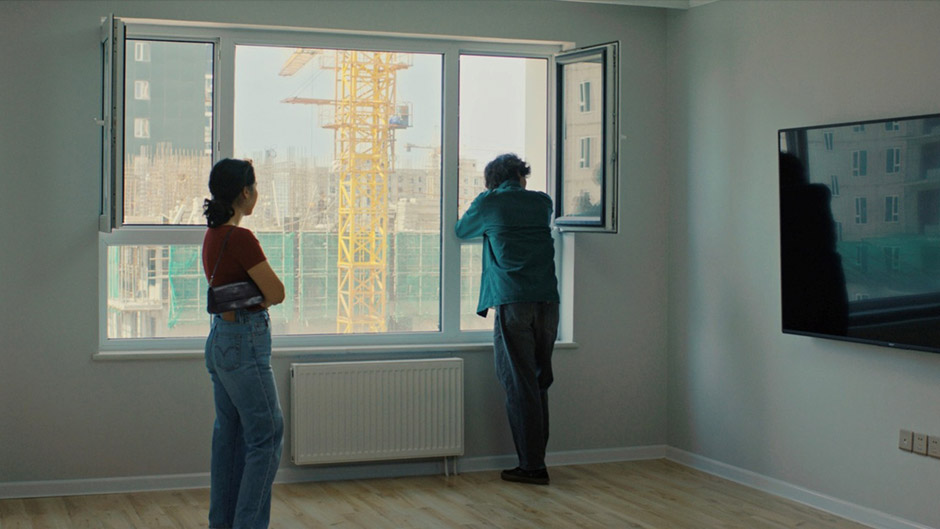
H2 2025 saw few projects that signaled engagement with the global film industry. The most prominent highlight is A South Facing Window, a short film developed through the International Film Camp in Macao by Lkhagvadulam Purev-Ochir, whose early international successes include Snow in September (2022) and City of Wind (2023), the film further consolidates her position as one of Mongolia’s most visible auteurs on the global stage. The Mongolian-French co-production premiered at the Locarno Film Festival, where it received two awards, and most recently won the Best Fiction Film prize at the Tampere Film Festival.
 A South Facing Window © Aurora Films, Guru Media
Despite the success of auteur-driven projects, such cases remain largely confined to the festival circuit and do not yet translate into a broader ecosystem of sustained international co-production. Collaboration on commercially oriented feature films remains limited and uneven. The most notable example from H2 2025 is 1242: Gateway to the West, a Hungarian–English–Australian–Mongolian co-production that reimagines the thirteenth-century Mongol invasion of Hungary. Billed as a large-scale historical epic, the film represents a rare attempt to integrate Mongolia into a multi-national commercial production framework. However, the project ultimately underperformed both critically and commercially in its primary markets, including Hungary and Mongolia.
Disclaimer: Due to various bureaucratic traditions, both private corporations and government institutions in Mongolia often do not directly interact with individuals, including researchers and journalists. This has been the single biggest hindrance in the researching and writing of a report such as this. Virtually all data and information in the present report were acquired through the writer’s personal contacts in various companies and government bodies. Hence, many of the sources have requested to remain anonymous. Even then, however, most declined to share significant data in fear of any potential troubles.
Amarsanaa BATTULGA
Critic, Programmer, Researcher at Nanjing University
Amarsanaa Battulga is a film critic and programmer from Mongolia. His writing has appeared in publications such as Die Welt, Cineuropa, photogénie, and Documentary, among others. He has served on juries at festivals in Locarno, Hong Kong, Singapore, and Ulaanbaatar, and is a FIPRESCI member, Berlinale Talent Press alumnus, and voter for the 83rd Annual Golden Globes.