Title
THE A REPORT
2025 H2
 Kalash Nanda KUMAR
Critic, Journalist
Kalash Nanda KUMAR
Critic, Journalist
Updated on 12 May 2026
Overview
Malaysia’s film industry in the second half of 2025 reflects a paradox of renewed local box office strength alongside structural fragility in theatrical exhibition. Domestic films have staged a remarkable resurgence, culminating in a total local box office of MYR 252.77 million (USD 62.37 million) for 2025, the highest returns on record1, surpassing the previous benchmark in 2022 at MYR 196 million2 (USD 48.36 million). Titles such as Papa Zola The Movie (MYR 63.88 million, USD 15.76 million) and Malam Terlarang (MYR 12.2 million, USD 3.01 million) released late 2025 were a shot in the arm for the industry and demonstrated sustained audience appetite for local IP, particularly franchise-driven and family-oriented drama. Combined with earlier successes like Blood Brothers: Bara Naga (MYR 73.64 million, USD 18.17 million) and Ejen Ali The Movie 2 (MYR 58.4 million, USD 14.41 million), 2025 marks the strongest year for Malaysian cinema on record.
However, this growth is highly concentrated. A small number of tentpole productions account for a disproportionate share of revenue, while the majority of releases struggle to cross MYR 1 million (USD 0.247 million), suffering losses. At the same time, streaming platforms continue to reshape consumption patterns, fragmenting audiences3 and compressing theatrical windows. There is growing confidence amongst producers that domestic movies are able to compete with Hollywood blockbusters, even on opening weekends. If policy gaps within the industry are addressed and financing schemes continue to improve, it could mark a revitalization of the industry, which was beleaguered by the pandemic and political instability.
 Still image from Papa Zola, Malaysia’s highest grossing animated movie ever.
 © Astro Shaw
Top 10 Foreign Films in Malaysia Box Office (2025)
You can scroll left and right to view the content.
| No. | Title | Director | Country | Genre | Gross (MYR) |
Gross (USD) |
Production Company | Distribution Company |
|---|---|---|---|---|---|---|---|---|
| 1 | Ne Zha 2 | Jiaozi | China | Animation | 59.27M | 14.62M | Enlight Media, Chengdu Coco Cartoon, Beijing Coloroom Technology | Encore Films |
| 2 | Avatar: Fire and Ash | James Cameron | USA | Sci-Fi | 47.55M | 11.73M | Lightstorm Entertainment, TSG Entertainment | Walt Disney Pictures |
| 3 | Zootopia 2 | Jared Bush, Byron Howard | USA | Animation | 38.60M | 9.52M | Walt Disney Animation Studios | Walt Disney Pictures |
| 4 | Jurassic World: Rebirth | Gareth Edwards | USA | Action | 37.52M | 9.26M | Universal Pictures, Amblin Entertainment, The Kennedy/Marshall Company | Universal Pictures International |
| 5 | Demon Slayer: Kimetsu no Yaiba - Infinity Castle | Haruo Sotozaki | Japan | Animation | 31.49M | 7.77M | ufotable, Aniplex, Shueisha | Sony Pictures Releasing |
| 6 | Mission: Impossible – The Final Reckoning | Christopher McQuarrie | USA | Action | 24.64M | 6.08M | Paramount Pictures, Skydance Media, TC Productions | Paramount Pictures |
| 7 | How to Train Your Dragon | Dean DeBlois | USA | Action, Adventure | 17.17M | 4.24M | DreamWorks Animation, Marc Platt Productions | Universal Pictures International |
| 8 | Thunderbolts* | Jake Schreier | USA | Superhero, Action | 15.79M | 3.90M | Marvel Studios | Walt Disney Pictures |
| 9 | The Fantastic Four: First Steps | Matt Shakman | USA | Superhero, Action | 14.50M | 3.58M | Marvel Studios | Walt Disney Pictures |
| 10 | Lilo & Stitch | Dean Fleischer Camp | USA | Family | 13.91M | 3.43M | Walt Disney Pictures, Rideback | Walt Disney Pictures |
Source: Box Office Mojo
Top 10 Domestic Films In Malaysia Box Office (2025)
You can scroll left and right to view the content.
| No. | Title | Director | Country | Genre | Gross (MYR) |
Gross (USD) |
Production Company | Distribution Company |
|---|---|---|---|---|---|---|---|---|
| 1 | Blood Brothers: Bara Naga | Abhilash Chandra, Syafiq Yusof | Malaysia | Action | 73.64M | 18.17M | Skop Productions | Skop Productions |
| 2 | Papa Zola The Movie | Nizam Razak | Malaysia | Animation | 63.88M | 15.76M | Monsta | Monsta Studios |
| 3 | Ejen Ali The Movie 2 | Usamah Zaid | Malaysia | Animation | 58.40M | 14.41M | WAU Animation, Primeworks Studios, Komet Productions | WAU Animation, Primeworks Studios, Komet Productions |
| 4 | Malam Terlarang | Nurhanisham Muhammad | Malaysia | Horror | 12.20M | 3.01M | Astro Shaw | Astro Shaw |
| 5 | Money Games | Lai Kin Hoong | Malaysia | Comedy | 9.45M | 2.33M | JS Pictures | Elepfilm Entertainment |
| 6 | Gayong | Faisal Ishak | Malaysia | Historical Fiction | 4.11M | 1.01M | SOL Pictures | Sol Pictures |
| 7 | Keluang Man | Anwari Ashraf | Malaysia | Superhero, Action | 3.88M | 0.96M | Pasal Productions | Astro Shaw |
| 8 | Soloz: Game of Life | Syafiq Yusof | Malaysia | Biography | 3.26M | 0.80M | FrameMotion Studio, Skop Productions | Key Billions |
| 9 | White | Jerr Ps Rion | Malaysia | Horror | 2.53M | 0.62M | FBe Film Production | FBe Entertainment |
| 10 | OMG! Mom’s Big News | Ernest Chong | Malaysia | Family, Drama | 2.41M | 0.59M | Mega Films Distribution | One Etc Pictures |
Source: FINAS
Production Landscape
Malaysia saw the release of 71 domestic films in 2025, reflecting a stable output compared to recent years. However, volume masks an increasingly polarized ecosystem. On one end, large-scale productions are growing in ambition. Budgets for major titles now routinely exceed MYR 8–10 million (USD 1.97–2.47 million), with studios such as Skop Productions, Astro Shaw, and Primeworks Studios driving this expansion. These films are increasingly positioned as “event cinema4,” backed by aggressive marketing and wide theatrical releases.
On the other end of the spectrum, a significant number of films operate with more modest budgets, often lacking the resources for sustained marketing campaigns to encourage longer theatrical runs5. FINAS data shows that a majority of titles in 2025 earned below MYR 1 million (USD 0.247 million), highlighting fundamental weakness in capturing mass appeal.
Genre trends in 2025 reaffirm audience preferences: Action and franchise films dominate the box office, animation continue to show strong cross-demographic appeal, while horror, traditionally a reliable genre, has softened compared to previous years. Infrastructure remains concentrated in Klang Valley, with limited production decentralization in other major cities like Penang, Johor and Sabah6. While Malaysia continues to position itself as a regional production hub through incentives like FIMI, competition from Thailand, Indonesia, and Vietnam is intensifying7.
Number of Domestic Malaysian Films Released (2017-2025)
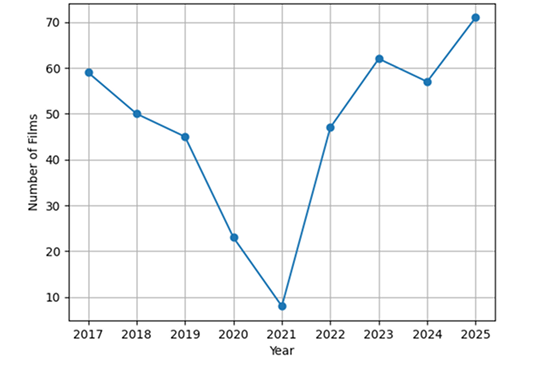
Graph: Number of domestic movies released from 2017 to 2025, based on data from FINAS.
Financing Models
Overall, financing in 2025 has leaned more bullish than cautious. The runaway success of Blood Brothers, Papa Zola, the Polis Evo franchise and other local titles has given producers confidence that Malaysian blockbusters could take on foreign titles. Building on my previous report 8, film financing in Malaysia follows a combination of state support, studio-led investments, private equity and funding from boutique media or production companies. A major source of support comes from Malaysia’s national film agency, FINAS, which offers grants and soft loans. Public funding through FINAS, particularly the Creative Content Fund (DKK) and Film in Malaysia Incentive (FIMI), continues to anchor the industry. In a politically and culturally sensitive climate like Malaysia, getting your production supported by FINAS signals confidence to private investors, studios and distributors. The agency’s flagship initiative also includes the ‘Film in Malaysia Incentive’ (FIMI) which offers tax incentives and cash rebates upwards of 35% of total production expenditure to encourage international projects into the country. Since its inception in 2013, a total of 128 productions have been supported (76 local; 52 international) with the incentive seeing returns upwards of MYR 2.3 billion (USD 567.48 million) to the local economy9. Notable previous projects include Crazy Rich Asians, Michael Mann’s Blackhat and Marco Polo.
However, fluctuating political priorities have affected the allocation of funds earmarked towards this incentive. Furthermore, the reduction of FIMI allocation 10 to MYR 40 million (USD 9.87 million) in 2025 (down from MYR 90 million in 2024) has raised concerns about long-term competitiveness. For major international productions looking to shoot in Malaysia, this is a drop in the bucket, and would mean only a few become successful beneficiaries. To protect the integrity of the fund, producers are only able to claim the rebate after the production is completed, but uncertainties around its disbursement creates anxiety and a lack of confidence. Producers and filmmakers are urging the government to expand the incentive, lest Malaysia loses its edge to its Southeast Asian neighbors.
Private sector participation is evolving. A relatively new player in the film financing scene is Golden Screen Cinemas (GSC). GSC has expanded into co-production, financing mid-to-large scale films (MYR 8–20 million budgets) on profit-sharing models11. This vertical integration spanning production, distribution, and exhibition is further cementing the company’s profile in the country while reshaping market dynamics. Encouragingly, 2025 saw increased risk appetite: Blood Brothers (~MYR 7 million budget), Ejen Ali 2 (~MYR 10 million), Keluang Man (~MYR 10.6 million). However, not all investments paid off. Keluang Man underperformed significantly, illustrating the volatility of high-budget local productions. Alternative financing avenues remain limited. Crowdfunding is still nascent, with only a handful of successful cases historically. Independent filmmakers continue to rely heavily on international co-production funds, film festival grants and government rebates.
Distribution Climate
Among its neighbors in Southeast Asia, Malaysia is unique in that its audiences are fragmented across ethnic and racial lines due inherited colonial policies. Malay-language titles dominate collections, reflecting the country’s ethnic population size, while Chinese and Tamil language titles remain as outliers12. However, in 2025, three Chinese domestic titles held a spot in top ten returns: Lai Kin Hoong’s Money Games (MYR 9.45 million), which featured popular Hong Kong actors Eric Tsang, Bobby Au-yeung and Edmond So, JeRR Ps Rion’s White, and Ernest Chong’s OMG! Mom’s Big News while Ne Zha 2 from China topped the international box office returns13, surpassing James Cameron’s Avatar, and Jurassic World14.
This might be a premature assumption, but the shorter theatrical window for Hollywood titles might be favoring domestic titles as accessibility to them is much harder and rarer on streaming platforms15. Major studios like Skop Productions, Astro Shaw, Primeworks Studios and Wau Animation including cinema chains like GSC are investing heavily to build on this momentum. Whether foreign or local, action films continue to be the populist choice, though surprisingly, horror titles which have been a staple, are not commanding audiences as it was in preceding years.
 Still image from breakout horror hit Malam Terlarang, which grossed MYR 12 million.
 © Astro Shaw
Theatrical Reach
Despite cinemas fully reopening and content pipelines back to full throttle, long-term trend suggests a contraction of audiences. Due to limited data around the industry, this is by no means a comprehensive extrapolation. The decline of Hollywood box office returns in Malaysia does not indicate complete audience disappearance, but could also reflect shifting preferences to domestic and Asian movies. Industry sentiment remains cautiously optimistic. Producers are scaling up budgets and ambitions, but persistent challenges such as financing gaps, policy inconsistencies, and exhibition bottlenecks continue to define the landscape.
The three major cinema chains in Malaysia are GSC, TGV Cinemas, and MMCineplexes, followed by Lotus Five Star and MBO cinemas. In 2020, during the pandemic, MBO - the third largest chain at the time, suffered severe losses and announced liquidation16. Subsequently, a majority of its assets were acquired by GSC17, and as a result, commanded 51% of the theatrical market share with 52 venues across Malaysia18. MBO was subsequently relaunched with new investors onboard.
GSC continues to dominate, controlling over half of the market following its acquisition of MBO assets. PPB Group, which owns GSC, has been taking aggressive measures towards becoming a more active player in its film exhibition and distribution business. Rising ticket prices and ‘expansion’ of the theatrical experience through IMAX screens, 4DX, boutique outlets, diverse programming, et al., indicates the struggle cinemas are facing to gain pre-pandemic era footfalls. To supplement the ‘drought’ period between Hollywood tentpoles, GSC has been acquiring titles from China, Singapore, India and Indonesia. The company announced that it plans to invest MYR 327 million (USD 80.68 million) over the next five years towards its film distribution segment. In 2024, it distributed 72 films, securing 14% market share. It remains the largest local distributor of Asian, independent English and international films in Malaysia. Distributors like GSC and Astro Shaw have significant influence over market dynamics having an established pipeline from production (co-financing major tentpoles) to exhibition.
Despite strong local box office performance, overall theatrical health remains constrained. Geographically, cinema access remains urban-centric, with Malaysia’s capital, Kuala Lumpur accounting for the majority of revenue. A key structural issue persists: extreme box office concentration. In 2025, the top five local films alone (out of 71) contributed to the majority of domestic revenue. Most films saw limited runs and rapid drop-offs. This imbalance poses long-term risks to industry sustainability.
 Chinese animated movie Ne Zha 2 topped Malaysia's overall box office in 2025.
 © Enlight Media
Technology & Production Services
Recent box office successes of Papa Zola, Blood Brothers and Malam Terlarang coupled with the critical independent darling the likes of Tiger Stripes and Abang Adik are testament to the highly-skilled talent available in the country. Often overlooked are the capabilities of local stunt crews for action choreography and coordination. Teams such as Defenderz (also known as the Malaysia Action Team) have demonstrated a high level of sophistication in designing and executing complex sequences. Their work on Blood Brothers highlights an ability to stage large-scale, kinetic action within tight production timelines and limited budgets. As tentpole action movies continue to dominate audience preferences, building this skill gap is crucial.
In animation, Malaysia has emerged as a regional powerhouse. Studios like Wau Animation and Monsta have achieved both commercial success and international visibility. Wau Animation’s Ejen Ali: The Movie and its sequel, as well as Monsta’s BoBoiBoy Movie 2, demonstrate strong technical pipelines in CGI and franchise development. These studios have also built scalable production ecosystems, including merchandising and transmedia expansion, positioning Malaysian animation competitively within Southeast Asia.
Streaming Platforms & Digital Growth
Streaming has become one of the most competitive and rapidly evolving parts of Malaysia’s content landscape. The market in 2025 is saturated, from Netflix to Disney+ Hotstar, Prime Video, Apple TV+, Max, Viu and finally, iflix—each of them positioning in unique ways to stand out in this crowded field to domestic audiences. For local studios, developing streaming-first content has become both a way to diversify revenue and a strategic response to the instability from Hollywood, and as a means to celebrate Malaysian IP.
Astro’s sooka has emerged as Malaysia’s fastest-growing OTT platform, with 1.2 million monthly active users and a doubling paying base in FY25, offering a hybrid of live sports and Astro Originals. Astro has positioned itself as the “home of Malaysian storytelling”: betting big on its Keluang Man Cinematic Universe to establish Malaysia’s first large-scale superhero IP, with both theatrical and streaming tie-ins. However, it remains to be seen whether the significant losses from its debut entry, Keluang Man, which grossed only MYR 3.88 million (USD 0.96 million) against a MYR 10.6 million (USD 2.62 million) budget, will force a shift in strategy. However, CEO Euan Daryl Smith insists “our edge is local”: 82% of Astro’s viewing time now comes from Malaysian and vernacular content, supported by 10,000 hours of fresh programming annually19.
At the same time, Chinese streaming giant iQIYI (dubbed the “Netflix of Asia”) has expanded aggressively into Malaysia. With over 120 million global subscribers and 500 million monthly active users, iQIYI has invested in local originals and partnerships with creators such as MIG Productions and Infinitus. Its first Malay-language hit Rampas Cintaku drew more than 100 million views globally, and the platform has announced more than a dozen Malay-language series20.
Despite challenges and uncertainties, the content frenzy indicates that there is a lot to be optimistic about. Looking ahead to 2026, the industry is expected to stabilize further and recover in admissions. For cinema chains, diversifying their content and programming slate might just be the solution as Hollywood movies continue to underperform, as GSC noted in their annual report. However, for local producers, rising production costs, a lack of reliable financing infrastructure, and market saturation from Hollywood and regional imports remain major obstacles. For emerging filmmakers, opportunities lie in co-productions with international partners and the export of Malaysian IP into streaming ecosystems.
- Note: All conversions are based on the exchange rate as of December 31 (MYR 4.0530/USD)
Interview
with Abhilash CHANDRA, Writer, Co-Director and Co-Producer of Blood Brothers: Bara Naga

With Blood Brothers: Bara Naga, director Abhilash Chandra has made his debut into the industry in the loudest possible way. Released nationwide in April 2025, it became a breakout commercial success topping the annual domestic box office chart, collecting MYR 73.64 million (USD 18.17 million), and spawning a major new franchise. In this interview, Abhilash shares his start into the industry, his process co-directing with Syafiq Yusof, and the precarity of distribution with the advent of streaming and VOD.
Q. Can you talk to me about how you ended up co-directing and co-producing Blood Brothers?
A.I was working in Astro under Black Flag, the production house behind Polis Evo. When I was there, I worked on Polis Evo, which I co-wrote and Syafiq was the director. That was my connection with Syafiq. We got close then, experimenting with the stunt team and trying things with action. There are a few action scenes that are reminiscent of the style of fighting in Blood Brothers. After that, I finished The Experts and was doing my own thing. I was working on a Greenpeace PSA project. It was a two-minute monster movie about the haze, very small but we had a lot of freedom from Greenpeace and tried to maximize the production value. A few weeks later, Syafiq saw it while he was working on Sheriff. He really liked it and called me, saying maybe we should work on something together. From there, I pitched a few concepts. This was around 2023, right after Polis Evo 3. We zeroed in on one project about bodyguards, and from there it developed into Blood Brothers.
Q. What was it like co-directing and co-producing with Syafiq Yusof, who is already an established director? How was the labour and responsibility shared?
A.Most of the time it’s about communication and alignment. There’s 100 ways to skin a cat. The most important thing is understanding the intention of the scenes. He doesn’t come in with that air of “I’m Syafiq, I’ve done all these films.” Otherwise what’s the point? He’s extremely collaborative and open. If I don’t understand a choice right away, I let him try it and then if he sees that I want to try something. He gives me the space. Especially during crunch time, because time is money. But most importantly, we are aligned on the direction of the story. We go through every scene, every page together. During prep, we had weekly alignment, these are the decisions I made - do you agree, do you have other thoughts, and then we realign again. It’s constant communication, constant discussion and getting into each other's heads and really understanding why we're making certain choices.
Q. Can I verify—is the budget of the film six million?
A.It’s seven actually. Seven million, including marketing. Six is probably production only. With post and marketing, it came to seven.
Q. Given the scale and ambition, what were the biggest challenges?
A.It’s always about the reality of the shoot days you can afford. The ambition is always there, but the hurdle is how much you can actually do. Originally, it needed to finish production in about 40-plus days, which didn’t make sense because it’s a new film, not an established franchise. Very quickly, we realized that’s not going to work. We wouldn’t get the quality of action we needed. We had to accept that we needed more days, otherwise we would compromise on choreography and performance because we're pushing the actors to a certain level that they can't perform. I’ve got to give it to Skop (production company)—they are a family of filmmakers first. They understood. So it was set at 45 to 48 days. If I was talking to accountants, it would be very hard to explain why you need those extra days. You can’t quantify quality. They’ll say you still get the scene, but it’s very different. I believe that difference is what takes a film from 50 million to 70 million. Polis Evo 3 made 50 million, Blood Brothers made 78 million1. Those additional days made the difference. But it’s not that simple, you need to know what you’re doing, and have a team that knows what they’re doing.
Q. Were you expecting the film to make the kind of returns it did?
A.No. I've been doing this for a bit. The first film that I made under a production house, there were high expectations that came with that film, but the movie didn't meet the mark. So early on, I learned about not setting expectations too high and unrealistic. You just do the work and be sincere about what you're trying to make and stick to your craft. It’s like raising a child. You give it everything, and hopefully the world accepts the child.
Q. What factors do you think contributed to its success?
A.There is comfort in Syafiq (Yusof)’s name, and we have established actors and Skop as a brand. But that only accounts for maybe five to ten percent of the audience. That helps for the first two days. After that, the film needs legs. For me, it’s the script and the execution. A good marketing plan, backed by strong distribution. It was released in 170 cinemas (nationwide). We set out to make a family-oriented action film. It’s about mafia and gangsters, but really it’s about family. There’s humor. We created Jackie to balance the tone. Otherwise it would just be men being angry all the time. The idea was to show we can make something more special if we put our minds to it. The most important thing is rewatchability. The fast pace made people want to come back and experience it again. All of that was planned. The names and brands help for the first two days. After that, the story needs to hold, and the action needs to hold.
Q. How would you describe Malaysia’s production infrastructure? Do you think we are able to produce more tentpole films like Blood Brothers?
A.There’s definitely opportunity. Adrian (Teh) just released Magic Rompak. Zahir (Omar) made a Constantine-like film called Mikhail. There’s also a Tamil remake of Kaithi called Banduan. There are production companies trying things and pushing the envelope. We’re at a time where people are experimenting. There’s room for more action films, as long as investors see returns. If local films can compete with Hollywood, demand will create supply. I hope people keep trying.
- 1 The director cites a total gross of MYR 78 million, which likely includes international and digital revenues, while this report reflects verified domestic box office data from FINAS for consistency.
Kalash Nanda KUMAR
Critic, Journalist
Kalash Nanda Kumar is a Malaysian journalist and critic whose work spans culture, environment, and current affairs. He has participated in numerous regional and international film festivals, serving as a juror, programmer, and facilitator. Kalash is a member of FIPRESCI, NETPAC and PEN Malaysia.
BIBLIOGRAPHY
- 1 “2025 Marks Historic High for Local Box Office, Says FINAS.” The Star Malaysia. December 30, 2025.
https://www.thestar.com.my/lifestyle/entertainment/2025/12/30/2025-marks-historic-high-for-local-box-office-says-finas - 2 FINAS. “Malaysian Box Office.” Accessed April 29, 2026.
https://www.finas.gov.my/en/malaysian-box-office/ - 3 Nielsen. “What Is Media Fragmentation? Reaching Audiences.” 2025.
https://www.nielsen.com/insights/2025/what-is-media-fragmentation-reaching-audiences/ - 4 “India’s Bollywood Bets Big on Event Cinema.” Malay Mail. January 26, 2026.
https://www.malaymail.com/news/showbiz/2026/01/26/indias-bollywood-bets-big-on-event-cinema/206754 - 5 “Local Film ‘Gantung’ No Longer Screening in GSC After One Weekend.” The Rakyat Post. June 12, 2025.
https://www.therakyatpost.com/news/malaysia/2025/06/12/local-film-gantung-no-longer-screening-in-gsc-after-one-weekend-malaysians-cry-wajib-tayang-but-what-is-it/ - 6 “Unlocking Sabah’s Creative Economy Potential.” The Borneo Post. December 28, 2025.
https://www.theborneopost.com/2025/12/28/unlocking-sabahs-creative-economy-potential/ - 7 “Malaysia Strengthens Position As Regional Filming Hub Through FIMI.” BERNAMA.
https://bernama.com/en/news.php?id=2434619 - 8 Kumar, Kalash Nanda. “A Report.” Asian Film Commissions Network. 2025.
https://www.acfm.kr/eng/addon/10000001/page.asp?page_num=4113 - 9 Idris, A. Azim. “Film Industry Leaders Decry RM40 mil Budget Allocation as Inadequate.” Scoop. 2024.
https://www.scoop.my/news/236483/film-industry-leaders-decry-rm40-mil-budget-allocation-as-inadequate - 10 Idris, A. Azim. “Film Industry Leaders Decry RM40 mil Budget Allocation as Inadequate.” Scoop. 2024.
https://www.scoop.my/news/236483/film-industry-leaders-decry-rm40-mil-budget-allocation-as-inadequate - 11 Basri, Shahrill. “PPB Group's GSC Expects Tough Year Ahead, to Focus on Local, Regional Movies.” The Edge Malaysia. March 5, 2024.
https://theedgemalaysia.com/node/703466 - 12 Department of Statistics Malaysia. Population Estimates 2025. 2025.
https://storage.dosm.gov.my/demography/population_2025.pdf - 13 “China Film Market News.” ECNS. March 22, 2025.
https://www.ecns.cn/news/culture/2025-03-22/detail-ihepukce6685664.shtml - 14 Box Office Mojo. “Malaysia Yearly Box Office 2025.” 2025.
https://www.boxofficemojo.com/year/2025/?area=MY&grossesOption=totalGrosses&sort=gross - 15 “Netflix Expects Shorter Theatrical Windows.” IGN. 2025.
https://www.ign.com/articles/netflix-will-launch-every-warner-bros-movie-currently-planned-for-theaters-as-intended-but-expects-shorter-windows-before-streaming-in-future-to-meet-the-audience-where-they-are-quicker - 16 Zainul, Emir. “MBO Cinemas Faces Liquidation on Virus Woes.” The Edge Malaysia. October 16, 2020.
https://theedgemalaysia.com/article/mbo-cinemas-faces-liquidation-virus-woes - 17 Aziz, Adam. “GSC Buys Majority of MBO Cinema Assets.” The Edge Malaysia. March 2, 2021.
https://theedgemalaysia.com/article/gsc-buys-majority-mbo-cinema-assets - 18 PPB Group Berhad. Annual Report 2024. March 26, 2025.
https://www.ppbgroup.com/images/pages/investor-relations/annual_report/2024/ppb-annual-report-2024.pdf - 19 Astro Malaysia Holdings. “Astro Caps Off FY25 with Content Triumphs, Quarterly Adex Rebound, and Streaming Momentum.” Press release, March 25, 2025.
https://corporate.astro.com.my/mediaroom-releases/astro-caps-off-fy25-with-content-triumphs-quarterly-adex-rebound-and-streaming-momentum - 20 Navalan, S. “Streaming Giant iQIYI, Known as Netflix of Asia, Has Big Plans for Southeast Asia.” The Star Malaysia. October 17, 2024.
https://www.thestar.com.my/aseanplus/aseanplus-news/2024/10/17/streaming-giant-iqiyi-known-as-netflix-of-asia-have-big-plans-for-the-entertainment-industry-in-south-east-asia