Title
THE A REPORT
2025 H2
 Tanveer HOSSAIN
Producer, Writer
Tanveer HOSSAIN
Producer, Writer
 Raka Noshin NOWER
Producer, Director, Writer
Raka Noshin NOWER
Producer, Director, Writer
Updated on 2 June 2026
(**) Data updated after release.
Overview
Cinema in Bangladesh: Recovery, Recognition, and the Road Ahead
The second half of 2025 marked a transition from holiday-driven spectacle to cautious stabilization in Bangladesh’s film industry. While H1 was dominated by large commercial hits, H2 leaned toward diversified storytelling and strategic consolidation. Urban multiplexes continued to perform steadily, but rural single-screen cinemas declined further, deepening the structural imbalance in exhibition. At leading chains such as Star Cineplex, Hollywood titles accounted for major box office revenue, underscoring the concentration of earnings around imported blockbusters.
Independent and regional productions gained visibility. Among the notable films, Saba (dir. Maksud Hossain, APM 2022, World Premiere TIFF 2024) completed an international festival circuit before its domestic release in September and later streamed on OTT Hoichoi, and Delupi (dir. Touqir Islam) staged its world premiere in a village field with its non-professional cast before expanding nationwide in November, signaling new community-centered release models. Production milestones also defined H2: the most awaited film, Roid, by Mejbaur Rahman Sumon completed shooting, while Master, an international co-production by Rezwan Shahriar Sumit, advanced through post-production. Besides, after Ali’s success, a wave of short films came out during H2 with international recognition.
Economically, digital expansion drove growth. Chorki reportedly reached 30 million subscribers, increasingly securing pre-licensing deals prior to theatrical release. However, the absence of centralized e-ticketing and transparent box office reporting continued to constrain mid-budget films. Although government grants supported 12 full-length and 20 short films, industry stakeholders maintained calls for a Film Reform Commission. Overall sentiment in H2 was cautiously optimistic: creative output expanded and international presence strengthened, yet sustainable growth remains tied to systemic financing and distribution reform.


Scene from Delupi | Photo Courtesy: Tanveer Hossain
Top 10 Films in Bangladesh Box Office (H2 2025)
You can scroll left and right to view the content.
| No. | Title | Director | Country | Genre | Gross (BDT) |
Gross (USD) |
Production Company |
Distribution Company |
|---|---|---|---|---|---|---|---|---|
| 1 | The Conjuring- Last Rites | Michael Chaves | USA | Horror | 45M | 368K | New Line Cinema, Atomic Monster, The Safran Company | Warner Bros. Pictures |
| 2 | Demon Slayer: Kimetsu no Yaiba - Infinity Castle | Haruo Sotozaki | Japan | Animation | 43.1M | 351K | Ufotable | Toho, Aniplex, Sony Pictures Releasing via Crunchyroll |
| 3 | Superman | James Gunn | USA | Action, Adventure, Superhero | 31.3M | 255K | DC Studios, Troll Court Entertainment, The Safran Company | Warner Bros. Pictures |
| 4 | One Battle After Another | Paul Thomas Anderson | USA | Action, Comedy, Thriller | 10.8M | 89.0K | Searchlight Pictures, Ghoul Productions | Warner Bros. Pictures |
| 5 | Weapons | Zach Cregger | USA | Horror | 10.5M | 86.0K | New Line Cinema, Vertigo Entertainment | Warner Bros. Pictures |
| 6 | Delupi | Mohammad Touqir Islam | Bangladesh | Fictional-Reality drama | 3M | 24.5K | Footprint Film Production. | Footprint Film Production. |
| 7 | Saba | Maksud Hossain | Bangladesh | Social Realism | 3M | 24.5K | Fusion Pictures, Mogador Film | Fusion Pictures |
| 8 | Mon Je Bojhena | Ayesha Siddiqua | Bangladesh | Romantic Drama | 1M | 8.1K | Impress Telefilm Ltd. | Impress Telefilm Ltd. |
| 9 | Barir Naam Shahana | Lessa Gazi | Bangladesh | Drama | 0.65M | 5.3K | Komola Collective, Goopy Bagha Productions Limited. | Cineplex |
| 10 | Fereshteh | Morteza Atashzamzam | Iran-Bangladesh | Social Drama | 0.60M | 5.0K | Sumon Faruque | Cineplex |
Top 7 Domestic Films in Bangladesh Box Office (H2 2025)
You can scroll left and right to view the content.
| No. | Title | Director | Country | Genre | Gross (BDT) |
Gross (USD) |
Production Company |
Distribution Company |
|---|---|---|---|---|---|---|---|---|
| 1 | Delupi | Touqir Islam | Bangladesh | Fictional-Reality drama | 3.0M | 24.5K | Footprint Film Production. | Footprint Film Production. |
| 2 | Saba | Maksud Hossain | Bangladesh | Social Realism | 3.0M | 24.5K | Fusion Pictures, Mogador Film | Fusion Pictures |
| 3 | Mon Je Bojhena | Ayesha Siddiqua | Bangladesh | Romantic drama | 1.0M | 8.1K | Impress Telefilm Ltd. | Impress Telefilm Ltd. |
| 4 | Barir Naam Shahana | Lessa Gazi | Bangladesh | Drama | 0.65M (est.) | 5.3K | Komola Collective, Goopy Bagha Productions Limited. | Cineplex |
| 5 | Fereshteh | Morteza Atashzamzam | Iran-Bangladesh | Social Drama | 0.60M (est.) | 5.0K | Sumon Faruque | Cineplex |
| 6 | Saat Bhai Champa: Adi | Ripon Nag | Bangladesh | Folk fantasy | 0.10M (est.) | 0.82K | Impress Telefilm | Impress Telefilm |
| 7 | Jol Rong | Kabirul Islam Rana | Bangladesh | Non-fiction drama | 0.02M (est.) | 0.16K | Impress Telefilm | Bangladesh Dragon Films |
Production Landscape
Films, Facilities, and Filmmakers
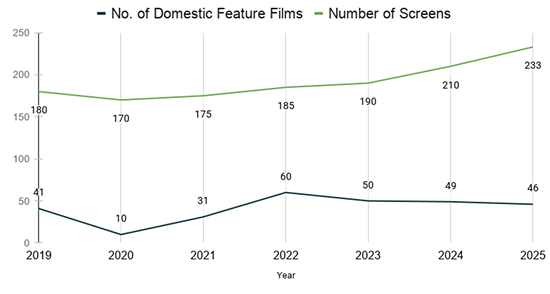
Volume and Types: The production cycle in 2025 reflected both recovery and recalibration. Between January and December, approximately 45 to 50 domestic feature films were released, of which 25 titles premiered in H2 (July–December). In addition to theatrical features, the year saw a steady flow of documentaries, short films, and OTT originals, particularly crime thrillers and socially grounded dramas. Social realism, “fictional-reality” hybrids, and regional storytelling gained momentum. Female-led narratives were more visible in marketing materials, though audience turnout did not always match visibility.
No. of Domestic Feature Films and Screens
Bangladeshi Films Released (July–December 2025):
You can scroll left and right to view the content.
| Month/Date | Title | Type | Director | Company | |
|---|---|---|---|---|---|
| July | 11 | Anyadin | Documentary | Kamar Ahmad Simon | Beginning Production |
| 18 | Ali | Feature Film | Biplob Hayder | Tori Multimedia | |
| August | 1 | Uraal | Feature Film | Jobaidur Rahman | Zatraparty and Joker |
| 8 | Jol Rong | Feature Film | Kabirul Islam Rana | Impress Telefilm | |
| September | 5 | Amar Sesh Kotha | Feature Film | Kazi Mohammad Islam Miah | MS Shocheton Film Media |
| Dot | Feature Film | Barua Sunanda Kakon | Tory Media Ltd. | ||
| 12 | Nandini | Feature Film | Shoibur Rahman Russell | Nayontara Ltd. | |
| 19 | Barir Naam Shahana | Feature Film | Leesa Gazi | Komola Collective, Openvizor, Goopi Bagha Productions |
|
| Fereshteh | Feature Film | Morteza Atashzamzam | Image Films and Maximum Enterprise | ||
| 26 | Saba | Feature Film | Maksud Hossain | Verite Pictures | |
| Shopne Dekha Rajkonna | Feature Film | Mostafizur Rahman Manik | M.S Enterprise | ||
| Udyoman Surjo | Feature Film | S.M. Shafiul Azam | Linet Films | ||
| October | 3 | Bandhob | Feature Film | Sujan Barua | Anupam Kathachitra |
| Bachelor in Trip | Feature Film | Nasim Sahnic | Ammajan Films | ||
| 10 | Ondhokare Alo | Feature Film | Anwar Siraji | Akash Jamin Production | |
| 17 | Direct Attack | Feature Film | Sadek Siddique | Ananda Bazar Multimedia | |
| Saat Bhai Champa: Adi | Feature Film | Ripon Nag | Impress Telefilm | ||
| 24 | Konna | Feature Film | Mohammad Rafiqul Islam Khan | Khan Films International | |
| 31 | Behula Dorodi | Feature Film | Sabuj Khan | Utshob Originals | |
| November | 7 | Mon Je Bojhena | Feature Film | Ayesha Siddiqua | Impress Telefilm |
| Silence: A Musical Journey | Feature Film | Emon Saha | Moonland Production | ||
| 14 | Goar | Feature Film | Rakibul Alam Rakib | Joyjatra Multimedia | |
| Delupi | Feature Film | Touqir Islam | Footprint Films | ||
| December | 12 | Khilari | Feature Film | MD. Shofullah | ZZ Films |
| 15 | Omimangshito | OTT Feature | Raihan Rafi | iScreen | |


Produced with the support of Cineplex, private equity, and OTT platforms


Produced with the support of international co-production


From left Saat Bhai Chompa: Adi, Jol Rong, Mon Je Bojhena
Courtesy: BFDC
Infrastructure:
Exhibition and Distribution: By late 2025, Bangladesh had 233 cinema screens, which is increasing. However, revenue concentration remains pronounced. Star Cineplex operates: 26 screens in 9 branches nationwide and 5 new to open, holding approximately 72% market share in multiplex exhibition. Controls roughly 44.45% distribution share of its own releases. This vertical integration has strengthened urban exhibition but limited screen access for smaller films.
Exhibition and Distribution: By late 2025, Bangladesh had 233 cinema screens, which is increasing. However, revenue concentration remains pronounced. Star Cineplex operates: 26 screens in 9 branches nationwide and 5 new to open, holding approximately 72% market share in multiplex exhibition. Controls roughly 44.45% distribution share of its own releases. This vertical integration has strengthened urban exhibition but limited screen access for smaller films.
Production Infrastructure: In H2 Bangladesh Film Development Corporation (BFDC) continues to provide essential studio space, equipment, and workforce, especially for mid-budget productions. Private studios such as Impress Telefilm and Fusion Pictures maintain higher technical standards and increasingly pursue international collaborations. Post-production quality has improved, with digital grading and sound design now often handled in Dhaka-based private facilities, reducing dependency on foreign labs. The Government of Bangladesh continued its annual film grant scheme. These grants remain crucial for independent and first-time directors. But no national screen quota policy was introduced in 2025, and Hollywood imports continue to dominate premium urban screens.
International Recognition:
Saba (dir. Maksud Hossain) was screened at several international film festivals, including the Toronto, Busan, and Göteborg International Film Festivals. Suraiya (dir. Robiul Alam Robi) won the World Cinema Fund. Short film Ali (dir. Adnan Al Rajeev) was recognized at several major international film festivals, including the SEMINCI Valladolid International Film Festival, where it received the Youth Jury Award. The short film A Thing about Kashem (dir. Bijon Imtiaj) won the Grand Prize at the Rhode Island International Film Festival. and the short film Dhet! (dir. Ummid Ashraf) was selected for several top-tier genre film festivals, including the South by Southwest London and the Fantasia International Film Festival.
Saba (dir. Maksud Hossain) was screened at several international film festivals, including the Toronto, Busan, and Göteborg International Film Festivals. Suraiya (dir. Robiul Alam Robi) won the World Cinema Fund. Short film Ali (dir. Adnan Al Rajeev) was recognized at several major international film festivals, including the SEMINCI Valladolid International Film Festival, where it received the Youth Jury Award. The short film A Thing about Kashem (dir. Bijon Imtiaj) won the Grand Prize at the Rhode Island International Film Festival. and the short film Dhet! (dir. Ummid Ashraf) was selected for several top-tier genre film festivals, including the South by Southwest London and the Fantasia International Film Festival.


A Thing about Kashem © Arifur Rahman
New Talents and Film Education:
Among the new talents, during H2, Touqir Islam made his grand entry as a filmmaker with his debut film Delupi. As per critics and audience, he is going to be the flag bearer of next generation filmmakers of Bangladesh.
Among the new talents, during H2, Touqir Islam made his grand entry as a filmmaker with his debut film Delupi. As per critics and audience, he is going to be the flag bearer of next generation filmmakers of Bangladesh.
There were a few educational and workshop initiatives that occurred during H2. DocLab trained filmmakers with European experts, and three winning projects advanced to development labs. Studio Yellow Something curated Equanimity Sessions, Goethe-Institut and Goopy Bagha ran web series workshops.


Commitment for H1 2026:
H2 2025 was the starting point of a handful of titles for H1 2026. One of the most highlighted features was Mejbaur Rahman Sumon’s second feature Roid after the box office success of Hawa, Rezwan Shahriar Sumit’s second feature Master. Besides these art house biggies, there are a few commitments for Eid Ul Fitr 2026, commercial commando Raihan Rafi declared Pressure Cooker, director Tanim Noor is coming with Bonolota Express after his successful debut with Utshob at H1 2025, Mehedi Hassan Hridoy’s Rakkhosh is also coming after his debut commercial success Borbaad. Another key highlight of the upcoming slate for Eid is Dom, marking the high-profile return of director Redoan Rony. Produced by SVF Alpha-i and Chorki, the big-budget project is distinguished by its extensive filming in diverse international locations, including the harsh, bone-chilling climates of Kazakhstan to heighten the realism of its narrative.
H2 2025 was the starting point of a handful of titles for H1 2026. One of the most highlighted features was Mejbaur Rahman Sumon’s second feature Roid after the box office success of Hawa, Rezwan Shahriar Sumit’s second feature Master. Besides these art house biggies, there are a few commitments for Eid Ul Fitr 2026, commercial commando Raihan Rafi declared Pressure Cooker, director Tanim Noor is coming with Bonolota Express after his successful debut with Utshob at H1 2025, Mehedi Hassan Hridoy’s Rakkhosh is also coming after his debut commercial success Borbaad. Another key highlight of the upcoming slate for Eid is Dom, marking the high-profile return of director Redoan Rony. Produced by SVF Alpha-i and Chorki, the big-budget project is distinguished by its extensive filming in diverse international locations, including the harsh, bone-chilling climates of Kazakhstan to heighten the realism of its narrative.
Financing Models
More Cautious, More Creative
Due to political unrest, recurring violence, and fears of mob attacks, the number of festivals and theatrical releases has naturally been limited in H2. This gap, however, has partly been filled by private screenings, OTT platforms, and digital telefilms. The financing landscape shifted toward a more structured, quality-driven era, moving beyond simple recovery toward systemic reform. Government grants remained a cornerstone of support, with the Ministry of Information and Broadcasting announcing in July 2025 BDT 9 crore (USD 738K)** to fund 32 projects, including 12 full-length features and 20 shorts. In October, an initiative was introduced through “guideline labs” designed to enhance technical standards and production quality among grant recipients.
Private investment became increasingly selective, often linked to the rising influence of digital platforms, with pre-sales to Chorki and BongoBD providing crucial upfront capital that mitigated box-office uncertainties. The theatrical market expanded physically to 233 screens, yet stakeholders continued pushing for a national e-ticketing and box office tracking system to attract larger-scale private funding.
International engagement shifted toward fellowships, creative labs, and festival exposure, rather than large-scale co-productions, although regional collaborations with Indian companies like SVF remained an important revenue and production source. This period was also marked by a growing “film reform” movement, culminating at the National Film Conference 2025, where industry leaders advocated for an independent Ministry of Film and a Film Reform Commission, aiming to formalize cinema as a serious global business. At the same time, digital and OTT productions and other telefilms crossing millions of views demonstrated that storytelling could thrive outside the constraints of theatrical release, bridging gaps in the market and creating a new, more sustainable model for Bangladeshi cinema.
Distribution Climate
Between Global Dominance and Local Resilience
Market Share By Countries
| Market | Percentage | Number of Film Released |
|---|---|---|
| US | 50% | 25 |
| Domestic | 42% | 22 |
| Others | 8% | 9 |
| Total | 100% | 55 |
Disclaimer: As there is no centralized box office tracking system, the data is sourced from Star Cineplex. Their database has not yet been updated, and revised figures are expected before the upcoming Eid releases. The figures reflect the latest available update, including 22 domestic theatrical releases, with the remainder distributed through alternative channels.
During H2 2025, Bangladesh’s film distribution climate reflected a sharp tension between global dominance and fragile local resilience, as foreign films, particularly from the U.S. and Japan, generated the highest box-office returns while domestic productions struggled to cross modest revenue thresholds, with most local titles earning under USD 25K, compared to multi-hundred thousand grosses for international releases like Demon Slayer: Kimetsu no Yaiba - Infinity Castle and The Conjuring: Last Rites.
Although domestic films represented 45.5% of total releases, their market power remained limited due to restricted screen access and short theatrical runs, as exhibition continued to be heavily concentrated in Dhaka-based multiplex chains, led by Star Cineplex controlling 72% of multiplex screens. Distribution authority was similarly concentrated, with Star Cineplex operating as a hybrid distributor holding 44.45% of the H2 market share, alongside Jaaz Multimedia, Alpha-I Studios, and Tiger Media, forming an oligopolistic structure that shaped release strategies and audience access. At the same time, local resilience was visible through the continued production of socially grounded films, modest international reach for select titles, and the rapid expansion of OTT platforms—particularly Chorki and BongoBD—which together absorbed millions of viewers and provided alternative distribution pathways amid rising ticket prices, piracy, and declining nationwide hall density, positioning H2 2025 as a period of structural imbalance but cautious transformation in Bangladesh’s film distribution ecosystem.

Theatrical Reach
Cinemas Between Streaming and Revival
Unlike the earlier half dominated by action spectacles, H2 saw socially grounded films gain attention across both theaters and digital platforms. Their circulation through overseas markets handled by companies like Swapno Scarecrow in the UK, USA, Canada, Australia, and New Zealand and their OTT partnerships with platforms such as Chorki show how H2 releases increasingly depend on a blend of theatrical, international, and streaming support to reach wider audiences.
Cinema Landscape and Screen Counts: Only 100–110 cinema halls run year-round, expanding during peak seasons like Eid up to 233 in Eid . Urban multiplexes dominate, while many regional halls remain underused. Star Cineplex continues to lead this shift, with six branches in Dhaka (22 screens), two in Chattogram, and one in Rajshahi (1 screen) and five new locations planned, along with upgraded technology to improve the viewing experience. These contrasts highlight the urgent need for cinema infrastructure beyond major cities.
No. Of Domestic Films and Multiplex Screens
| No. | Name | Number of Screens | Market Share |
|---|---|---|---|
| 1 | Star Cineplex | 26 screens in 9 active branches (22 in Dhaka, 4 outside Dhaka) | 72% |
| 2 | Silver Screen | 2 Screens in Chattogram (the first cineplex in the city) | 12% |
| 3 | Blockbuster Cinemas | 7 Screens located in Jamuna Future Park | 8% |
| Lion Cinemas | 4 Screens | 8% |
Note: Market share based on revenue
Local Hits vs. Foreign Titles: Bollywood remains banned due to political reasons—leaving audiences with fewer choices. Titles like Avatar: Fire and Ash, One Battle After Another, The Conjuring: Last Rites, Demon Slayer: Kimetsu no Yaiba - Infinity Castle, and Superman (2025) dominated screens, yet the shortage of timely foreign content has changed viewing habits and lowered attendance. At the same time, this gap creates an opportunity for local films to draw audiences back to theaters.
Pricing Dynamics and Multiplex Experience: Cineplex rates ranging from BDT 350–1800 (USD 2.87–14.75), including VIP formats. Urban theaters now offer luxury seating, tiered pricing, and limited weekday discounts, while smaller towns remain underserved. However, government taxes on tickets and add-ons like food and merchandise make fair pricing difficult.
A major reform has been introduced in the revenue-sharing structure between cineplexes and producers in H2. Producers can now take home approximately 25% to 31% per ticket from cineplex collections (31% in the first week, 30% in the second week, 27% in the third week, and 25% from the fourth week onwards), compared to around 17% previously. The reform was not initiated by any specific organisation or individual, but reflects a long overdue adjustment that had been building over time, driven by sustained word of mouth and social media discussions. It will be interesting to observe how anticipated blockbuster films perform in the first half of 2026 under this new model.
Audience Return and Trends Post Political Shift: After the regime change, audiences gradually started returning to cinemas, especially during holiday periods. The recovery should also be understood in the context of a previous period in which cinema-going was largely disrupted due to a sudden regime change and a severely weakened law and order situation during the interim government. With the release of Delupi, audience response improved, contributing to the gradual return of theatrical attendance.
Audiences for these films are primarily young viewers and family audiences. Films such as Delupi, Saba, and Barir Naam Shahana attracted niche audiences across different theatres, indicating an emerging appetite for more diverse and non-mainstream content. These works show that cinema continues to function as a meaningful cultural experience beyond large-scale action spectacles, and that audiences are returning after a prolonged gap.
In terms of industry structure, the art house cinema scene in Bangladesh can be described as emerging. It has only been in recent years that one or two art house films from Bangladesh have begun to receive recognition at major international film festivals on an annual basis.
Technology and Production Services
An Emerging Pillar
In H2, equipment rental conditions remain largely similar to H1. High-end cameras such as ARRI, RED, Sony Venice, Blackmagic, and Panasonic are still available, but in painfully small numbers. Lumen leads the rental market, though most equipment is available only as single units. Demand has increased, but the market remains constrained by limited infrastructure, lack of insurance, and the absence of standardized safety regulations and training systems. These structural limitations continue to restrict the development of a stable rental ecosystem, which in turn affects investor confidence and limits further expansion.
The majority of low-budget productions rely on basic Sony A7s or outdated lenses, which affects color, skin tone, and image depth. A major setback in H2 was the closure of Sandbag, led by Rashed Zaman. For over a decade, the organization trained young cinematographers and camera crews through fully funded residencies that provided accommodation, meals, stipends, and professional training. Its shutdown leaves a notable gap in technical workforce development.
AI is rapidly entering the workflow: directors now storyboard with MidJourney and Boords, producers plan with Filmustage, subtitlers use Veed, Otter, and transcription tools, and young artists create AI-driven posters and visuals. New studios like Alt.R, a director-led AI and CG studio founded by Adnan Al Rajeev (dir. of the Short film Ali), and initiatives from Goopy Bagha Production using AI for national celebrations, show how fast this shift is happening.
Bangladesh still has no film council or commission, no soundstages, no backlots, and no LED volumes. Promised post-production hubs remain stalled due to political issues. VFX survives mainly through advertising agencies and studios like Allied and Firedrum. Colorists such as Ummid Ashraf, Chinmoy Roy, and Asraful Islam find work mainly during Eid and Ramadan. Sound is even weaker—there is no proper film mixing studio in the country. While Coke Studio Bangla is produced locally, filmmakers must complete sound work in Mumbai or abroad.
The POST PRO Talent Lab trained 26 young filmmakers in sound and post-production in H1, and in H2 each of them created a short film that felt like a small revolution. Today, many of them are gaining recognition individually across different projects.


Studio Yellow Something Ltd.
Streaming Platforms and Digital Growth
From Niche to Mainstream
The telefilm industry hit an amazing milestone, with productions crossing 2 million views in a single day on YouTube. The digital landscape reached peak maturity, with OTT platforms serving as a primary recognition engine for new talent. Chorki dominated this sector with a 53.85% market share and 30 million subscribers, followed by BongoBD at 19.21% with 10.7 million subscribers. As 2025 concluded, the push for a National Film Council became more urgent to centralize the gains made in screen count and digital reach. With domestic films accounting for 45.5% of the total releases by December, the industry stands at a threshold where formal policy could turn this creative resilience into a sustainable global industry. The seeds of this growth—from multiplex expansion to the massive OTT subscriber base—are now firmly planted.
In H2 2025, OTT in Bangladesh performed steadily—not through massive blockbusters, but through low-budget, high-volume production models. While no single title became a huge national hit, platforms stayed profitable by supporting continuous content creation and giving space to emerging talent.
Global platforms like Netflix and Disney+ had limited impact due to high subscription costs and weak local catalogs. Instead, local platforms dominated: Chorki, BongoBD, Toffee, Hoichoi, and Deepto TV—each serving different audiences.
BongoBD stands out for its low-cost, population-driven strategy focused on economically accessible content, with rentals starting around BDT 50 (USD 0.4). Its investment in Roid was experimental, trusting a proven filmmaker known for Hawa. Toffee attracts users through free sports and low-data access, though it offers limited fiction. Meanwhile, Chorki and Hoichoi cater to urban, niche audiences seeking curated, premium content.
High-end OTT growth faced constraints in H2 2025 due to political instability, which delayed major partnerships and investment in original productions. The majority of uploads comprised co-productions with established studios such as Alpha-i and SVF, rather than fully independent high-budget originals
YouTube, meanwhile, remains a vibrant space for fiction, generating over 1,000 new videos per month, each averaging 3 million+ views. The platform demonstrates that online distribution is critical for visibility, providing an alternative avenue for filmmakers to reach audiences.
In terms of monetisation, for mid-length drama creators, YouTube has not only served as a tool for exposure but has also become a sustainable revenue stream. This shift reflects a broader change in viewing habits, where traditional TV drama series have significantly declined in popularity, and consumption has increasingly moved toward YouTube and OTT platforms. While higher-budget productions are now primarily developed for OTT, lower-budget productions have found their place on YouTube.
Emerging Opportunities: Despite challenges, OTT platforms offer a viable avenue for recouping production costs, expanding audience reach, and experimenting with novel storytelling. H2 2025 may remain constrained due to political and economic uncertainty, but post-election stability in February 2026 is expected to unlock broader revenue streams, strategic co-productions, and institutional support for both cinema and streaming.
Disclaimer on Data Reliability: In the absence of a centralized box office system, or a comprehensive industry database, exact figures for production volume, revenue, and audience reach remain unavailable in Bangladesh. Given the lack of standardized reporting, data is often adjusted or interpreted differently by concerned parties. The information in this report has therefore been compiled through direct communication with filmmakers, producers, and industry professionals, supplemented by cross-referencing social media market research pages and press coverage till 30 December 2025. While every effort has been made to ensure accuracy, the findings should be considered approximately 95% reliable, reflecting the limitations of a fragmented and largely undocumented Bangladeshi film industry landscape (H2 2025).
Interview Ⅰ
Mejbaur Rahman SUMON, Director & Screenwriter

Mejbaur Rahman Sumon is one of the most distinctive voices in contemporary Bangladeshi cinema. Known for Hawa (2022) and Roid (2026), his films blend poetic realism with bold, unconventional storytelling.
His work challenges traditional formulas while reaching both local and international audiences. In this conversation, Sumon reflects on his journey, the changing industry, and his vision for the future of Bangladeshi cinema.
Q. How do you see production, distribution, or streaming having shifted in 2025??
A.After this amazing visit to the Rotterdam Film Festival with my film Roid, I understood that the world is slowly opening its doors to stories that are honest and rooted.
Production today feels smooth. Many people are willing to invest. But cinema is not born from money—it is born from meaning. I am a graduate of Fine Arts, and I naturally move toward abstraction, silence, and emotional layers. For me, cinema is closer to painting than business.
Q. What personal challenges or big opportunities did you see in 2025?
A.I honestly did not feel any production obstacles. The system is ready, the money is available. But that is not where my struggle lives. My real challenge is staying true to the artistic perspective. I am not comfortable with the financial chapter of filmmaking. Instead, I seek the right distributor—and once that connection is built, the film can travel far.
Hawa is the best example. We saw it on screens everywhere, and it even reached the top charts in the US. That journey reminded me that art, when guided well, finds its own audience.
Q. What do you see as the biggest gap in the Bangladeshi film industry today?
A.From one perspective, it is not only the fund we are lacking, we are lacking artistic courage also. There are many investors, but fewer people who understand cinema as an art form. I am deeply inspired by Michelangelo—his work was not created for profit, but for truth. That is the spirit I search for in film. The gap is not always structural, it is emotional and creative too.
Q. How do you plan to welcome co-productions in your upcoming films?
A.For me, co-production is not about finance—it is about connection. I do not get along with the business side, but I deeply respect the role of distributors. With the right partners, a film can travel a long way. The journey of Hawa proved that. So did Roid. When art is respected, the world listens.
Interview Ⅱ
Humaira BILKIS, Filmmaker and Documentarian

Humaira Bilkis is a Bangladeshi filmmaker and documentarian whose work is rooted in realism, social observation, and human stories. Through non-fiction and research-driven storytelling, she has created a space for voices often overlooked in mainstream cinema.
In this conversation, she reflects on her creative journey, the challenges of working in a developing film ecosystem, and her vision for a more inclusive and connected Bangladeshi cinema.
Q. How are you these days, and what stories or projects are you currently working on?
A.Since the release of my film in 2022, I have been involved in many things—research, idea development, and a lot of quiet brainstorming. Right now, I am in the early process of shaping several new concepts, and I am also returning to a project that I first started nearly ten years ago. It feels like the right time to finally bring that story to life.
Q. How do you see production, distribution, and production having shifted in 2025?
A.In our country, the film ecosystem is still very underdeveloped. Even today, many people think film only means fiction, and even that is seen in a very binary way. They don’t realize that cinema has so many genres and forms, especially non-fiction.
Because of this limited understanding, production and distribution cannot truly grow. We are still not building spaces for documentary, hybrid cinema, or experimental work. Most of what I have learned about non-fiction storytelling came from foreign filmmakers when they visited Bangladesh. That exchange of ideas helped me understand how cinema can be much wider than what we usually imagine here.
Q. What early challenges shaped your journey in the film industry?
A.From the very beginning, the biggest challenge was explaining why non-fiction matters. People often asked why I wasn’t making fiction films instead. The documentary was not seen as “real cinema.” That struggle pushed me to stay firm in my direction. At the same time, I attended local workshops and later studied creative documentaries, which deeply shaped the way I think about storytelling. It also taught me to learn from outside our system, to observe how others work, and to slowly build my own path within an industry that is still learning to grow.
Q. How do you balance creative freedom with industry limitations in Bangladesh?
A.For me, this balance is very personal. It is not really connected to the industry, because independent filmmakers do not receive much support from it. Our film industry is still very monochromatic—only one type of cinema is celebrated, and that is fiction.
Documentary and non-fiction mostly survive through individual effort and personal vision. There is also a lack of proper space, especially on OTT platforms, to present our documentaries.
Tanveer HOSSAIN
Producer, Writer
Tanveer Hossain is a Bangladeshi film producer and storyteller working across fiction, documentary, and animation. A graduate of the Busan Asian Film School and BAFA. An alumnus of Berlinale Talents, EAVE, APostLab, APN etc. He has produced award-winning projects showcased at festivals such as Cannes, Rotterdam, Busan, Melbourne, Seminci, SXSW, Hanoi etc. Passionate about discovering unique voices, Tanveer bridges artistic vision with production expertise, connecting local narratives to global audiences. He serves as Executive Director of Green Screen and recently co-founded Katalog, a boutique production company championing Asia-Asia collaborations.
Raka Noshin NOWER
Producer, Director, Writer
Raka Noshin Nower is an award-winning TVC director of Bangladesh, now focusing deeply on narrative storytelling. She has already secured the national government film grant for her debut short Less Meat and was selected as a fellow of the International Film Camp 2025, Macau, organized by the Asian Creative Awards Academy, with her project Fish and Milk. As an emerging talent, Raka stands out as one of the few female filmmakers in Bangladesh to establish her own production company, Studio Yellow Something, positioning herself at the forefront of bold new voices shaping South Asian cinema.
Reliable Verbal contributors:
- Mahir Masud | Film Student
- Maruf Hossain Rayhan | Film Researcher and Enthusiast
- Humaira Bilkis | Filmmaker and Documentarian
- Mejbaur Rahman Sumon | Filmmaker, Screenwriter
Online article sources:
- https://www.boxofficemojo.com/year/2025/
- https://timesofindia.indiatimes.com/city/kolkata/indo-bangla-collab-breaks-eid-box-office-records/articleshow/121034043.cms
- https://en.prothomalo.com/entertainment/ott/hclc0i4d8v
- https://www.newagebd.net/post/film/261175/six-films-set-to-release-for-eid-ul-fitr-across-bangladesh
- https://www.daily-sun.com/printversion/details/784647
- https://www.thedailystar.net/tags/earns-tk-27cr
- https://www.upturn.com.bd/industry/entertainment
- https://www.dhakatribune.com/amp/showtime/384805/cinema-in-crisis-the-desire-remains-but-the-bowl
- https://www.facebook.com/share/16s5JLYfDr/?mibextid=wwXIfr
- https://www.facebook.com/share/p/172uD9UgD3/?mibextid=wwXIfr
- https://www.statista.com/outlook/amo/media/cinema/bangladesh?currency=USD
- https://www.newagebd.net/post/Film/271826/bfdc-remains-largely-abandoned
- https://www.thedailystar.net/entertainment/tv-film/news/fereshteh-brings-jaya-ahsan-back-bangladeshi-screens-september-3984191
- https://www.thedailystar.net/entertainment/tv-film/news/anyadin-set-seven-day-theatrical-run-july-11-3932761
- Standard 2D tickets in mainstream multiplexes typically range between USD 2.9 to 3.6
- 3D tickets are priced higher, typically ranging from USD 3.6 to 4.6, depending on the time and seat class