Title
THE A REPORT
2026 H1
 Kalash Nanda KUMAR
Critic, Journalist
Kalash Nanda KUMAR
Critic, Journalist
Updated on 6 Oct 2026
Overview
In my previous report, I wrote about the renewed confidence surrounding Malaysian cinema, alongside the structural weaknesses that a handful of successful films could easily obscure. The first half of 2026 brings that tension into sharper focus. Local filmmakers continue to find sizable audiences, but the wider theatrical business has yet to establish a dependable rhythm.
There are encouraging shifts within the domestic release slate. Horror has regained prominence, complicating the softer outlook for the genre in my last report. Chinese-language productions also occupy a meaningful part of the local market, while action remains a reliable source of its biggest individual successes. Across all 34 titles in FINAS' dataset (Jan to Aug), recorded ticket sales add up to MYR 111.91 million (USD 27.46 million) and 6.13 million admissions. However, only five titles account for approximately 67% of that sum1.
This variety is still encouraging, even if so much of our box office gross ends up within a small number of films. The government's new financing commitments and the growing circulation of Malaysian content across streaming platforms are other grounds for optimism. Whether these initiatives can be sustained across changes in political leadership remains to be seen. Malaysia could face a General Election next year2. Insiders have reported frustrations that many initiatives and priorities get shifted or get waylaid entirely as office bearers change hands.
 Tarung: Unforgiven © Astro Shaw
Top 10 Films in Malaysia Box Office (Jan-Aug 2026)
You can scroll left and right to view the content.
| No. | Title | Director | Country | Genre | Gross (MYR) | Gross (USD) | Production Company | Distribution Company |
|---|---|---|---|---|---|---|---|---|
| 1 | Spider-Man: Brand New Day | Destin Daniel Cretton | US | Action, Adventure | 82.34M | 20.20M | Columbia Pictures Marvel Studios Pascal Pictures | Sony Pictures Releasing |
| 2 | The Odyssey | Christopher Nolan | UK, US | Fantasy, Adventure | 24.51M | 6.01M | Universal Pictures Syncopy | Universal Pictures International |
| 3 | Tarung: Unforgiven | Razaisyam Rashid | Malaysia | Action, Drama | 23.59M | 5.79M | Alpha47 Films Icon Pictures Astro Shaw | Astro Shaw |
| 4 | Michael | Antoine Fuqua | US, UK | Biography, Drama | 15.75M | 3.86M | GK Films Lionsgate Films | Universal Pictures International |
| 5 | Polong | Zulkarnain Azhar | Malaysia | Horror | 15.05M | 3.69M | Apuu Films Golden Star Pictures | 10 Star Cinemas Primeworks Studios Astro Shaw |
| 6 | Libang Libu | Bobby Husaini | Malaysia | Comedy, Drama | 14.16M | 3.47M | Tangerine Films | Skop Production |
| 7 | Toy Story 5 | Andrew Stanton | US | Animation, Family | 13.27M | 3.26M | Pixar Animation Studios | Walt Disney Pictures |
| 8 | The Super Mario Galaxy Movie | Aaron Horvath, Michael Jelenic | US, Japan | Animation, Adventure | 12.57M | 3.08M | Illumination Nintendo | Universal Pictures International |
| 9 | Malaikat Malam | Nazifdin Nasrudin | Malaysia | Action, Drama | 12.23M | 3.00M | Viper Studios Skop Productions | Astro Shaw Primeworks Studios |
| 10 | Minions & Monsters | Pierre Coffin | US | Animation, Comedy | 12.21M | 3.00M | Illumination | Universal Pictures International |
Source: Box Office Mojo, verified on 22nd September 2026.
Top 10 Domestic Films in Malaysia Box Office (Jan-Aug 2026)
You can scroll left and right to view the content.
| No. | Title | Director | Country | Genre | Gross (MYR) | Gross (USD) | Production Company | Distribution Company |
|---|---|---|---|---|---|---|---|---|
| 1 | Tarung: Unforgiven | Razaisyam Rashid | Malaysia | Action, Drama | 23.59M | 5.79M | Alpha47 Films Icon Pictures Astro Shaw | Astro Shaw |
| 2 | Polong | Zulkarnain Azhar | Malaysia | Horror | 15.05M | 3.69M | Apuu Films Golden Star Pictures | 10 Star Cinemas Primeworks Studios Astro Shaw |
| 3 | Libang Libu | Bobby Husaini | Malaysia | Comedy, Drama | 14.16M | 3.47M | Tangerine Films | Skop Production |
| 4 | Malaikat Malam | Nazifdin Nasrudin | Malaysia | Action, Drama | 12.23M | 3.00M | Viper Studios Skop Productions | Astro Shaw Primeworks Studios |
| 5 | Ah Beng vs Liang Po Po | Matt Lai | Malaysia, Singapore | Action, Comedy | 10.04M | 2.46M | ATF Group The Film Engine Dreamax Entertainment | GSC Movies |
| 6 | I'm Not Gangster | Vince Chong | Malaysia | Crime, Comedy | 7.12M | 1.75M | Dissy Definition Film Company | GSC Movies |
| 7 | Khadam | Shamyl Othman | Malaysia, Indonesia, Hong Kong, India | Horror | 5.12M | 1.26M | Red Communications Pvt Ltd | GSC Movies |
| 8 | Kong Tao | Peiji Wu | Malaysia | Horror | 4.29M | 1.05M | Mega Films Distribution | Mega Films Distribution |
| 9 | Mama, Not Again! | Teddy Chin | Malaysia | Comedy, Family | 4.20M | 1.03M | 555 Film | Mega Films Distribution |
| 10 | Gayong 2 | Faisal Ishak | Malaysia | Action, Biography | 3.26M | 0.80M | SOL Pictures | Primeworks Studios |
Source: FINAS, published on 23 August 2026, verified on 22nd September 2026.
Production Landscape
The most consequential production development is the effort to give local intellectual property a life across multiple formats. Astro's investor presentation outlined its Astro Shaw Cinematic Universe 3, with Kudrat 1968 and Polis Evo: Mat Yam among the projects in its upcoming pipeline. These are television extensions within a broader screen business, rather than additions to the theatrical feature count. They nevertheless indicate how a major Malaysian broadcasting company intends to organise development around local IP, characters and worlds that can support repeat engagement4.
GSC's parent company, PPB, also identified a 2026 co-production slate5 including Khawarij, Pajak, Darah Gagap, Black Ops and Chelot. The corporate commitment is useful evidence of continuing development activity, although an announced slate does not establish that every project has entered production or will meet its proposed release window. The combination of exhibition, distribution and production resources remains an advantage for companies able to participate in these networks.
There is room within this structure for emerging filmmakers. Nazifdin Nasrudin made his feature directing debut with Malaikat Malam, developed through his working relationship with Syafiq Yusof. The film's interest in Malaysia’s motorcycle (‘rempit’) culture6 and young working-class lives shows how an established commercial milieu can accommodate an emerging director. Tarung: Unforgiven similarly brought actor Aedy Ashraf into feature producing7, through Alpha47 Films and a partnership involving Icon Pictures and Astro Shaw. These examples suggest that renewal is taking place partly through collaboration within established companies.
The resulting production landscape is more varied than a description centred entirely on sequels would suggest. New horror properties and vernacular comedy sit alongside franchise extensions and martial-arts films. That said, there is still insufficient published evidence to describe an industry-wide increase in budgets or private investment. FINAS's complete extract records 34 theatrical releases between January to August, measuring films reaching cinemas. Production starts, completed features and streaming commissions need separate accounting before we can judge whether the industry and workforce is experiencing a sustained expansion.
 Astro Shaw’s Cinematic Universe © Astro Shaw
Financing Models
Public funding received a substantive update in April 2026. Communications Minister Fahmi Fadzil announced MYR 300 million (USD 73.60 million) for the Film in Malaysia Incentive (FIMI) over five years 8. This marks a significant shift from 2025, when the annual FIMI allocation fell to MYR 40 million and prompted concerns about Malaysia's ability to remain competitive in attracting international productions. The five-year commitment provides a longer planning horizon for attracting international production, but the allocation should not be confused with money already disbursed to producers during the first half of 2026. At the same event, the government announced a MYR 10 million (USD 2.45 million) Dana Citra fund, supporting films concerned primarily with national identity, history and nationhood.
FINAS has described Dana Citra9 as open to different genres, including horror and comedy. This is a potentially useful distinction: a national narrative need not take the form of a historical epic or documentary. Its value will depend on how broadly that remit is interpreted, and whether applicants outside the familiar commercial networks can secure support. In a multilingual society, the scope for stories about belonging extends well beyond a single cultural perspective.
FIMI's offer remains a 30% cash rebate on qualifying Malaysian expenditure, with an additional 5% available through the cultural test. The maximum is therefore 35%, subject to the scheme's conditions. FINAS's presentation of the 2026–2030 funding cycle places greater emphasis on maintaining Malaysia's appeal to overseas partners10. For producers, however, the practical issue is the timing of cash. A rebate linked to expenditure does not remove the need to finance production before recovery, and a grant allocation is only useful once projects can obtain and deploy it.
Commercial companies are also looking beyond theatrical receipts. Astro reported a threefold year-on-year increase in sponsorship revenue in its cinematic-universe presentation. This points to a financing opportunity for properties that have already built an established audience and recognisable talent. Inversely, it offers much less reassurance to an independent film without comparable brand appeal.
The distinction matters when assessing the industry's financial health. Box office is not a producer's net return: exhibition, distribution, marketing and contractual deductions intervene before investors recover their money. Without project-level budgets and recoupment statements, even an impressive headline gross cannot establish profitability. The stronger funding commitments are welcome, but their impact should be assessed through completed productions and sustainable businesses rather than PR announcements alone.
Distribution Climate
The distribution business continues to favour companies that can coordinate production, marketing and theatrical access. GSC reported handling more than 90 distribution titles during 2025, providing a useful baseline for the scale of its operation entering 202611. Its involvement in domestic co-productions also illustrates how a distributor can become a project partner well before release. Despite that, PPB Group, which owns Golden Screen Cinemas (GSC), reported a 9% decline in film exhibition and distribution revenue to MYR 310 million (USD 76.05 million) for January–June, while segment profit fell 55% to approximately MYR 15 million (USD 3.68 million)12.
The first half slate of 2026 nonetheless contains several routes to audiences. Tarung: Unforgiven was distributed by Astro Shaw; Libang Libu by Skop Production; and Ah Beng vs Liang Po Po through GSC Movies. These partnerships are commercially significant, but the success of individual films does not establish the fairness of programming across the market. A meaningful assessment would require showtimes, seating capacity and the duration of bookings, rather than a screen count alone. Smaller producers must negotiate market access within an ecosystem where some competitors arrive with these relationships already in place.
For independent films, the gap between obtaining a release and building an audience remains considerable. FINAS records MYR 501,256 for Mother Bhumi and MYR 234,717 for The Wave Will Carry Us. These figures show the limited theatrical scale achieved by two films outside the dominant commercial genres. They do not, by themselves, explain whether marketing, scheduling or audience demand was decisive.
Tarung: Unforgiven leads the complete FINAS release list with MYR 23.59 million (USD 5.79 million) and approximately 1.24 million admissions. Polong follows at MYR 15.05 million (USD 3.69 million), ahead of Libang Libu at MYR 14.16 million (USD 3.47 million) and Malaikat Malam at MYR 12.23 million (USD 3.00 million). Together with Ah Beng vs Liang Po Po, these films point to continuing demand for local stories across action, horror and comedy, rather than dependence on a single genre.
Chinese-language releases are particularly worth following. Ah Beng vs Liang Po Po earned MYR 10.04 million (USD 2.46 million), I'm Not Gangster earned MYR 7.12 million (USD 1.75 million), Kong Tao MYR 4.29 million (USD 1.05 million) and Mama, Not Again! MYR 4.20 million (USD 1.03 million). Together, they account for approximately 23% of the gross across all 34 titles released in 2026 so far. Their contribution is substantial enough that the health of Malaysian cinema cannot be assessed through Malay-language blockbusters alone.
The operating picture is less buoyant. PPB attributed its weaker first quarter film-business performance to lower box office and concession income, a weaker blockbuster slate and higher operating costs. Its second-quarter profit nevertheless recovered to MYR 21.9 million from a MYR 7.3 million first-quarter loss. This volatility suggests that cinemas remain highly dependent on the timing and strength of releases.
Theatrical Reach
Release numbers recovered beyond the pre-pandemic level
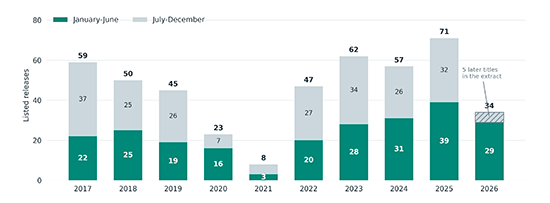
Bar chart illustrating the total number of films released between 2017 and 2026, and period of release within each year.
Source: FINAS
Source: FINAS
The figures from FINAS show a substantial expansion in the earning power of Malaysian theatrical releases, but the gains have been uneven. A small number of films can transform the annual total while most titles continue to earn modest sums.
January–August 2026 releases suggest a different pattern. Their combined recorded gross was lower than that of the same period in 2025 releases, but earnings were spread across more substantial performers. Five films crossed MYR 10 million, compared with two in the equivalent 2025 release group. This does not remove the concentration problem identified in my previous report, but it suggests that commercially significant returns may be spreading across a wider group of films. Whether this represents a durable shift, rather than the particular composition of the current release slate, will become clearer over the full year.
The listed release count fell from 59 in 2017 to 45 in 2019, then to 23 in 2020 and eight in 2021 (pandemic years). It recovered to 47 in 2022 and reached 71 in 2025, the largest annual slate since 2017, pointing to a full recovery, and more robust industry after the pandemic. One caveat however is that more releases did not consistently produce more revenue. The 2023 slate contained 62 films, compared with 47 in 2022, but recorded gross was about 44% lower. Two outliers that distort this data are the extraordinary success of Mat Kilau in 2022, and the second is its release after prolonged nationwide lockdowns that contributed to audiences returning to cinemas. Given the shifting preferences into blockbuster or ‘event’ movies over the last decade, the performance of individual films matters considerably more than overall release volume alone.
In my previous reports, I have cautioned that this should be ringing alarm bells for policymakers, producers and distributors. Relying solely on a handful of major films to keep cinemas aflot is a recipe for disaster. Further refinements and reforms to the ‘Wajib Tayang’ policy are needed as well as independent monitoring of the health of our cinemas to assess more accurately what gaps need to be filled and recommendations be made.
The 2025 surge came with many more admissions
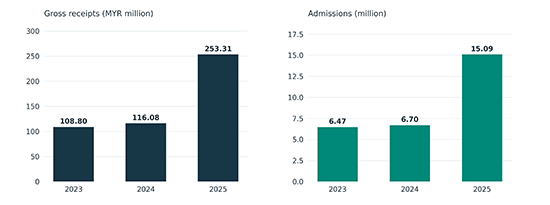
Bar chart illustrating box office gross and admissions between 2023 and 2025.
Source: FINAS
Source: FINAS
Technology and Production Services
Malaysia's technology offer entering 2026 includes FINAS's virtual-production facility in Ampang Jaya. INFiLED identifies the installation as a 2024 project, comprising 147.5 square metres of LED displays, with Cedar Broadcast & Communications, Integrasi Naluri, Brompton Technology and Disguise involved in the system. However, this is an existing capacity available to the sector, and should not be presented as a new investment13.
The immediate question is how widely that capacity can be used. A facility's commercial value depends on a dependable supply of productions, trained operators and directors comfortable planning for its workflow. For smaller films, access costs and the preparation required will determine whether virtual production is practical. Published information does not yet establish its utilisation rate or a measurable reduction in Malaysian feature-production costs.
The government's industry symposium in April also brought artificial intelligence into the policy discussion. Communications Minister Fahmi Fadzil has asked FINAS to examine copyright issues around the use of performers' faces and voices through AI. This was an instruction to study the issue, rather than evidence that a new protection regime had already taken effect.
There is a clear need for this discussion to accompany the promotion of new tools. Producers may see opportunities in development, localisation or promotional work, but the terms of consent and reuse will affect the people supplying the underlying performances.
Streaming & Digital Platforms
Streaming's importance is increasingly visible in the distribution of Malaysian films, although circulation and investment should not be treated as interchangeable. Netflix's public Malaysian Movies & TV category, checked for this report as of 21st September, displayed at least 138 distinct local titles. This is a count of publicly listed title cards, rather than a complete audit of local films accessible to Malaysian subscribers. Due to the lack of data transparency, it is also unclear how many local titles have left Netflix’s platform over the last six months.
The broader page now includes Tarung: Unforgiven, Polong, Libang Libu, Malaikat Malam and Gayong 214. Their presence gives the first quarter theatrical slate a continuing digital life, but these current listings should not be backdated into the reporting period. Nor is a Netflix listing evidence that Netflix commissioned or financed a film. Acquisition prices, exclusivity and producer returns have not been disclosed sufficiently to conclude that streaming has become a dependable primary recoupment route for Malaysian features.
Astro's figures provide a clearer indication of changes within one local business. Its Q1 FY2027 presentation, covering the quarter ended 30 April 2026, reported 29% year-on-year growth in sooka's VIP paying subscribers, attributed to sport and local content. The same presentation put combined monthly active users of Astro GO and sooka at 1.5 million; this is not sooka's subscriber total. The distinction is necessary when comparing platform claims that describe different kinds of engagement.
Local commissioning also continues alongside acquisitions. Astro identified Kudrat 1968 and Polis Evo: Mat Yam as upcoming original content, while reporting the circulation of Good Boys Go To Heaven across ASEAN markets and its Netflix performance in Malaysia and Singapore. The opportunity for Malaysian companies is to develop a property, exploit it across formats, and reach viewers through more than one service. The trade-off is greater dependence on a small number of buyers with considerable influence over rights and release strategy.
Comparable, current country-level film counts and commissioning expenditure are not publicly established for all major services, including Viu and iQIYI. The absence of these figures limits claims about which platform is investing most. More broadly, the platform proliferation highlighted in my previous report remains visible as a distribution opportunity, but it has not yet translated into a demonstrable financing or recoupment model for Malaysian producers. For filmmakers, the useful measure is not simply how many services carry Malaysian content, but whether those agreements support the next production while leaving producers with a viable stake in their work.
Co-Production
Khadam provides one of the clearest examples of the breadth of Malaysia's production partnerships. Producer Ahmad Izham Omar identifies Red Communications and Komet Productions as its producers, with participation from GSC and Media Prima in Malaysia, Magma and VMS in Indonesia, Sil-Metropole in Hong Kong and Applause in India. Directed by Shamyl Othman, the horror film opened in Malaysia in June. Its structure shows the possibility of assembling partners beyond a conventional two-country arrangement.
The advantage is not confined to a larger financing pool. Partners can contribute relationships with talent, distributors and audiences in their respective markets. Whether those relationships translate into sales depends on the rights agreed and the release secured in each territory. An international cast or a long list of production logos should not be mistaken for guaranteed regional distribution, and the published information on Khadam does not establish each partner's financial contribution.
A different model is taking shape in television. At the March Malaysian production launch of Hemelrijk , Kinovisuals and New Amsterdam Film Company announced a co-production partnership15 and linked the project to FIMI’s support. It is the first official Malaysia–Netherlands television co-production. These projects suggest that Malaysia can participate both as a location and services base and as a creative production partner. The distinction will become more important as the expanded incentive allocation is deployed. International work can sustain crews and facilities, but the longer-term benefit to Malaysian companies depends on the responsibilities, rights and revenues they retain.
 Khadam © Redcomm
- Note: All conversions are based on the exchange rate of approx. MYR 4.08 / USD.
Kalash Nanda KUMAR
Critic, Journalist
Kalash Nanda Kumar is a Malaysian journalist and critic whose work spans culture, environment, and current affairs. He has participated in numerous regional and international film festivals, serving as a juror, programmer, and facilitator. Kalash is a member of FIPRESCI, NETPAC and PEN Malaysia.
Sources
- 1 Perbadanan Kemajuan Filem Nasional Malaysia (FINAS). Tayangan Filem Cereka di Bawah Skim Wajib Tayang bagi Tahun 2026. Dataset generated 21 September 2026. Accessed 24 September 2026.
- 2 Bloomberg. "Anwar Ibrahim weighs delaying Malaysia general election to late 2027 amid poll setbacks." South China Morning Post, 27 August 2026.
- 3 Hakem Hassan. "Astro Shaw Launches Its Own Cinematic Universe, Set to Begin in 2025, Interlinking ‘Keluang Man’, ‘High Council’, ‘Polis Evo’, and More." Rojak Daily, 20 December 2024.
- 4 Astro Malaysia Holdings Berhad. 1st Quarter FY27 Results. Analyst presentation, 15 June 2026.
- 5 PPB Group Berhad. Annual Report 2025. 2026.
- 6 Ian Jeremiah Patrick. "Riding against the tide: Why ‘Malaikat Malam’ refocuses the ‘rempit’ genre in local storytelling." Malay Mail, 26 March 2026.
- 7 Patrick, “Riding against the tide.” See reference 6.
- 8 Berita RTM. "Kerajaan perkukuh sokongan industri filem, peruntukan RM300 juta tarik produksi antarabangsa." 9 April 2026.
- 9 Berita RTM. "FINAS perkenal Dana Citra, angkat naratif kenegaraan ke layar perak." 9 April 2026.
- 10 FOCUS. "Meet FINAS, Malaysia’s gateway to global production partnerships." 11 November 2025.
- 11 PPB Group Berhad, Annual Report 2025. See reference 5.
- 12 PPB Group Berhad. Quarterly Report for the Financial Period Ended 30 June 2026. 26 August 2026.
- 13 INFiLED. "INFiLED Powers FINAS Malaysia’s ICVFX Virtual Production Studio." Undated. Accessed 24 September 2026.
- 14 Netflix. "Malaysian Movies & TV." Accessed 24 September 2026.
- 15 Ian Jeremiah Patrick. "Breaking down upcoming Malaysia-Dutch supernatural thriller miniseries ‘Hemelrijk’: Origins, casting choices, and ambitions." Malay Mail, 17 May 2026.