Title
THE A REPORT
2026 H1
 Soobin KIM
Researcher, Policy R&D Department
Soobin KIM
Researcher, Policy R&D DepartmentKorean Film Council (KOFIC)
Updated on 6 Oct 2026
Overview
Strong Recovery led by Korean Films
The Korean film industry experienced a significant recovery in the first half of 2026, led by the consistent box office success of domestic films amid a slowdown in foreign films. Total box office revenue for the first half reached KRW 579.0 billion, a 41.9% (KRW 171.1 billion) increase compared to the same period last year, while admissions rose to 57.05 million, a 34.2% (14.55 million) increase year-over-year. The actual number of films released in the first half of 2026 was 248, which is a decrease of 16 films compared to the 264 of last year. This represents meaningful growth given the significant expansion of the market.
In particular, unlike last year when no film reached the 10 million milestone, this year, The King’s Warden was released in February and became a box office hit, signaling the early return of the ‘10 million film’. Even after surpassing 10 million admissions, The King’s Warden kept drawing audiences steadily, recording cumulative box office revenue of KRW 163.1 billion in the first half. It achieved massive box office success, surpassing both Roaring Currents and Extreme Job to become the highest-grossing film of all time. Looking at the monthly box office trends for the first half of the year, Once We Were Us was a hit in January, The King’s Warden in February and March, Salmokji: Whispering Water in April, and Colony in May and June, demonstrating that Korean films maintained consistent strength throughout the period.
However, it remains to be seen whether this recovered market size can be sustained. Much of the first-half recovery can be attributed to the massive success of The King’s Warden and Showbox’s achievement in making all of its distributed films successful, making it difficult to view this as a structural recovery of the overall theatrical ecosystem. In addition, Megabox Joongang’s application for corporate rehabilitation, announced in June, was also a case that showed the domestic theater industry continues to face difficulties.
Overall, the first half of 2026 served as a hopeful sign for the Korean film industry that has struggled since the COVID-19 pandemic, reaffirming audience demand for theatrical moviegoing. The key challenges ahead will be to restore the industry ecosystem and implement structural improvements so that this rebound can lead to sustainable growth.
Top 10 Films in Korean Box Office (H1 2026)
You can scroll left and right to view the content.
| No. | Title | Director | Country | Genre | Gross (KRW) |
Gross (USD) |
Production Company |
Distribution Company |
|---|---|---|---|---|---|---|---|---|
| 1 | The King’s Warden | Jang Hang-jun | Korea | Period Drama | 163.15B | 109.89M | Onda Works, BA Entertainment | Showbox |
| 2 | Colony | Yeon Sang-ho | Korea | Action, Thriller | 60.49B | 40.74M | WOWPOINT, Smilegate | Showbox |
| 3 | Salmokji: Whispering Water | Lee Sang-min | Korea | Horror | 33.32B | 22.44M | Showbox | Showbox |
| 4 | Project Hail Mary | Phil Lord, Christopher Miller | USA | Sci-Fi, Adventure | 32.95B | 22.20M | Amazon MGM Studios, Skydance Media | Sony Pictures |
| 5 | Avatar: Fire and Ash | James Cameron | USA | Sci-Fi, Action | 26.50B | 17.85M | Lightstorm Entertainment, 20th Century Studios | Disney |
| 6 | Once We Were Us | Kim Do-young | Korea | Romance | 24.40B | 16.44M | Covenant Pictures | Showbox |
| 7 | HUMINT | Ryoo Seung-wan | Korea | Action | 20.00B | 13.47M | Oeyoo Naegang | NEW |
| 8 | Michael | Antoine Fuqua | USA | Musical, Drama | 17.84B | 12.01M | GK Films | UPI |
| 9 | Toy Story 5 | Andrew Stanton | USA | Animation | 17.53B | 11.81M | Pixar Animation Studios | Disney |
| 10 | The Devil Wears Prada 2 | David Frankel | USA | Drama, Comedy | 16.19B | 10.90M | 20th Century Studios | Disney |
Top 10 Domestic Films in Korean Box Office (H1 2026)
You can scroll left and right to view the content.
| No. | Title | Director | Country | Genre | Gross (KRW) |
Gross (USD) |
Production Company |
Distribution Company |
|---|---|---|---|---|---|---|---|---|
| 1 | The King’s Warden | Jang Hang-jun | Korea | Period Drama | 163.15B | 109.89M | Onda Works, BA Entertainment | Showbox |
| 2 | Colony | Yeon Sang-ho | Korea | Action, Thriller | 60.49B | 40.74M | WOWPOINT, Smilegate | Showbox |
| 3 | Salmokji: Whispering Water | Lee Sang-min | Korea | Horror | 33.32B | 22.44M | Showbox | Showbox |
| 4 | Once We Were Us | Kim Do-young | Korea | Romance | 24.40B | 16.44M | Covenant Pictures | Showbox |
| 5 | HUMINT | Ryoo Seung-wan | Korea | Action | 20.00B | 13.47M | Oeyoo Naegang | NEW |
| 6 | Choir of God | Kim Hyung-Hyup | Korea | Drama | 13.63B | 9.18M | Studio Target | CJ CGV |
| 7 | Wild Sing | Son Jae-gon | Korea | Comedy | 12.13B | 8.17M | About Film | Lotte Cultureworks |
| 8 | Audition 109 | Jung Woo, Oh Seong-ho | Korea | Drama | 4.01B | 2.70M | By4m Studio, Fan Entertainment | By4m Studio |
| 9 | The Eyes | Yeom Ji-ho | Korea | Horror | 3.87B | 2.61M | Dream Capture, Time Heist | By4m Studio, Ehwabae Company |
| 10 | Even If This Love Disappears from the World Tonight | Kim Hye-young | Korea | Romance | 3.67B | 2.47M | By4m Studio | By4m Studio |
Production Landscape
Expanded Government Support Amid a Shortage of Korean Films
While the theatrical market entered a recovery phase in the first half of 2026, the production environment for Korean films remained challenging. Rising production costs and deteriorating profitability have made producers and investors increasingly cautious about launching new projects. The continued decline in investment following the pandemic has led to a continuous decrease in the number of Korean films produced. Rebuilding a stable production foundation capable of consistently supplying films of diverse scales remains one of the most critical challenges for the Korean film industry.
The total number of actual released films—including films with 40+ theatrical screenings or independent / art-house films—was 248 during the first half of 2026. Of these, 89 were Korean films and 159 were foreign. Compared with the same period in 2025, the number of Korean releases declined by 22, while foreign releases increased by 6.
Looking at the production status of commercial films—including films with net production budgets exceeding KRW 3 billion—based on last year’s data, only 31 Korean commercial films were released in 2025, down from 37 in 2024. The average production budget fell from KRW 11.7 billion to KRW 10.46 billion, but still remains in the KRW 10 billion range. More importantly, the estimated average rate of return for Korean commercial films dropped to -33.13% in 2025, a decline of 13.86%p from 2024 (-19.27%), and the lowest level recorded since the COVID-19 pandemic. This deteriorating profitability has led to a contraction in investment, causing a sharp decline in large-scale tentpole production and a growing preference for mid-to-low budget films with higher expected profitability.
Amid this overall contraction in production, filmmakers have begun experimenting with alternative production models. Director Yeon Sang-ho’s The Ugly, produced independently on a budget of just over KRW 200 million, attracted 1.07 million admissions last year. Building on that experience, he is set to release another ultra-low-budget film PARADISE LOST in the second half of this year. In addition, efforts to improve production efficiency through advanced technologies such as generative AI and virtual production are expanding, and international co-productions are being pursued more actively as a means of securing production financing through foreign capital.
In response to the contraction of commercial film production, the Korean government significantly expanded production support programs in 2026. The ‘Mid-Budget Film Production Support Program’, newly introduced last year, doubled its budget to KRW 20 billion and selected 16 projects for support, an increase of seven projects from the previous year’s nine. Funding for project development programs also increased by more than 80% YoY. Furthermore, Korean Film Council (KOFIC) has launched new programs—‘Slate Development Program’ and ‘Next Project Development Program’—to strengthen intellectual property development capabilities of production companies and promote the production of commercial films.
Financing Models
Expanding the Role of Public Finance and Overseas Capital
The financing structure of Korean films has traditionally consisted of lead investments from investment-distribution companies, supplemented by venture capital firms and film investment funds. However, the prolonged downturn in the film market—driven by rising production costs, declining profitability, and structural changes in distribution caused by the growth of streaming platforms—has begun to undermine this traditional investment model.
Major investor-distributors facing worsening returns have reduced investment in new projects and become more selective in their choices. Likewise, venture capital firms and other private investors remained cautious toward film investment. As investment risks increase, factors that can reduce uncertainty—such as bankable creators and actors, proven genres and established IP—are becoming more important in investment decisions.
Against this backdrop, the role of public financing has expanded in 2026 to fill the gap left by declining private investment. The government's 2026 budget allocation to the film account of the Fund of Funds is KRW 49 billion, up from KRW 39.8 billion in the initial 2025 budget, and it raised its contribution ratio from 50% to 60%, with the goal of creating subsidiary funds totaling KRW 81.8 billion alongside private capital. However, challenges remain in translating expanded policy funding into actual investment execution. Even last year, when the government's contribution—including a mid-year supplementary budget—reached KRW 59.8 billion, investment execution remained sluggish. As a result, investors continued to argue that there were too few attractive projects to invest in, while producers simultaneously struggled with a shortage of available financing. Consequently, discussions have increasingly focused not only on expanding policy funds and attracting private capital, but also on improving the investment execution structure.
Meanwhile, sources of overseas financing are becoming more diversified amid continued uncertainty in the domestic investment environment. Beyond the export of completed films, Korean producers are increasingly securing international financing from the development and production stages. At the 2026 Cannes Film Market, a number of Korean films still in production or awaiting release—such as Colony, PARADISE LOST and HOPE—secured international pre-sales, enabling the company to recoup its production costs at an early stage. In particular, films directed by internationally recognized filmmakers or those with strong genre appeal have attracted overseas capital through rights agreements and international co-production arrangements. As domestic investment remains constrained, overseas markets are becoming a more important source of financing for Korean films.
Distribution Climate
Showbox’s dominance and Diversification of Distributors’ Strategies
The Korean film distribution market in the first half of 2026 was characterized by Showbox’s dominant performance and evolving strategies among major distributors. While Showbox achieved consistent box office success through a diversified slate of films across genres and budgets, a number of major distributors adjusted their investments and release schedules more cautiously, placing greater emphasis on the second half market of the year. At the same time, the traditional distinction between peak and off-peak release seasons has continued to fade, and box office success is increasingly determined by film’s competitiveness rather than release timing.
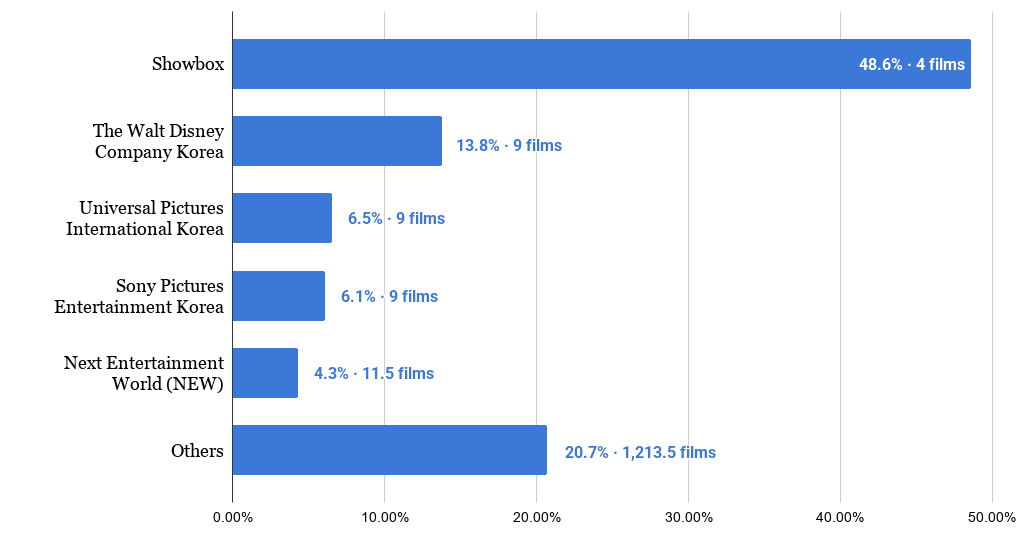
Top 5 Distributors by Box Office Revenue Share, H1 2026
Source: KOBIS (Korea Box-office Information System), data as of June 30, 2026
In the first half of 2026, Showbox recorded revenue of KRW 281.4 billion, accounting for 48.6% of the total market and ranking first among all distributors by a wide margin. Beginning with Once We Were Us, followed by The King’s Warden, Salmokji: Whispering Water, and Colony, the company released four consecutive box office hits. These four titles occupied the top 4 positions among Korean films released during the first half.


In contrast, other major investors-distributors—including CJ ENM, Lotte Cultureworks (Lotte), Megabox Plus M (Plus M), and Next Entertainment World (NEW)—adopted a more conservative strategy during the first half, focusing on the upcoming second half. CJ ENM, one of the strongest players in the distribution market, generated only KRW 5.7 billion in box office revenue during the first half, having released no commercial Korean films during the period. This follows a similarly cautious approach in 2025, when they distributed only two films - Pretty Crazy, No Other Choice. Rather than pursuing a high-volume release strategy, CJ ENM appears to be concentrating on a smaller number of large-scale, high-profile projects. Plus M also recorded only KRW 3.0 billion in revenue during the first half, with no commercial film releases, as it focused on its second half lineup beginning with HOPE, one of the most anticipated summer releases. Meanwhile, NEW, which achieved success with My Daughter is a Zombie last year, released HUMINT in the first half. However, the film failed to surpass 2 million admissions. NEW recorded KRW 24.9 billion in revenue, ranking second among Korean film distributors. Lotte released 2 commercial films, Heartman: Rock and Love and Wild Sing, but neither achieved significant box office success, attracting approximately 250,000 and 1.35 million admissions respectively. Lotte recorded KRW 16.8 billion in revenue during the first half of the year.
Meanwhile, the distinction between traditional peak and off-peak seasons in the domestic distribution market is gradually blurring. In the past, blockbuster films with summer or year-end release windows were often considered essential for commercial success. Recently, however, box office performance has increasingly been driven by a film’s quality, audience reception, and word-of-mouth rather than by its release date alone. As a result, distributors are becoming more flexible in determining release schedules, taking into account a film’s readiness and competitive market conditions rather than concentrating release within specific seasonal windows.
Theatrical Reach
Korean Films Drive the Recovery of the Cinema Market
The Korean theatrical market showed a clear recovery in the first half of 2026 compared with the previous year. Total box office revenue reached KRW 579.0 billion, up 41.9% year-over-year, while admissions increased 34.2% to 57.05 million. Unlike 2025, when the market lacked a 10 million admission hit and was driven by foreign films such as Japanese animation and Hollywood blockbusters, Korean films accounted for 63.9% of total box office revenue in the first half and played a leading role in the market’s recovery.
The box office was dominated by Korean films, with The King’s Warden, Colony, and Salmokji: Whispering Water ranking first, second, and third respectively. In particular, The King’s Warden, the highest-grossing film of the period, generated KRW 163.1 billion in revenue and became the highest-grossing film in Korean box-office history. Revenue from Korean films reached KRW 370.2 billion during the first half, an increase of 81.7% compared to the same period in 2025. This represents a recovery to 94.2% of the average revenue for Korean films in the first half of the pre-pandemic years (2017 to 2019)
Box Office Revenue Share and Number of Films Released by Country, H1 2026
Slice size represents box office revenue share; figures inside indicate number of films released.

Slice size represents box office revenue share; figures inside indicate number of films released.
Source: KOBIS (Korea Box-office Information System), data as of June 30, 2026
Signs of change also emerged in box office trends. While historical drama or action blockbusters have traditionally dominated the Korean box office, the first half of 2026 saw successful performances from a wide range of films, including mid-sized romance and horror films. This diversification suggests a broader spectrum of audience demand and a more varied box office landscape. Another notable feature was that young audiences in their 20s were the driving force behind the success. According to CGV ticketing data, audiences in their 20s accounted for 43% of admissions for Once We Were Us, while the same age group also accounted for 34% of admissions for Salmokji: Whispering Water, and 31% for Colony, the highest share among all age groups for each title. The growing influence of social media engagement and word-of-mouth among younger moviegoers is becoming an important factor in theatrical success1.
However, it is difficult to conclude that the recovery trend in the first half of the year has led to a stable recovery across the entire industry. The King’s Warden, alone accounted for 28.2% of total first half box office revenue, raising concerns about the market’s heavy reliance and the concentration of audiences on a small number of blockbuster titles. Furthermore, a series of events—including Megabox Joongang’s application for corporate rehabilitation and the suspension of merger discussions between Lotte Cinema and Megabox—which spread a sense of crisis throughout the Korean film industry, demonstrate that the theater industry continues to face structural difficulties.
Meanwhile, the government has continued efforts to stimulate cinema attendance through audience-support initiatives. Following a similar program in the previous year, the government again distributed cinema discount vouchers in 2026 and expanded the ‘Culture Day’ program to twice per month. The KRW 6,000 discount vouchers distributed in May and July are believed to have had a partially positive impact on maintaining audience demand even after the peak box office performance of The King’s Warden.
-
1 Son Jeong-bin, “이제 20대가 본다 영화가 살았다 관객이 늘었다”, Newsis, 2026.6.18.
https://www.newsis.com/view/NISX20260617_0003673136
Technology and Production Services
Spread of AI Film Production and Expanded Government Support
In the first half of 2026, the use of generative AI in the Korean film industry continued to expand beyond post-production into the entire stage of the filmmaking process. According to the 2025 Fourth Quarter and Annual Content Industry Trend Analysis Report (Korea Creative Content Agency, 2026), the adoption rate of generative AI across Korea’s content industries increased steadily from 12.9% in 2024 to 32.1% in 2025. The adoption rate of the film sector recorded a sharp increase of 21.3%p, rising from 8.7% in 2024 to 30.0% in 2025.
As the use of generative AI has expanded, the Korean film industry has recently seen not only hybrid films combining AI-generated and live-action elements, but also feature-length films created entirely with generative AI. Films such as Man in Hanbok and I Am POPO were released in theaters after being produced entirely through generative AI workflows. However, despite impressive capabilities in creating visual scenes, limitations remain such as unnatural emotional expression and a lack of overall cinematic quality, preventing these films from achieving commercial success. Nevertheless, recent developments suggest that generative AI is moving beyond the experimental stage and becoming a practical production tool within the filmmaking process.
The government has also expanded its support in response to these technical changes. The AI-related budget for 2026 was tripled compared with the previous year. KOFIC launched a new ‘AI Film Production Support Program’, providing support for feature-length and short-form films that incorporate generative AI into the production. In addition, through the supplementary budget for 2026, KOFIC introduced the ‘Advanced Production Technology Support Program’, allocating KRW 8 billion to support projects utilizing advanced production technologies such as VFX, virtual production, and premium exhibition formats. These initiatives demonstrate that policy support aimed at fostering technologies as a new competitiveness for the Korean film industry.
Streaming & Digital Platforms
The Steady Growth of Platforms and the Need for Regulatory Reform
The domestic streaming platform market is showing steady growth. According to the data from Wiseapp-Retail in May 2026, the combined monthly active users (MAU) of major OTT applications reached 22.09 million, up 4% from 21.24 million in the same month of the previous year. Over the past three years, the OTT app users have grown at a compound annual growth rate (CAGR) of 5.7%, demonstrating sustained expansion.
In terms of platform market share, Netflix remained the market leader with a 37.8% share of users, followed by CoupangPlay (24.4%), TVING (17.8%), Disney+ (6.7%), and Wavve (6.1%). Among domestic OTT platforms, CoupangPlay increased its share by approximately 4.4%p YoY, although the gap with Netflix remained substantial.
According to Korea’s Financial Supervisory Service, both Wavve and TVING recorded operating losses for four consecutive years between 2022 and 2025 despite revenue growth in some years. In contrast, Netflix surpassed KRW 1 trillion in annual revenue in 2025 and maintained stable profitability, posting operating profits in the range of KRW 10-20 billion for four consecutive years. Domestic OTT platforms, whose subscriber bases are largely limited to the Korean market, continue to face a difficult dilemma: increasing investment often leads to larger losses, while reducing investment can weaken their competitiveness. In addition to external challenges, recent large-scale personal data breaches at both TVING and CoupangPlay have further compounded the situation. To strengthen their competitiveness, TVING and Wavve have continued merger discussions and are exploring opportunities in sports, live-event content, and international markets etc.
As OTT platforms play an increasingly significant role across the film industry, there has recently been a growing need to modernize the legal framework to reflect the shifting boundaries between film, broadcasting, and OTT service. During the first half of 2026, policymakers and industry stakeholders actively debated a range of issues, including window regulations between cinema and online releases (‘holdback’), the revision of the audiovisual industry’s legal framework to incorporate OTT services, and the potential imposition of fund contribution on OTT operators.
Beyond OTT services, traditional ancillary markets continued to face structural challenges. Subscription rates for pay-TV, including IPTV and cable TV, have continued to decline. According to the 2025 Survey on Media Consumption Behavior (Korea Media and Communications Commission, 2025), the pay-TV subscription rate fell from 92.5% in 2023 to 91.4% in 2025, marking the third consecutive year of decline. However, the usage rate of VOD services among pay-TV subscribers rose slightly from 18.3% to 19.2%, suggesting a modest recovery in on-demand viewing within the traditional television market.
Co-Production
Expansion of International Co-Production Projects and Diversifying Collaboration Models
Amid continued investment contraction and rising production costs, the Korean film industry has increasingly turned to international co-production as a means of diversifying financing sources and revenue streams. Overseas expansion is also evolving beyond the traditional one-way model of exporting completed films or selling remake rights. Instead, Korean companies are pursuing interactive collaborative models that combine capital and human resources throughout the whole production process.
In Southeast Asia, one of Korea’s key co-production markets, the Korean film industry’s primary strength lies in its advanced production capabilities. Recent successful co-production projects in the region have combined Korea’s production expertise and experience in distribution and marketing with stories of local cultures. Notable examples include Leaving Mom, directed by Mo Hong-Jin, which topped the Vietnamese box office following its release in August 2025, and Mansion of Mr. Hua, which also topped the Vietnamese box office within six days of its release in June 2026. Another successful case was Ghost in the Cell, co-produced by Barunson E&A in partnership with renowned Indonesian director Joko Anwar, which generated strong box office momentum and remained at the top of the Indonesian box office for three consecutive weeks following its release in April 2026.
At the same time, the Korean film industry has also expanded its efforts to enter the North American market by leveraging its efficient production system and highly skilled workforce. Bugonia, a local remake based on Korean IP produced through a collaboration between CJ ENM and a North American production company, received critical recognition with invitations to the Academy Awards and the Venice Film Festival. In addition, director Kim Ji-woon’s The Hole, adapted from a Korean novel with North American financing and development support, and Pig Village, a project designed from its earliest stage for the North American market using Korea’s production system, serve as examples of diverse co-production models with the North American market. Both films are currently targeting release in 2026.
The Korean government has also expanded its support for international co-production in 2026. KOFIC introduced a dedicated international co-production quota within its ‘Mid-Budget Film Production Support Program’ and selected Bound by Australian filmmaker Eddy Bell, for support. Upon completion, the project is expected to become the first official Korea-Australia co-production feature film. In addition, KOFIC launched a new pilot program this year to support international co-productions, with plans to provide support for approximately 6 projects annually.
KIM Soobin
Researcher, Policy R&D Department / Korean Film Council (KOFIC)
Researcher at the Korean Film Council (KOFIC) since 2025, specializing in Korean film industry statistics, market analysis, and film policy research.
Exchange rate applied is based on the Bank of Korea’s average rate of H1 2026 (USD 1 = KRW 1,484.6)