Title
THE A REPORT
2026 H1
 SEKIGUCHI Yuko
Writer, Film Journalist, Critic, Editor
SEKIGUCHI Yuko
Writer, Film Journalist, Critic, Editor
Updated on 6 Oct 2026
Overview
By 2026, the landscape of Japan’s film industry had changed dramatically. In 2025, the government set a goal of expanding overseas sales of Japanese-originated content to JPY 20 trillion by 2033. To achieve this, the Ministry of Economy, Trade and Industry (METI) and experts from the content industry formed the “Entertainment and Creative Industries Policy Study Group.” Starting in 2026, the government announced a policy to focus on the following areas: “Support for New IP Creation,” “Support for Large-Scale Production,” “Support for Attracting Film Locations,” “Support for Expanding Distribution Platforms,” “Support for Building Development Platforms,” “Support for Overseas Expansion of the IP Ecosystem,” “Support for Localization,” and “Support for Overseas Expansion Promotion.” This initiative will be funded through the “Reiwa 7 Supplementary Budget Content Industry Growth Investment Support Project” (commonly known as the “IP360 Subsidy”). To make this a reality, entertainment companies have all sprung into action. That’s the impression from the first half of the year.
Even in the first half of 2026, some films—such as Detective Conan: Fallen Angel of the Highway (Toho, released in April), and The Super Mario Galaxy Movie (Toho-Towa)—grossed approximately JPY 13.5 billion and JPY 7.8 billion at the box office, respectively. However, the market is somewhat calmer than it was last year, when films like Detective Conan: One-Eyed Flashback and Kokuho showed signs of becoming major hits. Perhaps for this reason, one trend stands out: the key topics of the first half of 2026 all fall under IP360-related categories. The government has increased the budget for content-related initiatives for fiscal year 2026 from JPY 25.2 billion—the level maintained through fiscal year 2024—to JPY 58.9 billion. Of particular note is the “Large-Scale Production Support” initiative, which provides subsidies of up to JPY 1.5 billion to create numerous blockbuster films capable of succeeding overseas. Incidentally, to reach the JPY 20 trillion target, the goal is to increase overseas sales of animation—which stood at JPY 2.1 trillion when the plan was formulated in 2024—to JPY 6 trillion by 2033, and to raise live-action sales from JPY 100 billion to JPY 500 billion. IP360 will drive these initiatives, including the development of a financial infrastructure.
Three Japanese films were selected for this year’s Cannes Film Festival competition: Sheep in the Box directed by Koreeda Hirokazu, All of a Sudden directed by Hamaguchi Ryusuke, and Nagi Notes directed by Fukada Koji. Sheep in the Box and All of a Sudden have already been released and have been commercially successful, despite being art films.
Top 10 Films in Japanese Box Office (H1 2026)
You can scroll left and right to view the content.
| No | Title | Director | Country | Genre | Gross (JPY) |
Gross (USD) |
Production Company |
Distribution Company |
|---|---|---|---|---|---|---|---|---|
| 1 | Zootopia 2* | Jared Bush, Byron Howard | USA | Animation, Adventure | 15.70B | 100.69M | Walt Disney Animation Studios | Walt Disney Pictures |
| 2 | Detective Conan: Fallen Angel of the Highway | Hasui Takahiro | Japan | Animation, Mystery | 13.52B | 86.68M | TMS Entertainment | TOHO |
| 3 | The Super Mario Galaxy Movie | Aaron Horvath, Michael Jelenic | US, Japan | Animation, Adventure | 7.81B | 50.11M | Universal Pictures, Illumination, Nintendo | TOHO TOWA |
| 4 | The Devil Wears Prada 2 | David Frankel | US | Drama, Comedy | 5.04B | 32.31M | 20th Century Studios, Wendy Finerman Productions, Sunswept Entertainment | Walt Disney Pictures |
| 5 | Michael | Antoine Fuqua | US | Biography, Drama, Music | 4.93B | 31.63M | Lionsgate Films, GK Films, Optimum Productions | Kino Films |
| 6 | Until We Meet Again | Miki Takahiro | Japan | Drama, Mystery | 4.66B | 29.88M | - | TOHO |
| 7 | Doraemon the Movie: New Nobita and the Castle of the Undersea Devil | Yajima Tetsuo | Japan | Animation, Adventure | 4.27B | 27.36M | Eiga Doraemon Production Committee, ADK, Fujiko Productions | TOHO |
| 8 | SAKAMOTO DAYS | Fukuda Yuuichi | Japan | Animation, Action | 2.79B | 17.92M | TMS Entertainment, Shueisha | TOHO |
| 9 | Mobile Suit Gundam Hathaway: The Sorcery of Nymph Circe | Murase Shûkô | Japan | Animation, Action | 2.74B | 17.55M | Sunrise | TOHO, Bandai Namco Filmworks Inc. |
| 10 | Kyojo: Requiem | Nakae Isamu | Japan | Mystery | 2.70B | 17.31M | Fuji Television Network (Fuji TV) |
TOHO |
- *The figure represents the cumulative gross for a film released in December 2025.
Top 10 Domestic Films in Japanese Box Office (H1 2026)
You can scroll left and right to view the content.
| No | Title | Director | Country | Genre | Gross (JPY) |
Gross (USD) |
Production Company |
Distribution Company |
|---|---|---|---|---|---|---|---|---|
| 1 | Detective Conan: Fallen Angel of the Highway | Hasui Takahiro | Japan | Animation, Mystery | 13.52B | 86.68M | TMS Entertainment | TOHO |
| 2 | The Super Mario Galaxy Movie | Aaron Horvath, Michael Jelenic | US, Japan | Animation, Adventure | 7.81B | 50.11M | Universal Pictures, Illumination, Nintendo | TOHO TOWA |
| 3 | Until We Meet Again | Miki Takahiro | Japan | Drama, Mystery | 4.66B | 29.88M | - | TOHO |
| 4 | Doraemon the Movie: New Nobita and the Castle of the Undersea Devil | Yajima Tetsuo | Japan | Animation, Adventure | 4.27B | 27.36M | Eiga Doraemon Production Committee, ADK, Fujiko Productions | TOHO |
| 5 | SAKAMOTO DAYS | Fukuda Yuuichi | Japan | Animation, Action | 2.79B | 17.92M | TMS Entertainment, Shueisha | TOHO |
| 6 | Mobile Suit Gundam Hathaway: The Sorcery of Nymph Circe | Murase Shûkô | Japan | Animation, Action | 2.74B | 17.55M | Sunrise | TOHO, Bandai Namco Filmworks Inc. |
| 7 | Kyojo: Requiem | Nakae Isamu | Japan | Mystery | 2.70B | 17.31M | Fuji Television Network (Fuji TV) | TOHO |
| 8 | Cosmic Princess Kaguya! | Yamashita Shingo | Japan | Animation, Musical | 2.67B | 17.10M | Twin Engine, Studio Colorido Co | Twin Engine |
| 9 | The Last Man THE MOVIE: FIRST LOVE | Hirano Shunichi | Japan | Mystery | 1.72B | 11.01M | TBS Television | Shochiku |
| 10 | Gintama the Movie 2026: Yoshiwara in Flames | Ando Naoya | Japan | Animation, Action, Comedy | 1.57B | 10.06M | BN Pictures | Warner Bros. Entertainment Inc., Bandai Namco Filmworks Inc. |
- Source: Original research
- Exchange Rate: USD 1 = JPY 155.95
- Exchange Rate: USD 1 = JPY 155.95
Production Landscape
Domestic Features Released and Screens, H1 2026
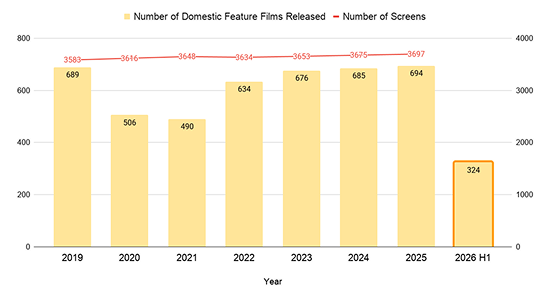
In the first half of 2026, a total of 324 Japanese films were released, including re-releases of older titles. By genre, there were 79 dramas, 56 animated films, and 50 documentaries. While horror releases totaled 26 in the first half of the year, the genre is one to watch heading into the second half. Japanese horror films, which already have a proven track record in overseas markets, are becoming a key driver for co-productions, foreign business partnerships, and the global expansion of Japanese intellectual property (IP). Initiatives such as the “Yami International Film Festival,” dedicated entirely to horror, and the “Japan Horror Film Awards” have also been established to further revitalize the market.
One project worth noting is Godzilla Minus Zero, scheduled for release in Japan on November 3. It serves as the sequel to Godzilla Minus One, which featured a bold new interpretation, and is generating buzz as the first Japanese film to meet the “Filmed For IMAX” standard. Its release has already been confirmed in North America, Asia, and the Middle East.
Another topic of interest is the slate of films produced through the K2P Film Fund Ⅰ, a production fund managed by K2 Pictures. Director Koreeda Hirokazu’s Look Back and director Nishikawa Miwa’s Children Untold are generating significant buzz (Section 8 features an interview with Kii Muneyuki, CEO and Representative Director of K2 Pictures).
Another notable topic is the Toho-distributed film Chiikawa the Movie: The Secret of the Mermaid Island, released in July, following the first half of the year. Prior to its release, Toho stated that the film “has the potential to achieve top-tier box office results” and it is currently living up to those expectations.
Moving into the second half of the year and beyond, we look forward to keeping an eye on films from TBS Holdings—which has formed a strategic partnership with the U.S. production company Legendary Entertainment—as well as those from UNITED PRODUCTIONS, a production company that aims to “expand globally as a supplier of horror content.”
In labor-related news, the Japan Film Production Standardization Organization (EITEKI)—a third-party body voluntarily launched in April 2023 by the film industry to improve working conditions and business relationships on film sets and create a safe working environment for staff—announced a shift in its funding model, from the previous system of collecting “1% of the guaranteed payment for works applying for EITEKI certification” to a “fixed-rate membership fee system.” Additionally, to further pursue fair practices across all video production sites, EITEKI revised nine sections of its guidelines.
Financing Models
In Japan, film production is generally carried out through a production committee system. Production costs are funded by a combination of capital provided by industry companies listed as members of the production committee, government grants and subsidies, international co-productions, crowdfunding, and private funds. A notable development this year is the launch of K2P Film Fund I, a private film production fund established on May 10, 2024, that is set to become a new funding model for Japanese cinema, with participation from financial institutions and business companies, including Mitsubishi UFJ Bank and the Development Bank of Japan.
On April 17 of this year, the “Cool Japan–SBI Content Investment Limited Partnership,” was announced—a JPY 12.5 billion venture capital fund, with up to JPY 10 billion contributed by the Cool Japan Organization (Overseas Demand Development Support Organization). However, in June, after the Cool Japan Organization reported a cumulative deficit of JPY 54 billion in its fiscal year 2025 financial statements, the Ministry of Economy, Trade and Industry (METI) announced that it would consider restructuring options, including integration with another organization or abolition, and make necessary adjustments. The ministry is considering establishing an authorized corporation to serve as the central coordinating body for promoting the content industry overseas.
Separately, the SBI Group plans to invest in the “SBI Neo Content Investment Limited Partnership,” a large-scale content investment fund worth JPY 100 billion, through a fund-of-funds structure.
Major Japanese film studios have also taken steps toward overseas expansion.
Toei has entered into a strategic co-production partnership with M Distribution Co., Ltd., a subsidiary of Thailand’s largest cinema chain, Major Cineplex Group. Together with this company—which possesses strengths in creativity and the distribution of films to Thailand, Laos, and Cambodia—Toei will develop and manage international intellectual property (IP).
Toho is aiming for a 30% ratio of overseas revenue by 2032 and is accelerating its overseas expansion centered around its holding company, TOHO Global Co., Ltd. It has formed strategic alliances with Toho International and the animation distribution and marketing company GKIDS in North America; Toho Entertainment Asia in Asia; and PLAION PICTURES in Germany; and has acquired all shares of its subsidiary, Anime Ltd. in the United Kingdom.
Distribution Climate
Distributors' Market Share, H1 2026
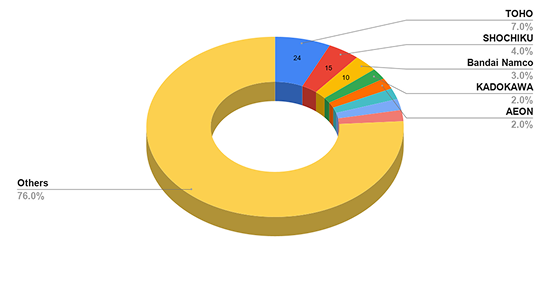
* Market share is calculated based on the number of films released.
There is no change to the fact that the “first window” consists of theatrical screenings provided by film distribution companies—which hold the distribution rights to films they have produced or acquired—to exhibition companies that own multiplexes and other venues. For purchased films, the film distribution company manages the rights, while for produced films, the managing company of the production committee does so. Subsequently, the films are distributed through video-on-demand (VOD) services, video media (DVD/Blu-ray), and in-flight and onboard screenings as the “second window,” followed by television broadcasts (terrestrial, BS, and CS).
What has become particularly noticeable is the shortening of the period before video-on-demand services—which constitute the “second window”—begin. An increasing number of films are becoming available on video-on-demand services approximately 45 days after the end of their theatrical run. A notable case, however, is the animated film Cosmic Princess Kaguya! (distributed by Twin Engine), which had a special theatrical release on February 20. While this film began streaming on Netflix simultaneously, it also became a massive hit at the box office, grossing approximately JPY 2.67 billion by June.
Is this a phenomenon unique to Japan? Aside from new theatrical releases, two major trends stand out.
First, there are revival films. These are proving to be even bigger hits than new releases. A prime example is The Fall 4K Digital Remastering (2006, distributed by Showgate). It opened in just 43 theaters last November, gained traction through word of mouth, and expanded to 100 theaters. It enjoyed a long theatrical run spanning 25 weeks. Last October, Princess Mononoke (1997, distributed by Toho) and Kiki’s Delivery Service (1989, distributed by Toho)—both screened in IMAX in their 4K digitally remastered versions—became massive hits. One reason behind the high anticipation is that none of these films are available for streaming; viewers can only watch them by waiting for a TV broadcast or purchasing the home video release. In the first half of this year, the number of films undergoing 4K digital remastering and being revived in theaters has been increasing.
Another category is ODS (Other Digital Stuff) content. This includes live and recorded music concerts; live broadcasts of stage performances such as plays and musicals; traditional performing arts like Kabuki and Rakugo; Western classical arts such as classical music, opera and ballet; and public viewings of major sporting events like the World Cup and the World Baseball Classic.
Tickets for ODS events cost more than twice the price of a standard movie ticket. Since these genres have a dedicated fan base, theaters can expect near-capacity crowds, making it easier to estimate profits even when production costs are high. In 2026, more than 25 titles were screened each month, totaling 173 titles in the first half of the year.
Theatrical Reach
In recent years, while the number of traditional movie theaters has been gradually declining, the opening of multiplexes has led to a slight increase in the total number of screens. In 2026, Shinjuku Cinema Qualite and Cine Libre Ikebukuro in Tokyo closed in January; MOVIX Sakai in Osaka Prefecture closed in February; Satsugeki in Sapporo, Hokkaido, closed in March; and Cinema Sunshine Numazu in Shizuoka Prefecture and AEON CINEMA Kitakami in Iwate Prefecture closed in April. On the other hand, AEON CINEMA Ezuriko opened in Iwate Prefecture in April, TOHO Cinemas Oimachi opened in Tokyo in March, and TOHO Cinemas Nagoya Sakae opened in June. The closures of traditional movie theaters are expected to continue into the second half of the year.
Movie ticket prices are trending upward. As a result, even if theater attendance declines compared to last year—when hit films such as Demon Slayer: Kimetsu no Yaiba, Detective Conan: One-Eyed Flashback, and Kokuho were released—overall box office revenue may not change significantly. Looking at standard ticket prices, T-Joy raised its price to JPY 2,200 last September, and Shochiku Multiplex Theaters (SMT) raised theirs to JPY 2,100 in October. Earlier this year, in June, Aeon Entertainment announced a price increase to JPY 2,000.
Subsequently, Tokyu Recreation (109 Cinemas) and TOHO Cinemas abolished their nationwide uniform pricing and introduced a tiered system. In June, 109 Cinemas set prices between JPY 2,000–2,200 for non-members and JPY 1,800–2,000 for Cinema Point members. Following the first half of the year, in July, TOHO Cinemas also revised its prices to a range of JPY 2,000–2,200.
At the Tokyo International Film Festival, Mr. Ando Hiroyasu, who had served as chairman for seven years, stepped down effective May 31. The position of chairman was left vacant, and Mr. Hisamatsu Takeo, who served as Festival Director from 2017 to 2021, has resumed that role. Additionally, the SKIP City International D-Cinema Film Festival, which had served as a launching pad for young filmmakers, concluded with its 22nd edition last year, and it was announced that it will restart in a new format this year.
Family-friendly Disney films were a major draw at the box office in the first half of the year. The top three box office hits through June were Zootopia 2 (distributed by Disney) with approximately JPY 15.7 billion, Detective Conan: Fallen Angel of the Highway (distributed by Toho) with approximately JPY 13.5 billion, and The Super Mario Galaxy Movie (distributed by Toho-Towa) with approximately JPY 7.8 billion.
Technology and Production Services
Technological changes have been particularly evident in the animation market. There has been a rise in international co-productions, in which Japanese production companies partner with overseas streaming and distribution companies to share the burden of production costs while securing overseas distribution channels. Following the first half of the year, in July, Aniplex and Crunchyroll signed an agreement regarding worldwide theatrical distribution. The Japanese anime market has now grown to approximately USD 13.5 billion, driven by expanding overseas sales, investment in original content by streaming platforms, the diversified development of IP across games, movies, events, and merchandise, and government support for content exports.
The following are the major platforms and services that build and provide digital ecosystems.
First, following the first half of the year, in July, Nakama, Inc. launched AniBiz.com, an online platform serving as a B2B marketplace that connects Japanese anime studios and anime IP holders with overseas licensees seeking to develop merchandise, games, streaming content, advertising, and events. It digitizes the global expansion, rights management, and licensing transactions of anime IP to promote the globalization of the anime industry.
MangaNow Studio, a next-generation manga and anime production studio and platform, uses AI to enhance creativity and generate new value in storytelling, producing high-quality manga and anime through the collaborative efforts of AI and professional creators. Operated by IMAKAI Co., Ltd., the platform also matches professional creators, addressing challenges such as talent shortages and production efficiency. However, regarding the use of AI, there are still many issues that require further discussion, including quality, copyright, creators’ rights, and the source data used for training.
Streaming & Digital Platforms
In 2025, the market size for Japan’s subscription-based video streaming services was estimated at approximately JPY 601.7 billion, a 14.3% increase from the previous year. While the market experienced rapid growth following the COVID-19 pandemic, growth had slowed since 2021; however, it showed a high growth rate in 2025.
This is due to rising average revenue per user and an increase in the number of services used per person. This growth resulted from price adjustments, such as Netflix’s rate hike in October 2024 and Prime Video’s launch of a paid, ad-free plan in April 2025 in anticipation of introducing ads. It was also driven by a 0.2 increase in the number of services used per person compared to the previous year.
Netflix retained its top spot in the domestic Subscription Video on Demand (SVOD) market, as it did the previous year. U-NEXT ranked second, and Prime Video ranked third.
Japan SVOD Market Share, 2025
You can scroll left and right to view the content.
| Rank | Platform | Market Share | Change |
|---|---|---|---|
| 1 | Netflix | 27.1% | +5.6 pp |
| 2 | U-NEXT | 17.1% | -0.8 pp |
| 3 | Prime Video | 12.1% | -1.0 pp |
| 4 | Disney+ | 8.4% | -0.6 pp |
| 5 | DAZN | 8.2% | -1.2 pp |
| 6 | Hulu | 5.0% | -0.7 pp |
| 7 | d Anime Store | 3.9% | -0.7 pp |
| 8 | TELASA | 3.1% | +0.7 pp |
| 9 | Lemino | 2.8% | -0.4 pp |
| 10 | FOD Premium | 2.6% | +0.1 pp |
- Source: GEM Partners. YoY change represents the percentage point change from 2024.
On the business front, Netflix announced a strategic partnership with MAPPA, the animation studio behind Chainsaw Man and Jujutsu Kaisen. The companies will launch new projects focused on story development and merchandise expansion with an eye toward the global market. Additionally, during the first quarter, Netflix reached 31.4 million viewers with its Japan-exclusive broadcast of the World Baseball Classic. In addition to membership growth driven by the streaming of BTS’s comeback concert, factors such as a price increase and rising advertising revenue contributed to Netflix recording its highest market share since launching its service in Japan.
U-NEXT established StudioMonowa Co., Ltd. in partnership with TBS Holdings and South Korea’s CJ ENM. As a premium IP studio targeting the global market, the company will leverage Japanese and South Korean platforms, IP, and production capabilities to jointly plan and develop world-class video content. In conjunction with this, U-NEXT Holdings acquired the animation production company GoHands. By securing its own animation production line, the company has laid the groundwork to make a leap toward becoming a comprehensive IP producer. As of the end of May, the number of subscribers stood at 5.22 million, an increase of 490,000 compared to the same period last year.
Interview
with KII Muneyuki, CEO of K2 Pictures
Film Financing Alternatives to the Production Committee System
In 2004, with the enforcement of the amended Trust Business Act in Japan—which removed restrictions on trust assets—it became possible to establish funds that sell and manage beneficial interests in copyrights and patent rights entrusted by IP holders. At the time, megabanks such as Mizuho Bank and Sumitomo Mitsui Banking Corporation, as well as specialized funds like JDC Trust, Cinema Investment, and Japan Asia Investment Co., Ltd., established film funds targeting corporations and individual investors. These funds garnered attention from filmmakers as a new method of fundraising and from individual investors as a way to support their favorite movies. However, not all of these ventures were successful.
About 20 years have passed since then. K2 Pictures has launched the film production fund K2P Film Fund I. Major financial institutions, including Mitsubishi UFJ Bank and the Development Bank of Japan, have participated. In February of this year, the fund closed with a total size of approximately JPY 5 billion, and at the Cannes Film Festival in May, it announced a lineup of 10 new films. Among the films distributed by K2 Pictures, director Koreeda Hirokazu’s Look Back and director Nishikawa Miwa’s Children Untold have already generated significant buzz. We spoke with KII Muneyuki, CEO and Representative Director of K2 Pictures, about the fund, which is brimming with challenging projects.
 Shumei: The living legacy of Kabuki, Director Miike Takashi
 © 2026 K2 Pictures·3Top
Q. There have been many film funds in Japan in the past. However, most of them failed, and very few are still active today. Please tell us why you decided to launch K2P Film Fund I.
A.You never know if a movie will be a hit until you make it. Movies are highly volatile financial products. That’s why, generally speaking, the more challenging the project, the harder it is to secure funding. As Director Nishikawa Miwa has said, Children Untold likely wouldn’t have been made if it hadn’t been produced by K2 Pictures. After all, people would probably think we were out of our minds to spend JPY 800 million on an ensemble drama set in postwar Japan, with war orphans as the main characters. We created the fund so that we could make movies freely.
Q. Could you explain your approach to risk hedging?
A.K2P Film Fund I plans to produce 50 films over seven years. When you make 50 films, some will be hits and others won’t. The fund operates as a blind pool, raising capital without disclosing investment targets in advance and building its portfolio sequentially based on the judgment of K2 Pictures’ producers. Since we don’t judge success based on a single film but instead diversify investments across multiple projects, we can make bold investments in films that might become blockbusters or in edgy, innovative works. Managing the portfolio in this way is also one way to address the high-risk, high-return nature of the film business.
K2P Film Fund I does not simply use the JPY 5 billion in private equity it has raised to produce 50 films at JPY 100 million each. For example, it might enter into a multi-year exclusive global streaming agreement with Netflix and use that contract as collateral to secure a loan. By applying leverage, the fund grows its capital. If a JPY 5 billion fund is increased to JPY 15 billion in this way, the profit distribution on the JPY 5 billion in equity will come from the JPY 15 billion worth of films. The idea is that as the fund grows, so do the profits. If the final revenue reaches JPY 16 billion, we repay the JPY 10 billion loan, recover the initial JPY 5 billion in equity, and the remaining JPY 1 billion is recorded as profit. I believe this is a significant benefit, even if the amount is small. Under the production committee system—which is a voluntary association under the Civil Code—only companies engaged in the content business (even if only partially) may contribute capital; foreign companies that do not participate in the operation of the funded project within Japan and merely provide capital are not permitted to participate. K2P Film Fund I aims to serve as a platform for these companies.
K2P Film Fund I does not simply use the JPY 5 billion in private equity it has raised to produce 50 films at JPY 100 million each. For example, it might enter into a multi-year exclusive global streaming agreement with Netflix and use that contract as collateral to secure a loan. By applying leverage, the fund grows its capital. If a JPY 5 billion fund is increased to JPY 15 billion in this way, the profit distribution on the JPY 5 billion in equity will come from the JPY 15 billion worth of films. The idea is that as the fund grows, so do the profits. If the final revenue reaches JPY 16 billion, we repay the JPY 10 billion loan, recover the initial JPY 5 billion in equity, and the remaining JPY 1 billion is recorded as profit. I believe this is a significant benefit, even if the amount is small. Under the production committee system—which is a voluntary association under the Civil Code—only companies engaged in the content business (even if only partially) may contribute capital; foreign companies that do not participate in the operation of the funded project within Japan and merely provide capital are not permitted to participate. K2P Film Fund I aims to serve as a platform for these companies.
Q. Please explain K2 Pictures’ role.
A. Profits from hit films go back to the fund, not to K2 Pictures. While dividends to K2 Pictures are minimal, we’ve separated the risks, so even a major failure wouldn’t cause significant damage. In exchange for a lower profit margin from the fund, K2 Pictures operates as a production company that takes on commissions to create Netflix series and TV dramas, and as a distributor that handles commissioned and acquired titles. To prevent any potential conflict of interest or breach of fiduciary duty, K2 Pictures does not produce film projects outside the fund; all our film productions are carried out using the fund’s capital.
Q. Who decides to give the green light for a film’s production, and under what authority?
A.The eight producers I trust are responsible for evaluating and selecting projects for production. They only approve projects for which they have a sound, theoretical basis for success; anything that won’t turn a profit is rejected. In return, I never tell them to cast an actor just because they’re a box-office draw. I don’t operate under the mindset that a project needs to recoup its costs in Japan alone. I grant the producers full responsibility and authority from production through to recoupment, so they have a great deal of discretion. But there’s only one requirement: to turn a profit. While the honor of winning film awards certainly helps raise the profile of the film and the producers, what ultimately matters is how we generate a profit. That is where the responsibility lies. Ultimately, the final decision to give the green light rests with three people: myself, our outside director Frederic Katsuro Schmidt, and Kouda Tetsuro of the game company Akatsuki.
Q. Your career, Mr. Kii, began in film exhibition at Toei. During your time at T-Joy (now a wholly-owned subsidiary of Toei), you launched a multiplex chain and established live viewings as a new business venture. After that, you gained experience in production and distribution within the Programming and Film Planning Departments, and eventually founded K2 Pictures at just the right moment. Finally, I’d like to ask you one last time: Could you tell us why you decided to launch this fund?
A.In the Japanese film industry, the structure is such that companies take the profits, so creators don’t have sufficient incentives. It’s a system where creators simply can’t make money no matter what they do. Naturally, their motivation ends up being low. Our fund is an impact fund that gives 30 percent of the success fee to the creators. We ask investors to contribute on the premise that a portion will go to the creators from the very beginning. If they don’t like that, we tell them to make their money through stocks, bonds, real estate, or other means. No matter how many years you’re in the business, you never know whether a movie will be a hit or not. I’m sure no one really knows. But unless talented creators are nurtured, there is no future for the industry.
SEKIGUCHI Yuko
Writer, Film Journalist, Critic, Editor
After serving as Managing Editor of Kinema Junpo and Editor-in-Chief of Variety Japan, Sekiguchi Yuko established Avanti Plus Co., Ltd. Currently freelance. Served on the Ministry of Internal Affairs and Communications Intellectual Property Strategy Headquarters Content Licensing Council, Agency for Cultural Affairs Grant Review Committee, Agency for Cultural Affairs Film Promotion Consultation Panel, Corporate Mecenat Conference, international film festival juries, Japan Arts Council Film Festival Division Chief Examiner, Agency for Cultural Affairs Arts Selection Award Jury, Ministry of Education, Culture, Sports, Science and Technology Educational Video Review Panel, Kinema Junpo Best Ten Selection Committee, Mainichi Film Awards Jury, and Tokyo International Film Festival Selection Advisory Board. Works across newspapers, magazines, web, radio, television, and streaming platforms.