Title
THE A REPORT
2026 H1
 Nyay BHUSHAN
Producer, Photographer
Nyay BHUSHAN
Producer, Photographer
Updated on 6 Oct 2026
Overview
Happy Days Again?
The first half of 2026 has given some cause for optimism for the Indian industry, thanks largely to continued momentum at the box office and more importantly, the early stages of what could be a galvanised push for new funding models which will be a closely watched trend if it yields results in the near future.
The year’s first half saw total box office climb to INR 63.98 billion (USD 662.5 million), registering an 11.3% jump from the same period in 2025, making it the highest grossing January-June period since the pandemic, according to Ormax Media. Footfalls at Indian cinemas in H1 2026 jumped to 378 million, a 4.4% rise from 362 million in the same period in 2025.
This uptick was powered by a handful of blockbusters which dominated over smaller films. While six films crossed the INR 2 billion (USD 20.7 million) mark, up from four in H1 2025, the total number of films crossing the threshold INR 1 billion (USD 10.36 million) mark actually dropped from 17 to 13.
The blockbuster momentum could continue in the second half of the year thanks to a promising lineup of films such as the much-awaited epic Ramayana: Part 1 due in November which will be preceded by high octane offerings such as Jailer 2 in October, followed by Telugu language drama Fauzi and superstar Shah Rukh Khan’s King, both releasing in December along with Hollywood tentpoles Avengers: Doomsday and Dune Part 3.
Assuming H2 2026 lives up to expectations, Ormax Media predicts that overall in 2026, the Indian box office could cross INR 150 billion (USD 1.55 billion), becoming the best-ever year for India, beating the current record of INR 133.95 billion (USD 1.39 billion) set in 2025.
The annual industry report for 2025 (released in March) by Ernst and Young and the Federation of Indian Chambers of Commerce and Industry (FICCI) also predicts rosy growth for Indian films. It expects filmed entertainment to grow at a 7% CAGR and reach INR 253 billion (USD 2.62 billion) by 2028.
The first half of 2026 was powered by the massive Hindi blockbuster Dhurandhar 2: The Revenge, the much-awaited spy action sequel to last year’s explosive hit Dhurandhar (as featured in the H2 2025 report). The duology unleashed fierce debates about how it mixed fact and fiction like never seen before in Indian cinema to portray India’s long-running battles against Pakistan-backed terrorism attacks. The spectacular box office performance of both films has not only upped the ante for Indian action films, they also helped reclaim the Hindi industry’s market share which was being yielded to South Indian industries in earlier years (as explained in the H1 2025 report). In H1 2026, Hindi cinema’s share grew by 5 percentage points, from 39% to 44%, compared to the same period in 2025.


Regardless, the South Indian Telugu industry still continued to make an impact with three films in the top ten with sports drama Peddi (The Leader), starring superstar Ram Charan, landing at the third spot with an INR 2.82 billion (USD 29.2 million) haul.

Released in March, Dhurandhar 2 collected INR 12.77 billion (USD 132.2 million) making it the highest grossing Hindi film of all time at the Indian box office while its worldwide haul of INR 18.13 billion (USD 187.74 million) made it the second highest grossing Indian film of all time. Dhurandhar 2 was responsible for almost 20% of the total Indian box office haul for H1 2026. In all, the Dhurandhar franchise, headlined by top star Ranveer Singh and directed by Aditya Dhar, has amassed a phenomenal worldwide total of approximately INR 32 billion (USD 331 million) proving that, when they connect with audiences, big-budget extravaganzas are time-tested vehicles to stimulate theatrical attendance at a massive scale. But this also means that theatrical revenues can be highly dependent on a handful of big-budget films rather than being interspersed with a slew of mid-budget films.
Top 10 Films in Indian Box Office (H1 2026)
You can scroll left and right to view the content.
| No. | Title | Director | Primary Language | Genre | Gross (INR) |
Gross (USD) |
Production Company |
Distribution Company |
|---|---|---|---|---|---|---|---|---|
| 1 | Dhurandhar 2: The Revenge | Aditya Dhar | Hindi | Action, Thriller | 12.77B | 132.2M | Jio Studios, B62 Studios | Jio Studios |
| 2 | Border 2 | Anurag Singh | Hindi | War, Action | 3.79B | 39.2M | T-Series, JP Films | AA Films, T-Series |
| 3 | Peddi (The Leader) | Buchi Babu Sana | Telugu | Action, Sports Drama | 2.82B | 29.2M | Vriddhi Cinemas, Sukumar Writings, Mythri Movie Makers | Mythri Movie Makers |
| 4 | Mana Shankara Vara Prasad Garu (Our Respected Shankara Vara Prasad) | Anil Ravipudi | Telugu | Action Comedy | 2.55B | 26.4M | Shine Screens | Mythri Movie Distributors |
| 5 | Karuppu (The Protector) | RJ Balaji | Tamil | Legal, Action Thriller | 2.29B | 23.7M | Dream Warrior Pictures | Red Giant Movies |
| 6 | Bhooth Bangla (Haunted Mansion) | Priyadarshan | Hindi | Horror Comedy | 2.03B | 21.0M | Cape of Good Films, Balaji Motion Pictures | AA Films |
| 7 | The Raja Saab (The King) | Maruthi | Telugu | Romantic Horror Comedy | 1.72B | 17.8M | People Media Factory | People Media Factory |
| 8 | Welcome to the Jungle | Ahmed Khan | Hindi | Action Comedy | 1.64B | 17.0M | Base Industries Group, Jio Studios | Jio Studios |
| 9 | Vaazha II: Biopic of a Billion Bros | Savin S.A. | Malayalam | Comedy Drama | 1.41B | 14.6M | WBTS Productions, ImaginCinemas | Sree Gokulam Movies |
| 10 | Drishyam 3 | Jeethu Joseph | Malayalam | Crime Thriller | 1.29B | 13.4M | Aashirvad Cinemas | Maxlab Entertainments |
Production Landscape
Big is Beautiful
When it comes to the production landscape for big-budget blockbusters, the trend of casting top stars from both the Hindi and regional language industries, in an attempt to create pan-Indian films for wider appeal with dubbing across multiple languages, gradually took shape with films like K.G.F Chapter 2 and the superhit Oscar-winner RRR both releasing in 2022. The Dhurandhar franchise also featured actress Sara Arjun, who has appeared in various South Indian films, alongside top Hindi cinema star Ranveer Singh. The pan-India film trend will be tested at an even more ambitious level in H2 2026 with Ramayana which features top Hindi film actor Ranbir Kapoor alongside leading South Indian actress Sai Pallavi in addition to the wildly popular South Indian actor Yash. Beyond just aiming for India and the diaspora market, Ramayana producer Namit Malhotra, via his VFX conglomerate Prime Focus which also owns acclaimed Oscar-winning VFX powerhouse DNEG, is targeting mainstream global appeal considering the film will be distributed worldwide (except India) by Sony Pictures.
In all this talk of big-budget extravaganzas, the survival of the small to mid-budget film merits introspection since, as discussed earlier, such films still find it challenging to attract theatrical audiences. But there is hope that India’s overall production landscape can potentially get a fillip with new financing models which gathered steam in H1 2026 which could boost smaller genre films as well.
Total Revenues For Indian Films
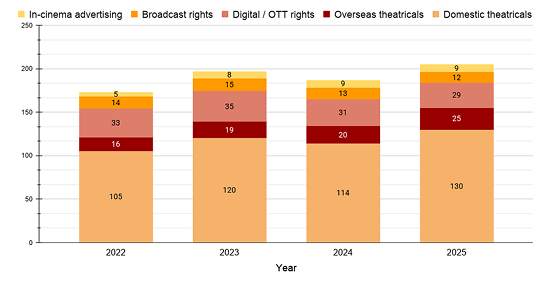
- 2022-2025 | Unit: INR billion
- Source: Ernst and Young / FICCI Report
- Source: Ernst and Young / FICCI Report
Financing Models
Nurturing New Cinematic Cash Cows
One of the most significant developments over the last couple of years has been the evolution in financing models which have been analysed in the H1 2025 and H2 2025 reports explaining how leading film companies such as Maddock Films and Excel Entertainment both attracted equity investment from the Indian arm of Universal Music. Similarly, leading label Saregama Music also invested in acclaimed filmmaker Sanjay Bhansali’s banner Bhansali Productions.
H1 2026 saw this trend developing further. Boutique banner Sikhya Entertainment sold a 50.1% stake for INR 1.5 billion (USD 15.5 million) to Reliance Strategic Business Ventures Limited, a wholly owned subsidiary of India’s largest conglomerate Reliance Industries Ltd. which has extensive interests in media and entertainment with its JioStar conglomerate and JioStudios. The deal valued Sikhya Entertainment at about INR 3 billion (USD 31 million). Founded in 2008 by producer Guneet Monga Kapoor and Achin Jain, Sikhya has primarily backed independent films such as the Oscar-winning Netflix documentary short The Elephant Whisperers (2022) and popular festival titles such as The Lunchbox which premiered at Cannes in 2013. Sikhya will now have the support of JioStudios which is a major player and whose credits include the blockbuster Dhurandhar films.
Similarly, veteran banner Sippy Films (best known for one of Indian cinema’s all-time blockbusters, Sholay, 1975) acquired an undisclosed investment from Kuberans Tech Investments, a sector-agnostic investment firm with interests in technology, media and education. The investment is aimed at restructuring Sippy Films as a character IP-led studio by tapping into its legacy properties while developing new projects.
Birla Studios, the new venture backed by the Aditya Birla Group announced in February 2026, unveiled its first project slate in August, and will be covered in detail in the H2 2026 report.
But what could be a game changer for film financing in India is the concept of film funds which saw activity in H1 2026. Historically, Indian film financing has been highly fragmented and perceived as speculative and therefore earlier attempts at establishing dedicated film funds faltered due to various reasons. But the launch of film funds such as Filmoney Global hope to gain investor confidence and nurture out-of-the-box storytelling.
Filmoney Global is promoted by producer Siddharth Jain who earlier founded The Story Ink which is a premier book-to-screen adaptation company whose credits include the 2023 Netflix series Trial By Fire based on the book of the same name about a fatal and horrific fire tragedy in 1997 at a cinema in Delhi. Filmoney Global will operate through a series of international Special Purpose Vehicles (SPVs) focused on equity financing for theatrical-first genre films focusing more on story concept than star power, in addition to streaming and AI-led content.
With its offices in Dubai, Mumbai, London and New York, Filmoney Global will be launching “ring-fenced SPVs that give investors clean, disciplined exposure to Indian content”, according to Jain. More details about the first SPV and deployment details such as number of films and budget bands will be announced with a slate later in the year. Subsequent SPVs will follow a sequenced rollout rather than a fixed calendar and each will close when the right slate and the right partners are aligned. All this will pan out broadly over two years.
Filmoney is also looking closely at international co-productions and India-Asia collaborations along with a strong foot in the UK. Jain also points out that the community of Busan International Film Festival and Asian Contents & Film Market (ACFM) “is exactly who we want to build with.”
However, a clearer picture will only emerge from H2 2026 onwards when Filmoney Global announces its first slate of projects which will give an indication of its game plan. In essence, the purpose of a film fund is to introduce risk mitigation to the Indian film eco-system by offering a more diversified portfolio of films to invest in across genres and budgets.
Distribution Climate and Theatrical Reach
While footfalls did increase in H1 2026, thanks largely to Dhurandhar 2: The Revenge, there is still room for growth considering that back in H1 2022, footfalls touched 400 million powered by blockbusters like K.G.F: Chapter 2 and RRR. Given high anticipation for some tentpoles in H2 2026, footfall growth could be sustained.
In H1 2026, Average Ticket Price saw a slight increase largely due to higher pricing for event films, again thanks to Dhurandhar 2: The Revenge, especially for IMAX and other premium formats.
Given the historic dominance of Indian films at the box office, Hollywood hardly cracks the top 10 and H1 2026 was no different. Traditionally, Hollywood tentpoles release in the second half of the year. H2 2026 should give a clear indication if this will be a breakthrough year given the strong performance of summer tentpoles like The Odyssey and Spider-Man: Brand New Day and high anticipation for Christmas releases Avengers: Doomsday and Dune Part 3.
Market Share by Country
India (H1 2026)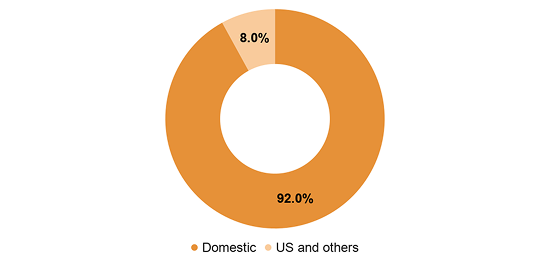
India (H1 2026)
Source: Ormax India Box Office Report H1 2026
Indie films continue to struggle for theatrical space which is dominated by mainstream cinema. But selective attempts are being made to showcase indie films. The most notable is MAMI Independent, which celebrated its first year anniversary in H1 2026 after it was launched in February 2025 as a joint initiative between the Mumbai Academy of Moving Image and leading exhibitor PVR INOX. Every Wednesday, MAMI Independent showcases an indie feature at one of the screens at the PVR Lido boutique multiplex in Mumbai. The program also includes masterclasses and interactions with filmmakers. Entry is free by registration.
Technology and Production Services
Lights, Camera, MoCap

The Indian film industry received a major tech boost in February 2026 with the launch of what is considered the country’s most advanced motion capture facility, the A&M MoCap Lab at Annapurna Studios in the southern film hub of Hyderabad. A&M MoCap is a joint venture between acclaimed actor-producer Akkineni Nagarjuna’s Annapurna Studios and blockbuster producer (credits include the Baahubali franchise) Shobu Yarlagadda’s Mihira Visual Labs along with Vancouver and LA-based Animatrik Film Design. A&M MoCap was unveiled by one of India’s most successful directors, S. S. Rajamouli whose credits include the Oscar-winning RRR and the Baahubali franchise. Animatrik’s credits include Avengers: Endgame, Ready Player One, Spider-Man: No Way Home and RRR. A&M MoCap is currently working on key sequences for Rajamouli’s much-awaited Varanasi, due for release in April 2027, which has a stellar cast for pan-India appeal featuring South Indian stars Mahesh Babu and Prithviraj Sukumaran, alongwith India’s well-known crossover star from Hindi cinema to Hollywood, Priyanka Chopra.
Indian Animation: From Myth to Momentum
Indian animation is also on the cusp of a breakthrough, as explained in the H2 2025 report with last year’s box office hit Mahavatar Narsimha, based on Indian mythology, which collected INR 3.02 billion (USD 31 million). The future looks promising given the anticipation around the upcoming animation feature Baahubali: The Eternal War Part 1, a spinoff based on the original two part, mythical epic Baahubali live action franchise released in 2015 and 2017 which was a pioneering pan-India box office sensation collecting an estimated INR 24 billion (USD 248 million).
Baahubali: The Eternal War Part 1, which is scheduled for a 2027 release, reunites Baahubali director S. S. Rajamouli and producer Shobu Yarlagadda. The film is co-produced by Yarlagadda, Rajamouli and Prasad Devineni and directed by Ishan Shukla who earned accolades with his 2024 feature animation debut Schirkoa followed by directing an episode of Star Wars: Visions while the screenplay is penned by Scott Mosier (credits include Clerks, Mallrats, Dogma). The project’s global ambitions are also seen in its partners which include international animation production companies Aniventure, Zaratan and Alcyde. Baahubali: The Eternal War Part 1 got its first major international exposure in June 2026, when it was presented in the Work In Progress section at the Annecy Film Festival in France.
Considering that India’s theatrical revival has been riding on a wave of big-budget visual spectacles, such ambitious upcoming projects should give homegrown VFX and animation a further boost while aiming for mainstream global appeal beyond the diaspora.
Streaming & Digital Platforms
Sports Drives Digital Growth
An expanded survey of what India watches on digital platforms revealed new content consumption patterns. Ormax Media launched its Ormax StreamView survey in January 2026 covering all kinds of content, including fictional and non-fictional series, films, sports and news, spanning multiple genres and languages to reflect the vast and diverse Indian market.

The first findings of the survey, released in July for H1 2026, indicated how the massive popularity of cricket drove huge viewership numbers for JioHotstar. This was led by the ICC Men’s T20 World Cup 2026 which garnered an estimated 246 million views followed by the Indian Premier League which got 228.4 million views while the India vs New Zealand series came in fifth with 30.5 million views. Not to be left behind, football’s FIFA World Cup came in at the eighth spot with 17.6 million views for the Zee5 platform. As for other non-fictional content, Netflix came in third with the reality show India’s Got Latent (Season Two), with 38.5 million views. The show was also streamed on YouTube.
The dominance of non-fiction content in the top ten list, especially cricket, shows that digital consumption is now wide-ranging and growing rapidly. As for fictional content, the massive theatrical run of the Dhurandhar franchise also translated into huge digital viewership for both JioHotstar and Netflix who streamed the films jointly. Dhurandhar racked up 35.2 million views while its sequel is projected to touch 27.8 million views. In terms of fictional series, Made in India: A Titan Story on Amazon MX Player came in seventh with 17.8 million views, while Hindi social drama Chiraiya (Bird) on JioHotstar was tenth with 16.3 million.
Digital Rights Viability
With cricket as its aggressive locomotive engine, JioHotstar is on a roll in capturing digital viewership but this also puts the spotlight on the steep price for cricket rights and whether this is viable despite gaining record viewership. For instance, JioHotstar, which was formed after the 2024 merger of Disney India’s operations with Viacom18 India under the umbrella of the deep-pocketed Reliance conglomerate, reportedly acquired the International Cricket Council’s rights for 2023-27 at INR 290 billion (USD 3 billion) while the IPL rights for the same period cost INR 264.26 billion (USD 2.73 billion).
While JioHotstar’s subscription revenues are not known, according to Media Partners Asia, JioHotstar's advertising revenues could potentially grow to over INR 154.88 billion (USD 1.6 billion) by 2030, expanding from INR 33.40 billion (USD 345 million) in 2024 largely supported by premium sports properties and large-scale live programming.
Taking a wider view, according to the EY-FICCI annual report, video subscription revenues grew by 61% in 2025 to reach INR 148 billion (USD 1.53 billion), with 143 million households paying for 216 million video OTT subscriptions. The future also looks promising with video-on-demand subscription revenues projected to reach nearly INR 233.16 billion (USD 2.41 billion) by 2030, according to MPA, surpassing the INR 87 billion (USD 0.90 billion) threshold from 2024. Add to that the growth of advertising-supported content which jumped from INR 89.61 billion (USD 0.93 billion) in 2020 to INR 282.75 billion (USD 2.93 billion) in 2024, with MPA forecasts placing it at INR 563.76 billion (USD 5.84 billion) by decade's end, and this could give pointers about managing growth for the near future.
But the viability of acquiring content is not just limited to sports. EY-FICCI notes that digital rights fell to INR 29 billion (USD 300 million) in 2025 from INR 31 billion (USD 320 million) in 2024 owing to market consolidation, the shutdown of a few regional platforms and tighter control over profitability. The report also notes that amongst the 500 films that were released on OTT platforms in 2025, only 30 were direct-to-digital releases, down from 60 in 2024. This indicates an overall cautious approach by OTT platforms in commissioning and acquiring content compared to their initial bull run growth phase. Similarly, the decline of traditional broadcasting also saw broadcasting rights falling to INR 12 billion (USD 124 million) in 2025, from INR 13 billion (USD 134 million) in 2024, as film channels struggled with ratings and monetization.
Co-Production
Women Lead the Way
Much as challenges remain for independent filmmakers to get their projects off the ground, there are attempts to nurture new voices, especially through coproductions, as seen with the initiatives led by Women in Film India, affiliated to WIF LA and led by Oscar-winning producer Guneet Monga Kapoor.
At the 2025 Cannes Film Festival, the newly launched WIF India introduced its flagship program: The Women in Film India Fellowship: Cannes Producers Edition. The fellowship was designed to elevate mid-career women producers from India by giving them structural support, mentorship, and international pathways. The first cohort of women producers included Tillotama Shome, Rucha Pathak and Dimpy Agarwal with a special accreditation grant given to Shefali Bhushan.

In 2026, WIF India extended its program, supported by Jio Studios, by offering its scholarship which covered two major programs at the Cannes Marché du Film: The impACT Lab, a development program focusing on workshops, mentorship, and international industry access for emerging creators; The Producers Network, a prestigious global platform featuring curated industry breakfast meetings, networking sessions, and direct access to international co-producers.
The four scholars chosen for the program, who also got to pitch their upcoming projects to potential international partners, included Suruchi Sharma and Jasmin A. Singh (for the ImpACT Lab) and Archana Borhade and Molshri Singh (for the Producers Network supported by Jio Studios).
A similar initiative at the 2025 Toronto Film Festival by WIF India—in association with India’s Information and Broadcasting Ministry and the National Film Development Corporation along with US non-profit Gold House—also promoted a delegation of six women filmmakers who pitched their upcoming projects at the festival. This included Arshaly Jose, Deepa Bhatia, Katyayani Kumar, Madhumita Sundararaman, Paromita Dhar and Pramati Anand.
WIF India will again be taking a delegation to the 2026 Toronto festival.
Time will tell how projects from these creators will materialise and what kind of takeaways can be shared to further boost international co-productions with India, but the fact that such initiatives have been launched with a long-term purpose is quite encouraging for the independent community.
Attracting High Profile Foreign Productions
In terms of India's efforts to position itself as a hub for foreign productions to shoot in the country based on various incentives (as explained in the H1 2025 report), there is still untapped potential to attract more high profile projects, though in the past Christopher Nolan has filmed in the country for some scenes for The Dark Knight Rises and Tenet.
India attracted a major production when acclaimed US independent studio A24 wrapped filming in May on The Peasant, directed by and starring Dev Patel. The Peasant is A24’s first production to shoot in India across multiple locations, from the desert state of Rajasthan to the mountains of Himachal Pradesh. While budget details and its India spend are not known, the project follows up on Patel’s 2024 directorial debut Monkey Man. Though the film had an Indian setting, because of Covid restrictions in 2020-21, Monkey Man was actually filmed in Indonesia in a bio-bubble with some minor patchwork filmed later in Mumbai. However, given its apparent depiction of Indian religious imagery intertwined with political themes, Monkey Man was stalled for release in India by the country’s censor board.
Similarly, UK co-production Santosh, directed by Sandhya Suri, filmed in India and went on to premiere at Cannes in 2024 but its India release in 2025 faced a hurdle when the censor board refused to clear the film without heavy cuts for what it considered objectionable scenes. The filmmakers refused to comply with the cuts which led to Santosh not being released in India. This highlights the challenges foreign productions can face when shooting in India, particularly when potentially sensitive themes could run afoul of the authorities and hence impact distribution in the country.
Assuming there aren’t any similar issues to block its India release, all eyes are on The Peasant though its release date is not yet confirmed.
Dhurandhar Duology Shoots in Thailand
Meanwhile, on the flip side, Indian productions shooting overseas in all manner of locations has been a long-running tradition. With the Dhurandhar duology, the stakes were raised exponentially when the ambitious production did extensive filming in Thailand which entailed a considerable spend in the country. As shared in H2 2025 The A Report: Thailand compiled by Vorakorn Reutaivanichkul, “October 2025 set a historic record with THB 2.58 billion (USD 77.41 million) in monthly investment, driven largely by the massive unit of the Bollywood spy-universe juggernaut Dhurandhar (starring Ranveer Singh). The production utilized Bangkok to recreate complex international conflict zones, wrapping principal photography just as the fiscal year closed.”
While budget details for the Dhurandhar films are not known, it is clear that the Thailand leg of the shoot was a major spend, indicating how pan-Asian incentives can be tapped if the location and other logistics are well-aligned.
Disclaimer: All figures are calculated based on the exchange rate of USD 1 = INR 96.57 as of July 23, 2026. Previous reports used the exchange rates applicable at the time; therefore, USD figures for the same INR amounts may differ across reports.
Nyay BHUSHAN
Producer, Photographer
Nyay Bhushan is founder of Connectment Films under which he has produced and directed short films Backdrop, The Saint, Stuck in Inner Traffic and Mango Shake which were featured on digital platform Filmaka. Connectment is currently developing various projects as co-productions. In the Nineties, Nyay co-founded CONNECT, India’s first magazine on global entertainment, which received a message from Steven Spielberg for its readers. Nyay served as the first India-based regular correspondent for Billboard (1997-2008) and The Hollywood Reporter (1999-2020). As a fine art photographer, his work has received several honours at the International Photography Awards and the Prix de la Photographie Paris (PX3) Awards.
- Note: No foreign film made it to the top 10