Title
THE A REPORT
2026 H1
 Kevin MA
Film Festival Consultant, Translator
Kevin MA
Film Festival Consultant, Translator
Updated on 6 Oct 2026
Overview
If one only looks at the box office report from the Hong Kong Motion Picture Industry Association (MPIA) for the first half of 2026, one may think that Hong Kong’s film industry is back on the upswing after a rough 2025. According to the MPIA, box office revenue went up by 24.66% compared to the same period in the previous year.
However, anecdotal evidence from people in the film industry continues to paint a pessimistic picture. The number of local film productions remains low, exhibitors are continuing to find ways to cut costs due to low attendance, and cautious film investors continue to rely on government funding as a prerequisite to greenlight productions. Even though the Hong Kong government finally saw its three-year budget deficit end this year, Financial Secretary Paul Chan is remaining prudent for the foreseeable future and did not announce any new initiatives to help the ailing film industry.
Similar to how the 2023 writer’s strike in the United States affected the output of Hollywood films, the slowdown in productions in the previous year is having a knock-on effect in 2026. Distributors continued to make up for the shortage of new films by releasing films that had previously been stuck in post-production or release limbo for years. Ciao UFO, the winner of Best Film at this year’s Hong Kong Film Awards, is one such film.
However, much like the people of Hong Kong, its film industry has also shown extraordinary resilience in the face of hardship. In addition to smaller, government-supported projects by first-time filmmakers, several filmmakers have also taken on considerable financial risk by at least partially self-funding their productions. While the “harsh winter” that was described in last year’s report continues in the Hong Kong film industry, reports of its death remain premature.
While this report focuses on the first half of 2026, newly available data from the CCIDA’s 2025 industry report also allows us to revisit and update several aspects of 2025 that could not be fully covered in our previous report.
Top 5 Films in Hong Kong Box Office (H1 2026)
You can scroll left and right to view the content.
| No. | Title | Director | Country | Genre | Gross (HKD) |
Gross (USD) |
Production Company |
Distribution Company |
|---|---|---|---|---|---|---|---|---|
| 1 | Night King^ | Jack Ng | Hong Kong, Mainland China | Comedy | 118.1M | 15.18M | Edko Films, Guava Pictures, Maoyan Entertainment | Edko Films |
| 2 | Avatar: Fire and Ash | James Cameron | USA | Fantasy | 40.6M | 5.22M | Lightstorm Entertainment | 20th Century Studios |
| 3 | Cold War 1994^ | Longman Leung | Hong Kong, Mainland China | Action | 38.1M | 4.90M | Edko Films, China Film Group, Ruyi Film, Wuxi Jiaxiong Film | Edko Films |
| 4 | The Super Mario Galaxy Movie^ | Aaron Horvath, Michael Jelenic | USA | Animation | 36.6M | 4.70M | Universal Pictures, Illumination, Nintendo | Universal Pictures |
| 5 | Toy Story 5^ | Andrew Stanton | USA | Animation | 33.5M | 4.31M | Pixar Animation Studio | Walt Disney Studios |
Top 5 Domestic Films in Hong Kong Box Office (H1 2026)
You can scroll left and right to view the content.
| No. | Title | Director | Country | Genre | Gross (HKD) |
Gross (USD) |
Production Company |
Distribution Company |
|---|---|---|---|---|---|---|---|---|
| 1 | Night King^ | Jack Ng | Hong Kong, Mainland China | Comedy | 118.1M | 15.18M | Edko Films, Guava Pictures, Maoyan Entertainment | Edko Films |
| 2 | Cold War 1994^ | Longman Leung | Hong Kong, Mainland China | Action | 38.1M | 4.90M | Edko Films, China Film Group, Ruyi Film, Wuxi Jiaxiong Film | Edko Films |
| 3 | The Snowball on a Sunny Day | Philip Yung | Hong Kong | Comedy | 16.4M | 2.11M | Word By Word, Brilliant Idea Group, Hong Kong Asia Cultural Dissemination, Boya Media | Mei Ah |
| 4 | We Are Nothing at All^ | Herman Yau | Hong Kong | Drama | 12.4M | 1.59M | The Plan Limited | Golden Scene |
| 5 | Ciao UFO^ | Patrick Leung | Hong Kong | Drama | 10.7M | 1.38M | Icon Group Limited, Sun Pictures, And The Sky Is Blue Pictures Limited | Golden Scene |
Production Landscape
According to the 2025 industry report co-published by the Cultural and Creative Industries Development Agency (CCIDA) (formerly Create Hong Kong) and MPIA, the number of Hong Kong film productions remained stagnant at 18 in 2025, though this was higher than we had expected in our previous report based on the information available at the time. As mentioned in previous reports, the decrease in the number of productions was caused by the downturn in box office revenue in both Hong Kong and mainland China.
This is likely why at least eight of the eighteen films that were filmed in Hong Kong in 2025 received some form of government funding, including First Feature Film Initiative projects Love & Sex on Streaming, Dead End and We Are Born Good; Directors’ Succession Scheme projects Good Trip and Afterpiece; as well as Fung Chih-Chiang’s Wakesurf Lovers and Mabel Cheung’s The Butterfly Bone. Even the filmed version of New Wave filmmaker Clifford Choi Kai Kwong’s stage play Berkeley Days (counted as a film production by CCIDA and MPIA) received funding from the government-supported Hong Kong Arts Development Council.
Although local media was eager to proclaim the return of the local film industry when Soi Cheang’s Twilight of the Warriors sequel, Donnie Yen’s Hollywood-funded John Wick spin-off Caine, and Terry Ng’s Desire Parasite were spotted filming in public at the same time in mid-July, the number of film productions will remain roughly the same in 2026.
Market Share by Countries (2025)
Based on Box Office Revenue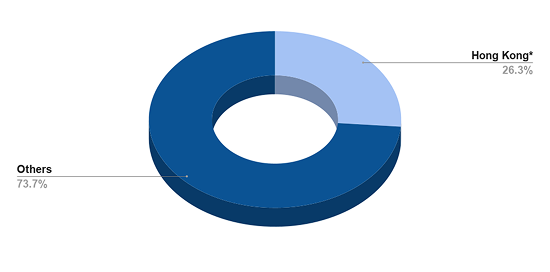
Based on Box Office Revenue
- Hong Kong* includes Hong Kong local productions, Hong Kong–Mainland China co-productions, international co-productions, and other Chinese-language films (88 films released; 187 for Others, total 275).
- The market share is based on the box office revenue.
- The market share is based on the box office revenue.
However, some industry figures, including Entertaining Power’s Angus Chan, have told local media that the industry has been reinvigorated by news of large-scale mainland China co-productions such as 1971 (tentative), Anselm Chan’s follow-up to record-breaking blockbuster The Last Dance, Herman Yau’s Nemesis in the Dark, and Cheang’s Twilight of the Warriors sequel filming in Hong Kong. Even though the local industry has yet to climb out of its slump completely, these large-scale productions prove that the city still has solid infrastructure and crews to support filmmaking.
Financing Models
As mentioned in part one, the Hong Kong government’s Film Development Fund continues to be the most prolific investor of Hong Kong cinema, co-producing a significant number of commercial film productions under their various schemes. Even prolific companies such as One Cool Films, Emperor Motion Pictures and Media Asia Films have slowed down their productions considerably, opting to distribute rather than invest in their own productions.
After not announcing any new film funding in the second half of 2025, the Hong Kong Film Development Fund (FDF) finally announced in April that it would offer a maximum of HKD 10 million (USD 1.29 million) to two projects under the Film Production Grant Scheme for Promoting Chinese Culture: Anselm Chan’s Food is Heaven and Janet Chun’s Yin Yang Healer.
However, as mentioned in part one, Financial Secretary Paul Chan was reluctant to announce any new measures for the film industry in this year’s budget speech, opting to instead boost the tourism and art sectors. However, Chan did emphasize that the government has already injected over HKD 9 billion (USD 1.16 billion) into the creative industries—including the FDF—over the years.
Likely inspired by the 2023 autobiographical comedy The Lyricist Wannabe, which was entirely self-funded by Norris Wong and producing partner Wong Hoi, more adventurous filmmakers are opting to avoid the frustrations of the traditional film financing process by either partially or fully funding their own films. Director Herman Yau spent the money he made from directing big-budget mainland China co-productions to finance his HKD 8 million (USD 1.03 million) social drama We Are Nothing at All, about a suicide bus bombing; director Philip Yung admitted that he had gone into considerable debt in order to partially fund his Lunar New Year comedy Snowball on a Sunny Day; and the HKD 3 million (USD 385,604) budget for indie comedy Unidentified Murder came solely from Eddie Wong, an adolescent friend of directors Jack Lee and Kwok Ka-hei. In our interview, Norris predicts that more filmmakers will take the self-funding route in the foreseeable future as traditional funding remains difficult to obtain.
As for the Hong Kong–Europe–Asian Film Collaboration Funding Scheme (HKEA), which had no updates to report as of our previous report, the scheme has since named its first two winning projects: Diego Cenetiempo's Follow Me and Sacha Chuk's The Epilogue of Summer, each receiving a maximum of HKD 9 million in funding.
Distribution Climate
As usual, MPIA has kept most box office statistics for the first half of 2026 secret from the public (their main source of revenue is subscription fees paid by local film companies). Nevertheless, they did report that total box office revenue in Hong Kong for the first half of 2026 went up by 24.66% compared to the same period in 2025, reversing the multi-year downward trend, at least for the first half of the year. However, the number of local releases decreased from 21 to 17, although the total number of theatrically released films increased slightly, from 140 in H1 2025 to 142 in H1 2026.
Figures of Released Domestic Feature
Hong Kong (2019-H1 2026)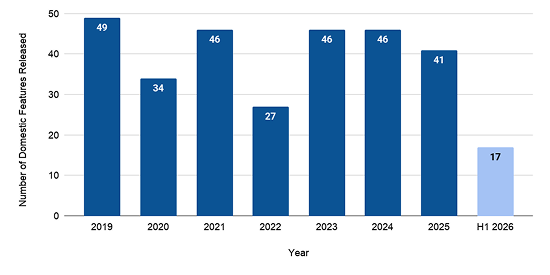
Hong Kong (2019-H1 2026)
Looking at the broader year-over-year trend, without record-breaking blockbusters such as Twilight of the Warriors and The Last Dance, the box office share of Hong Kong and Hong Kong–mainland China co-productions fell from 43.9% in 2024 to only 13.3% for full year 2025. The figure for 2026 isn’t available yet. Still looking at H1 2026 performance, this figure is expected to improve significantly for 2026, thanks to Edko Films’ Night King and Cold War 1994, which earned HKD 118.1 million (USD 15.18 million) and HKD 38.1 million (USD 4.90 million), respectively, in the first half of 2026.


Looking ahead to the rest of the year, it’s unlikely that there will be a local title that can repeat the success of Night King and increase market share of local films. However, strong foreign titles during the summer—namely Toy Story 5, The Odyssey, Spider-Man: Brand New Day and CHIIKAWA the Movie: The Secret of the Mermaid Island, as well as mainland China sleeper hit Dear You and Stephen Chow’s Kung Fu Soccer—could give a much-needed lift to total box office revenue by the end of the year and potentially end the long-running slump.
According to the CCIDA/MPIA report, there were 41 releases 1 in 2025 that were considered “Hong Kong films”, down from 46 in 2024. Considering that there was already a decrease in local releases in the first half of 2026, the total number of Hong Kong releases this year is expected to once again be lower than the previous year.
Perhaps the biggest evidence of this slowdown is that the 2026 “local” releases include: police thriller Man of the Edge, which was released in mainland China, Taiwan and Malaysia in 2022; Guan Hu’s pandemic drama A Man and a Woman, which had its world premiere at the Shanghai International Film Festival in 2024; Patrick Leung’s Ciao UFO, which was trapped in release limbo since 2019 due to a disagreement between the producer and an investor over release strategies; and First Feature Film Initiative project Gamer Girls, which spent four years in post-production due to budgetary constraints.
However, it’s also worth noting there are at least nine local films that are still waiting for theatrical release after premiering at film festivals at home or abroad.
- 1 This figure differs from the 33 wide commercial theatrical releases counted in our previous report. At the time that report was written, the 2025 CCIDA/MPIA industry report had not yet been published; the 41 figure reflects CCIDA/MPIA's own criteria for a "Hong Kong film," which may differ from the "wide commercial theatrical release" count used previously.
Theatrical Reach
While a wave of cinema closures dominated film industry news in the first half of 2025, a number of shuttered cinemas reopened under new ownership in the second half of the year. As of the end of 2025, Hong Kong had 271 screens in 53 cinemas, merely a moderate drop from 277 screens in 57 cinemas in 2024.
Top 3 Cinema Chains, H1 2026
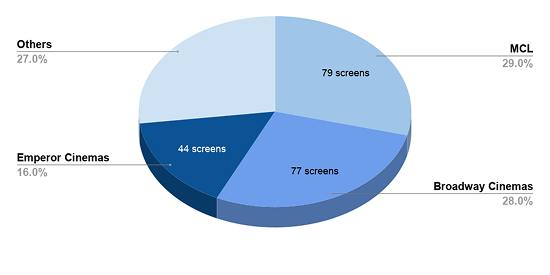
Fortunately, the exhibition sector has remained steady in the first half of 2026, with no cinema closures nor new cinema openings occurring. However, major cinema chains have been gradually reducing staffing in their cinemas to save costs, with leading cinema chains Broadway Cinemas and MCL opting for ticket gates and ticketing machines in lieu of human staff in most of their cinemas.
As mentioned in previous sections, Jack Ng’s Night King—produced and distributed by Edko Films—was by far the biggest winner at the Hong Kong box office, thanks to the extended Lunar New Year holiday, the presence of comedy star Dayo Wong, and Edko’s strong marketing campaign. However, instant blockbusters like Night King are increasingly rare in Hong Kong. Instead, they tend to follow the path taken by We’re Nothing at All and Ciao UFO, relying on social media and cinema greeting sessions to accumulate word-of-mouth over weeks and months. It’s not unusual to see filmmakers and actors making dozens of cinema greetings in the first several weekends of a film’s release just to attract audiences.


However, things have been even more difficult for foreign films. Much like South Korea, Hong Kong audiences have now been programmed to simply wait for streaming to watch most films. As a result, even seemingly sure-fire hits such as Avatar: Fire and Ash (delayed by three weeks in Hong Kong after a large-scale fire at a residential complex last November) and The Super Mario Galaxy Movie grossed considerably less than their predecessors.
On the other hand, distributor-owned cinema chains are increasingly finding success from exclusive releases and retrospective programming during quieter periods of the year. For example, Edko, the biggest local distributor of arthouse titles, released some of their smaller titles exclusively in their Broadway Cinema chain.
After the surprise commercial success of documentary Johatsu – Into Thin Air and Four Trails in recent years, Broadway’s arthouse cinema Broadway Cinematheque is continuing to follow the model of opening certain titles in extremely limited engagements to create demand before expanding them. BC has also been acquiring and releasing remastered versions of classic titles such as Yi Yi: A One and a Two, Ryuichi Sakamoto concert films, and most recently, Lee Chang-dong’s Oasis to attract a new generation of cinephiles to the cinema.
Meanwhile, Broadway’s main rival MCL also held retrospective of classic titles under various themes (its most recent program is dedicated to Leslie Cheung), and it managed to secure an exclusive engagement of Hollywood breakout horror hit Obsession from Universal Pictures. Last but not least, Emperor Cinemas held exclusive engagements of filmed stage plays from the United Kingdom and Christopher Nolan’s debut film Following in time for The Odyssey.
While classic titles don’t gross as much money as new titles, they are relatively cheap to acquire, and Broadway Cinematheque has proven that turning each niche film release into an event with limited screenings can help boost demand.
Technology and Production Services
Production services in Hong Kong have not made big strides due to budgetary and land limitations. Hong Kong’s film industry is gradually shrinking, and there is no room in the city to create additional spaces designated for film productions. As the industry continues to undergo its long-running slump, it is not financially viable to build film facilities.
While there has been no new significant development in the use of artificial intelligence in the Hong Kong film industry, it is being employed more in film productions. Three years ago, the Hong Kong Digital Entertainment Association launched Future Animation – AI-Assisted Animation Production Support Scheme with the support of the local government, subsidising select companies to produce animation using artificial intelligence. The scheme’s films are being screened at Broadway Cinema’s MOViE MOViE Anifest.
In a recent interview on local media, an art director said that artificial intelligence helped him draw up conceptual images that would take an illustrator several days to make, while a screenwriter admitted that he used A.I. to help him find references during the writing process. The industry’s general attitude is that A.I. can assist creators in streamlining productions and lowering costs, but it cannot replace artists. However, there has yet to be a real debate in the industry over the ethics of the technology and the jobs that are lost for the sake of convenience.
Streaming & Digital Platforms
In my second-half report last year, I quoted a report published last August by PricewaterhouseCoopers about the growth of the entertainment and media industry in Hong Kong, Asia and around the world. While Hong Kong’s OTT market is rising along with the rest of the world, its growth rate is considerably lower from the rest of the world due to limited market size and a lack of strong local players.
Local audiences continue to prefer Netflix and Disney+ over local streaming services due to variety in programming, but PCCW, whose streaming service Viu is available in 16 markets across Asia and boasts 66.5 million monthly active users, launched their first Hong Kong original series with The Season. Featuring talents from Hong Kong, Japan, Korea and beyond, the six-episode English-language series was also sold to Hulu in the United States.
In the first half of 2026, the Hong Kong Film Fund also finally announced the winners of its Content Development Scheme for Streaming Platforms after roughly two years: Tsang Tsui-shan’s Kowloon Grand Hotel, Lawrence Lau’s Bus Lightyear, Cho King-man’s Spirited Away and Derek Tsang’s Balikbayan Box Club. Each project will receive HKD 4.5 million (USD 578,406) for the production of their pilot episodes, though there is no guarantee that these projects will be picked up by streaming services in the future.
All figures in USD are provided for reference only, converted at an approximate rate of USD 1 = HKD 7.78.
Interview
With Norris WONG, Writer-director

Norris Wong is a writer-director. She co-directed Good Trip with Wong Hoi under the Hong Kong government’s Directors’ Succession Scheme. The film will be released theatrically in Hong Kong in mid-October.
Q. Tell us more about the Directors’ Succession Scheme and your film Good Trip.
A.This is a new scheme under the Hong Kong Film Development Fund. Two of its films have already been released: Measure in Love and Afterpiece. The idea is that a young director is picked by a renowned Hong Kong director to receive HKD 9 million (USD 1.16 million) in funding to make a film. There’s no requirement about the film’s topic, but since we’re on the Director’s Succession Scheme, we decided to use “succession” as a creative starting point and include references to old Hong Kong cinema genres that aren’t done now, such as action, gambling, vampires and wuxia.
Q. Since Good Trip is a road movie, is it bigger, smaller, or similar in scale to other purely local productions at the moment?
A.Good Trip was made with the HKD 9 million grant, plus HKD 3 million (USD 385,604) in additional funding. That’s already more money than all of my and my directing partner’s previous projects combined. Compared to other directors in my generation, I would say my film had a slightly higher budget than average.
Q. A lot of filmmakers in your generation rely on government funding, even though most of them are commercial films. Do you think you would’ve been able to make your films without government funding?
A.Without government funding, I’d have to self-fund like I did for my sophomore film. When we bring a project to investors, they would ask us to raise part of the budget with government support before they’re confident enough to invest. This has become commonplace in the Hong Kong film industry. But I won’t say it’s a good thing or a bad thing. If you look at Taiwan, almost all their films receive some kind of government support during various stages of production.
Q. How do you look at the state of the industry now?
A.I think it’s not only happening in Hong Kong, but now you can see filmmakers not only focusing on making films. Some are now also making streaming content. I myself write TV series as well for Viu TV.
Q.Then how do you see the future of the Hong Kong film industry?
A.I think there will be more low-budget productions. This summer’s Wakesurf Lovers was partially funded by the director after it received government funding. Unidentified Murder was also made with private funding (instead of a traditional investor). So, I think there will be more of these small, self-financed productions.
Q.As someone working in the Hong Kong industry, what is the biggest challenge you’re facing now?
A.It’s harder than ever to make something long-lasting or something that becomes a classic because people are watching more than ever at a rate that is faster than ever. A story’s lifespan is so short nowadays. In the 90s, something like Titanic would be popular for years. But now, people’s focus seems to only last a few days.
Kevin MA
Film Festival Consultant, Translator
Formerly a film industry journalist and English editor, Kevin has been the Hong Kong Consultant of the Udine Far East Film Festival since 2023. He has been doing translation work for film companies and writing work for film organizations in the region for over 15 years.
- Ticket Price Range: USD 6.37 – USD 37 (Average: USD 9.24)
- Converted at a fixed exchange rate of HKD 7.78 = USD 1.
- Source: Hong Kong Box Office Limited