Title
THE A REPORT
2026 H1
 SUN Yanbin
Associate Professor / Beijing Film Academy
SUN Yanbin
Associate Professor / Beijing Film Academy
Updated on 6 Oct 2026
Overview
“Film+” and AI Drive the Rebirth of China’s Film Industry
In H1 2026, China’s film industry was undergoing a structural transition marked by transformation and upgrading. Box office revenue reached CNY 17.35 billion (USD 2.56 billion), a 40.63 % drop compared with CNY 29.23 billion (USD 4.32 billion) recorded in H1 2025, pointing to a notable contraction in overall box office scale. Meanwhile, the market demonstrated a strong Matthew effect, with box office returns having become concentrated on a handful of films and key release windows. Beneath such pressures lie profound industrial shifts.
After more than two decades of rapid growth, China has built up an enormous film market. Since 2025, multiple driving forces, including the explosive growth of competing entertainment media such as micro‑short dramas, the shift in household consumption patterns from subsistence-oriented to development-and experience-driven spending, as well as Generation Z audiences’ growing focus on emotional and experiential value, have steered the Chinese film sector away from box-office expansion. Instead, the industry is pursuing deeper economic value. This shift is well reflected in the “Film+” initiatives actively promoted by state authorities and implemented by market players throughout H1 2026, whereby film is leveraged to boost cultural and tourism consumption. On February 12, the launch of Seedance 2.0 accelerated AI penetration into film and television production. It reshaped long-established logics governing film investment-financing, production workflows and workforce configuration, giving rise to brand-new business models for AI-generated films. China’s film industry is undergoing a rebirth in H1 2026.
Top 10 Films in China Box Office (H1 2026)
You can scroll left and right to view the content.
| No. | English Title | Director | Country | Genre | Gross (CNY) |
Gross (USD) |
Production Company | Distribution Company |
|---|---|---|---|---|---|---|---|---|
| 1 | Pegasus 3 | Han Han | China | Drama, Comedy | 4.42B | 653.1M | Shanghai Tingdong Film Co., Ltd.; Tianjin Maoyan Culture Media Co., Ltd.; Damai Entertainment (Beijing) Co., Ltd. | Tianjin Maoyan Culture Media |
| 2 | Dear You | Lan Hongchun | China | Drama, Comedy, Romance, Family | 1.93B | 285.3M | Shenzhen King Ant Pictures; Beijing Damai Entertainment Culture Co., Ltd.; Rongde Holdings Group Co., Ltd.; Shenzhen Lichun Film Co., Ltd. | Beijing Damai Entertainment Culture Co., Ltd. |
| 3 | Blades of the Guardians: Wind Rises in the Desert | Yuen Woo-ping | China | Action, Wuxia | 1.45B | 213.9M | Xiamen Yuanping Film Co., Ltd.; Beijing Damai Entertainment Culture Co., Ltd.; Beijing Dengfeng International Cultural Communication Co., Ltd. | Beijing Dengfeng International Culture & Media Co., Ltd.; Beijing Shangshi Culture Group Co., Ltd. |
| 4 | Scare Out | Zhang Yimou | China | Espionage, Crime | 1.37B | 201.8M | Damai Entertainment (Beijing) Co., Ltd., Shanghai Zhongzhong Film Co., Ltd., Beijing Lifeng Cultural Development Co., Ltd., China Film Co., Ltd. | Damai Entertainment (Beijing) Co., Ltd. |
| 5 | Boonie Bears: The Hidden Protector | Lin Huida | China | Animation, Comedy, Fantasy | 1.07B | 157.6M | Fantawild Animation (Shenzhen) Co., Ltd.; Zhejiang Hengdian Film Industry Co., Ltd.; China Film Group Co., Ltd. | China Film Group Co., Ltd.; Zhejiang Hengdian Film Industry Co., Ltd.; Lianrui (Shanghai) Film Industry Co., Ltd. |
| 6 | Vanishing Point | Cheng Weihao | China | Crime, Mystery, Thriller | 0.57B | 84.1M | Zhonghe Qiancheng Film Industry (Wuxi) Co., Ltd., Tianjin Maoyan Weiying Culture Media Co., Ltd., Khorgos Jiangwan Film Co., Ltd., Beijing Zhonghe Qiancheng Film and Television Culture Media Co., Ltd. | Tianjin Maoyan Weiying Culture Media Co., Ltd. |
| 7 | Cold War 1994 | Leung Lok Man | China | Drama, Action, Crime | 0.30B | 43.7M | Wuxi Jiaxiong Pictures Co., Ltd., Wanda Pictures Co., Ltd.*, Edko Films Limited, Shanghai Ruyi Film and Television Production Co., Ltd. | Ruyi Film Entertainment Company Limited |
| 8 | Panda Plan: The Magical Tribe | Derek Hui | China | Comedy, Family, Fantasy | 0.29B | 42.5M | Emei Film Group, Shanghai Maoyan Pictures Co., Ltd., Chengdu Maoyan Pictures Co., Ltd. | HY Media |
| 9 | Project Hail Mary | Christopher Miller & Phil Lord | United States | Sci-Fi, Adventure, Action | 0.28B | 41.4M | — | Columbia Pictures, Huaxia Film Distribution Co., Ltd., China Film Group Co., Ltd. |
| 10 | Night King | Ng Wai Lun | China | Comedy, Drama | 0.23B | 33.4M | Edko Films Limited, Khorgos Pomegranate Film Co., Ltd., Tianjin Maoyan Culture Media Co., Ltd. | Edko (Beijing) Film Distribution Co., Ltd. |
Top 10 Domestic Films in China Box Office (H1 2026)
You can scroll left and right to view the content.
| No. | Title | Director | Country | Genre | Gross (CNY) |
Gross (USD) |
Production Company | Distribution Company |
|---|---|---|---|---|---|---|---|---|
| 1 | Pegasus 3 | Han Han | China | Drama, Comedy | 4.42B | 653.1M | Shanghai Tingdong Film Co., Ltd.; Tianjin Maoyan Culture Media Co., Ltd.; Damai Entertainment (Beijing) Co., Ltd. | Tianjin Maoyan Culture Media |
| 2 | Dear You | Lan Hongchun | China | Drama, Comedy, Romance, Family | 1.93B | 285.3M | Shenzhen King Ant Pictures; Beijing Damai Entertainment Culture Co., Ltd.; Rongde Holdings Group Co., Ltd.; Shenzhen Lichun Film Co., Ltd. | Beijing Damai Entertainment Culture Co., Ltd. |
| 3 | Blades of the Guardians: Wind Rises in the Desert | Yuen Woo-ping | China | Action, Wuxia | 1.45B | 213.9M | Xiamen Yuanping Film Co., Ltd.; Beijing Damai Entertainment Culture Co., Ltd.; Beijing Dengfeng International Cultural Communication Co., Ltd. | Beijing Dengfeng International Culture & Media Co., Ltd.; Beijing Shangshi Culture Group Co., Ltd. |
| 4 | Scare Out | Zhang Yimou | China | Espionage, Crime | 1.37B | 201.8M | Damai Entertainment (Beijing) Co., Ltd., Shanghai Zhongzhong Film Co., Ltd., Beijing Lifeng Cultural Development Co., Ltd., China Film Co., Ltd. | Damai Entertainment (Beijing) Co., Ltd. |
| 5 | Boonie Bears: The Hidden Protector | Lin Huida | China | Animation, Comedy, Fantasy | 1.07B | 157.6M | Fantawild Animation (Shenzhen) Co., Ltd.; Zhejiang Hengdian Film Industry Co., Ltd.; China Film Group Co., Ltd. | China Film Group Co., Ltd.; Zhejiang Hengdian Film Industry Co., Ltd.; Lianrui (Shanghai) Film Industry Co., Ltd. |
| 6 | Vanishing Point | Cheng Weihao | China | Crime, Mystery, Thriller | 0.57B | 84.1M | Zhonghe Qiancheng Film Industry (Wuxi) Co., Ltd., Tianjin Maoyan Weiying Culture Media Co., Ltd., Khorgos Jiangwan Film Co., Ltd., Beijing Zhonghe Qiancheng Film and Television Culture Media Co., Ltd. | Tianjin Maoyan Weiying Culture Media Co., Ltd. |
| 7 | Cold War 1994 | Leung Lok Man | China | Drama, Action, Crime | 0.30B | 43.7M | Wuxi Jiaxiong Pictures Co., Ltd., Wanda Pictures Co., Ltd.*, Edko Films Limited, Shanghai Ruyi Film and Television Production Co., Ltd. | Ruyi Film Entertainment Company Limited |
| 8 | Panda Plan: The Magical Tribe | Derek Hui | China | Comedy, Family, Fantasy | 0.29B | 42.5M | Emei Film Group, Shanghai Maoyan Pictures Co., Ltd., Chengdu Maoyan Pictures Co., Ltd. | HY Media |
| 9 | Night King | Ng Wai Lun | China | Comedy, Drama | 0.23B | 33.4M | Edko Films Limited, Khorgos Pomegranate Film Co., Ltd., Tianjin Maoyan Culture Media Co., Ltd. | Edko (Beijing) Film Distribution Co., Ltd. |
| 10 | The Furious | Kenji Tanigaki | Hong Kong, China | Action, Crime | 0.20B | 29.3M | Edko Films Limited, Zhejiang Hengdian Film Industry Co., Ltd. | Edko (Beijing) Film Distribution Co., Ltd. |
Production Landscape
Reduced Output with Improved Quality, Rising Uncertainty in Production
Market Overview & Performance:In H1 2026, as the overall box-office shrank, the number of released films, films that obtained distribution licences, and the total number of planned projects all went down. The output reduction will continue. However, shrinking film output does not mean a shrinking market size. On the one hand, the market cuts output for better quality. On the other hand, market participants actively tap into the film copyright‑based economy and strengthen integration between films, technology and other business sectors.
Production Volume & Trends: According to data released by China Film Administration, a total of 836 feature films, 122 animated films, 56 VR films, 44 documentaries were registered or approved for production during H1. In the same period, 227 feature films were granted theatrical release licences. Patriotic films and reality-themed films remained core production priorities. Notably, driven by the good performance of animated films in 2025, the number of animated films adapted from traditional Chinese culture has risen sharply. It reached 67 titles, a 21.8% increase from 55 titles in the same period of 2025.
Notable Projects: Key projects currently in production yet to be released include sci-fi films The Wandering Earth 3 and The Decisive Moment; historical film Kashmir Princess; animated features All Wishes Come True!, Demon Agent, Three Kingdoms: The Beginning. Also in the pipeline are two films directed by Stephen Chow, Kung Fu Soccer and Mermaid 2, alongside real-themed films Mindset Blooms, Once Upon A Time in the Middle East and Make Zhonghe Great Again. These films are poised to anchor the Summer Season and National Day holiday in the second half of the year.


The Decisive Moment © Damai Entertainment, et al.
Corporate Landscape & Project Scales: Film production companies have adjusted their industrial and organizational structures in response to shifting markets. Shaw Brothers Holding Limited intends to acquire core assets under CMC Inc., including the content label Daylight Entertainment, UME Cinemas and CMC Pictures. Wanda Film Holding Co., Ltd. formally rebranded as Ruyi Film Entertainment Company Limited (Ruyi Film), decoupling itself from Wanda Real Estate’s capital system and undergoing a transformation from a theatre-focused operator into an integrated entertainment group. Enlight Media is shifting its operational focus away from film-making towards copyright exploitation. It is ramping up development of copyright-driven derivatives, trend-setting toys, video games, literary works and short-form dramas, while further consolidating animated features as its core business line. On the other hand, film studio Huayi Brothers has entered pre-reorganization proceedings amid unsustainable debt burdens and years of losses from film projects. Meanwhile, the independent film Dear You achieved remarkable breakout success on a modest budget. Produced for CNY 14 million (USD 2.07 million), it grossed over CNY 2 billion (USD 296 million) at the box office as of July 31, stunning the whole industry. This outstanding performance has brought independent films greater market visibility.
Industry Opportunities & Challenges: Overall, the industry faced greater uncertainty in the future. Big-budget films with strong commercial elements may not win, while low budget films stand a chance of achieving surprise success. Film production needs to address the opportunities and challenges brought by AI; it also requires more prudent judgment to improve the market success rate of projects.
Financing Models
Cautious Investment Strategies While New Technologies Become Capital Hotspots
Financing Landscape Shifts: Due to the smaller overall box-office market and stronger Matthew effect, investors became more cautious. Companies strictly limited project numbers and risks for individual films, and cut high-risk big-budget productions. Live-action films face pressure, while animated films draw more capital. Capital flowed into new areas including copyright development and AI technologies.
Evolving Financing Structures: Studios remain the main source of film financing, with a broader investment scope. Enlight Media has invested in and set up more than ten entities covering games, derivatives, anime series and micro dramas. Film companies invest in AI infrastructure. Ruyi Film, Shanghai Film and Huanxi Media have all invested in AI-focused businesses. Driven by the “Film+” concept, companies from other industries finance films to boost their brand exposure. For example, tea-drink brand Mixue Ice Cream & Tea is preparing its first animated film Make a Wish, Snow King.
New Trends in Private Capital: Private capital serves as the main financing channel for independent films. The government mostly offers production-related resources, awards and subsidies. Take Dear You as an example. Its production funds came from four sources: hundreds of individual investors, professional film companies, non-film businesses, and self-funding from the director and creative team. Besides, film venture-funding programs also supply money for independent films. Major film festivals have set up project-pitching sections. Examples include the NEWHER Feature Film Support Program and the 10th CFDG Program. These pitching initiatives help attract private capital for film projects.
Updates on Government Support: Government support funds also favor the application of new film technologies. In H1, the National Special Fund for Film Industry Development gives priority to rewarding innovations in film‑related cultural consumption, the use of AI, Virtual Reality, Virtual Production and premium projection technologies, as well as film bases upgraded with these new technologies. Local governments such as Chengdu, Xiamen, Qingdao, Shenzhen, Ningbo have rolled out support policies. The policies attach greater importance to how film‑shooting locations boost local tourism and economy. Ticket platforms such as Maoyan, Damai, Taopiaopiao and Douyin, together with financial institutions including China UnionPay, ICBC, CCB and CMB, have launched consumer-friendly activities including discounts on ticket purchases, ticket-stub lotteries and low-price movie vouchers. Total annual subsidies will reach no less than CNY 1.2 billion (USD 177 million). These joint efforts with the government aim to boost the recovery of film consumption.
Market Sentiment & Newly Emerged Schemes: The state vigorously advocates the application of new‑quality productive forces and emphasizes films’ role in boosting consumption. The capital market follows this trend and channels capital into innovative applications of new film‑related technologies and integrated film‑industry projects. This trend will persist.
Distribution Climate
Domestic Films Stay Strong, Unbalanced Release-Window Allocation
China Box Office Share by Film Origin (H1 2026)
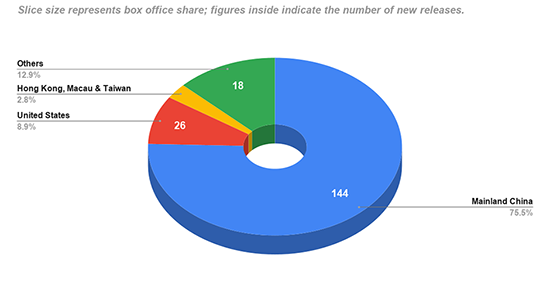
- Data source: Maoyan Professional Edition
You can scroll left and right to view the content.
| Region | Gross (CNY100M) | Box Office Share | New Releases |
|---|---|---|---|
| Mainland China | 130.99 | 75.48% | 144 |
| United States | 15.36 | 8.85% | 26 |
| Hong Kong, Macao & Taiwan | 4.85 | 2.79% | 14 |
| Others | 22.34 | 12.88% | 18 |
| Total | 173.54 | 100% | 202 |
Distribution Market Shifts: According to Maoyan Professional Edition, China’s total box‑office reached CNY 17.35 billion (USD 2.56 billion) in H1 2026. Domestic films (including Hong Kong, Macao and Taiwan productions) took CNY 13.58 billion (USD 2 billion), accounting for 78.27%; foreign films generated CNY 3.77 billion (USD 557 million), accounting for 21.72%. Although China has adopted looser policies for imported‑film introduction, the strong performance of domestic films has not changed notably. A total of 202 new films were released in this period: 144 Mainland China films, 26 US films, 14 Hong Kong‑Macao‑Taiwan films and 18 films from other countries. Damai Entertainment, Maoyan Culture, China Film Group, Shangshi Culture and Huaxia Film are the top five distributors.
Top 5 Distributors by Market Share (H1 2026)
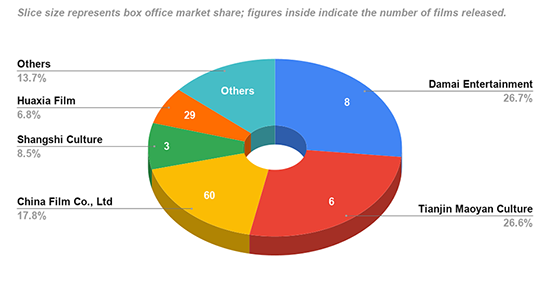
- Data source: Maoyan Professional Edition
The top five foreign films are: Project Hail Mary grossed CNY 280 million (USD 41.36 million); Toy Story 5 recorded CNY 219 million (USD 32.35 million); Hoppers earned CNY 185 million (USD 27.33 million); The Super Mario Galaxy Movie took CNY 154 million (USD 22.75 million); and Return to Silent Hill grossed CNY 142 million (USD 21 million).


Hoppers © Walt Disney Pictures, et al.
Vertical Integration & Market Fairness: Damai Entertainment and Maoyan Entertainment dominate ticketing platforms and control online distribution resources. Vertical integration of film enterprises has no obvious impact on screening-slot allocation. Still, the Matthew effect grows stronger for blockbusters and key release windows such as the Spring Festival. For example, the top five films in the first half took nearly 60% of total revenue. The nine-day Spring Festival generated CNY 5.752 billion (USD 850 million), accounting for 33% of the half-year total box-office.
The National Arthouse Film Alliance serves as the main channel for art films. In H1, regional distribution delivered notable results. Cantonese-language film Night King and Teochew-dialect film Dear You achieved solid market performance via regional distribution. In addition, government support enables opera films to obtain stable screening slots.
Release Bottlenecks & Capacity Crises: The Matthew effect in box-office distribution leads to unbalanced film supply. Around 20 films were released in important windows including the Spring Festival, Qingming Festival, May Day and Dragon Boat Festival. By contrast, quality films are in short supply on regular weekends, and foreign films become the mainstay supporting the market on these days. Another reflection of rising market uncertainty is the frequent temporary scheduling, sudden withdrawal and release‑window adjustment of films.
Theatrical Reach
Diversified Business Exploration, Declining Regular Cinema‑Going
Exhibition Landscape Shifts: According to Top Data, screening sessions in H1 reached a record 73.31 million. However, lacking visual-effect blockbusters—especially compared to the strong performance driven by Ne Zha 2 in the same period last year—premium large-format (PLF) auditoriums experienced a sharp year-on-year drop in box-office revenue. Cinema operating profits continued to decline, with average revenue per screening falling steeply by 43.1% year-on-year to CNY 236 (USD 34.87). Meanwhile, projection technologies kept upgrading: China Film Group launched the CINITY 2.0 system with plans to renovate 300 auditoriums nationwide, while Huaxia Film updated Huanying Island to support live broadcasts for sports, concerts, and immersive events.

Two international A-class film festivals were held: the 16th Beijing International Film Festival and the 28th Shanghai International Film Festival.


28th Shanghai International Film Festival
© China Film News
Theater Infrastructure & Pricing Trends: In the first half of the year, 456 new cinemas opened. Driven by the "2026 Film Economy Promotion Year" ticket subsidy policy, the average movie ticket price stood at CNY 41.1, down CNY 4.5 year-on-year. Theaters are actively creating new business models and expanding their service scope. Ruyi Film promotes the "Super Entertainment Space 2.0", combining pop toys and immersive experiences. Xi’an Film Group launched the "Borderless XR Cinema Hundred Cities Thousand Theaters Project" to build standard XR cinema venues. Huaxia Film rolled out its "Ultra-Live" program, which broadcasts opening ceremonies, concerts and other events live in cinemas. It streamed more than 28,000 screenings of the 2026 World Cup across 255 cities. To deal with China’s aging population, over 2000 cinemas have completed age-friendly upgrades.


Attendance & Audience Trends: In H1 2026, theatrical admissions reached 421 million, a year-on-year drop of 34.32%. Regular attendance declined, audiences placed greater trust in genuine post‑release word‑of‑mouth. Film preferences are affected by factors such as gender, age and region. By gender, male viewers account for 65.3% of the crime‑action film The Furious while female‑themed movie It’s OK draws 74.7% female audiences. By age, young viewers prefer thrillers; audiences aged 24 and below make up 35.2% of The Caged Butterfly. Viewing tastes also differ across regions. Dialect films such as Night King, Dear You and A Table For Two achieve far better market performance in their local markets than elsewhere.
Leading Title Performance: Domestic films occupied the top eight spots in the H1 rankings. Sports-comedy Pegasus 3 grossed CNY 4.421 billion (USD 653 million), accounting for 25.4% of the market. Dialect drama Dear You ranked second at CNY 1.931 billion (USD 285 million, 11% market share). Costume‑action film Blades of the Guardians: Wind Rises in the Desert was third with CNY 1.448 billion (USD 214 million). Spy thriller Scare Out took fourth with CNY 1.366 billion (USD 202 million). Animated film Boonie Bears: The Hidden Protector ranked fifth, earning CNY 1.067 billion (USD 158 million). Also in the H1 top-ten box-office list are suspense-thriller Vanishing Point, crime-action Cold War 1994, fantasy-comedy Panda Plan: The Magical Tribe, Hollywood sci-fi Project Hail Mary and comedy Night King.


Dear You © King Ant Pictures, et al.
Blades of the Guardians: Wind Rises in the Desert © Damai Entertainment, et al.
Technology and Production Services
Rapid Growth of Virtual Reality & Virtual Production, and Wide AI Adoption in Film Production
Technology Ecosystem Shifts: Driven by strong national policy guidance and the film industry’s urgent need to cut costs, the film-technology ecosystem is updating rapidly. AI tools are being adopted for film and television production, Virtual Production infrastructure keeps expanding, and XR films are moving toward commercial trials.
Infrastructure & Facility Upgrades: In H1, new LED virtual-shooting volumes kept being built and put into operation. iQIYI IQStage virtual auditorium at Hengdian World Studios officially launched. Western Digital-Intelligent Studio in Chengdu opened as Western China’s first permanent cinema-grade LED-VP volume. Phase-III of Wuxi Metaverse Dreamworks, the world’s largest single-site VP base, started construction. Nanning Beitou Mingyuehui AI Digital Film Creation Center was completed and opened. Changsha Xingsha Film Studio (Hunan Haopai Film Base) officially broke ground.


while the right shows the Beitou Mingyuehui AI-powered Smart Film Production Center in Nanning.
Besides, Yongchuan Sci-Tech Studio (Chongqing), Qingdao Oriental Movie Metropolis, Wuxi National Digital Film Industrial Park and Deqing Bocai Base (Zhejiang) continuously upgraded their VP technologies. For instance, Pegasus 3 adopted the iQIYI IQStage system to set up temporary LED-VP units at Qingdao Oriental Movie Metropolis and Oriental Pearl Digital Base (Lingang, Shanghai).


Leading Tech & Service Providers: ByteDance leverages its self-developed Seed large-model system to carry out multiple rounds of technical upgrades. It has successively released Seedance 2.0 to Seedance 2.5, which support native output of single-segment 30-second 4K videos. Kling AI launched the world’s first native 4K direct-output video model. Tencent Video brought out WorkRally. Aishi Technology released PixVerse C1, a vertical model for film and television. MiniMax unveiled its multi-agent creation workspace MiniMax Hub. AI exerts notable influence on mass-producible and replicable film-television content production.

VR technology has made progress in both content production and user applications. In H1, 56 VR films completed filing and project approval, and 22 obtained release licences. As of June, there were more than 120 completed and under-construction large-scale XR virtual-cinema projects across 27 provinces and municipalities, mostly concentrated in Beijing, Shanghai, Xi’an, Zhengzhou and Hangzhou. Representative VR films include Xuanzang and Kucha Kingdom in The Tang, Candle in the Tomb XR and Mulan2125. VR still faces challenges including insufficient high-quality content supply, high hardware R&D costs, and imperfect market operations.
AI Transformation Across the Production Value Chain: In H1, AI has been applied throughout the full film chain: project development, pre-visualization, virtual production, post-production VFX, localized dubbing and marketing. For instance, AI completed dubbing for Pegasus 3 in just five days. AI can greatly cut production cycles and diversify creators. Yet constrained by weak long-narrative performance, shortages of multi-skilled talents, messy copyright and pricing rules, and AI-content homogenization, it is merely an auxiliary tool for cost reduction and higher efficiency. It cannot replace the full traditional film production system in the short run. Notably, Youhug Media signed two AI digital talents in March, sparking industry-wide debates over AI versus human actors.

Streaming & Digital Platforms
Reducing Copyright Costs and Rolling Out AI Tools
Digital Platform Landscape Shifts: Faced with competitive media, major long-form streaming platforms have shifted their strategic priority from acquiring new subscribers to capturing greater user engagement. While actively expanding into micro-drama business segments, platforms persist in cost-cutting and efficiency-driven reforms by scaling back copyright expenditure, particularly spend on outright buy-out licences.
OTT Investment Strategies & Position: In H1, according to QuestMobile statistics, Tencent Video, iQIYI and Mango TV took the top three spots among long-video platforms, with monthly active users (MAU) of 319.38 million, 291.18 million and 243.41 million respectively. 184 films premiered on streaming platforms in Q1. Copyright acquisition remains the main approach for commercial films. Platforms have rolled out new revenue-sharing rules for films that move to streaming within a 90-day post-theatrical window. For example, iQIYI offers a revenue-sharing bonus of up to 120% for exclusive premiere films whose net revenue exceeds CNY 5 million (USD 0.74 million). This means high-quality films that fall short of box-office expectations in cinemas have greater incentives for an early shift to streaming platforms and can secure higher financial returns there.
Streaming Financing & Recoupment Trends: Four films co-invested by iQIYI, including This is My Time, two films co-financed by Tencent Video such as All The Good Eyes, and one documentary backed by Youku were released in the first half of the year. To cut production costs, platforms are actively experimenting with AI-generated feature-length content. iQIYI has launched Nadou Pro for professional film crews.


Platform Catalogues & Originals: iQIYI has 62 new films in production, including The Shadow's Edge 2. It has also launched the Baoqian Project (Pre-Blockbuster Filmmaking Initiative) and Liaoyuan Project (Spark-Ignition New-Talent Filmmaking Initiative), which provide financial and resource support for emerging directors and independent films. Supported projects strike a balance between commercial appeal and artistic expression. Tencent Video prioritises investment in animated feature films.
Affected by China’s market-access policies, major global (e.g., Netflix, Disney+) platforms are not authorized to act as producers and directly fund the production of films in mainland China. They can acquire overseas streaming rights excluding mainland China territory with one-off copyright payments. Netflix pre-purchased the exclusive global streaming rights for Per Aspera ad Astra for all territories outside mainland China. It is the second domestic Chinese science-fiction film selected for exclusive global streaming acquisition by Netflix, following The Wandering Earth.
Co-Production
Scope for Closer Cooperation and Vibrant Film Cultural Exchanges
Bilateral relations continued to shape regional film exchanges in H1. While no Japanese films were imported into the Chinese mainland market, China–South Korea exchanges showed subtle signs of momentum. In May, representatives from China Movie Metropolis visited South Korea to meet with prominent production entities and production facilities in Daejeon and Paju. Nevertheless, these exchanges remain preliminary, non-governmental, and limited in scale, with no substantive announcements regarding official co-productions.
According to data from the National Film Administration, 17 co-productions obtained filing approval in H1. Most of China’s international co-productions are with Hong Kong, Taiwan and Macao regions, while co-productions with other countries remain limited.
In H1, three co-productions hit theaters. Mainland–Hong Kong co-production Cold War 1994 grossed CNY 296 million (USD 43.73 million) domestically and USD 51 million worldwide, with overseas box-office accounting for 14.5%. Dear You released in Singapore, Malaysia, Thailand, Australia, New Zealand, the UK, Ireland, Japan and France, delivering strong box-office performance among Southeast Asian Chinese audiences.

International cultural-exchange activities remained vibrant. Events such as the “Chinese Film Week” and “Chinese Film Festival” were held across 18 countries and regions. Meanwhile, the initiative “Travel China through Cinema” was actively promoted to attract overseas visitors to China via film-related engagement. Major domestic film festivals including the Shanghai International Film Festival and Beijing International Film Festival reached new heights in international participation and global influence. The member states of the Belt and Road Film Festival Alliance expanded to 51 countries.


SUN Yanbin
Associate Professor / Beijing Film Academy
Sun Yanbin has worked at Beijing Film Academy since 2016, conducting research on the Chinese and global film industries. He is the author of An Introduction to the Chinese Film Industry, a monograph that systematically examines the development and current state of China's film industry.
- Exchange rate: 1 USD = 6.769 CNY
- Only the first few entries are displayed for readability; the remainder are omitted.
- *The production entity remains credited as Wanda Pictures Co., Ltd. This is due to the transition period prior to the June 2026 rebranding into Ruyi Film, during which official credits retained the original entity name.
Source: Maoyan Professional Edition