Title
THE A REPORT
2026 H1
 LÊ Hồng Lâm
Journalist, film critic, independent film researcher
LÊ Hồng Lâm
Journalist, film critic, independent film researcher
Updated on 6 Oct 2026
Overview
Vietnam's theatrical market remained one of the fastest-growing film markets in Asia during the first half of 2026, extending its post-pandemic recovery into a fourth consecutive year of growth. Although the pace of expansion moderated compared with previous years, the market continued to demonstrate remarkable resilience, driven overwhelmingly by the sustained strength of domestic productions rather than imported titles.
According to Box Office Vietnam, the market generated VND 3.198 trillion (approximately USD 123 million) in box office revenue during H1 2026, with more than 35 million admissions across 1.23 million screenings. Average seat occupancy reached 21.1%, while the average ticket price stood at VND 91,036. Compared with H1 2025, when total revenue reached VND 3.017 trillion (USD 116 million), the market recorded a year-on-year increase of VND 181 billion (approximately USD 7 million), representing growth of approximately 6.0%. While this represented a more moderate growth rate than in previous recovery years, it suggests that Vietnam's theatrical market is entering a more sustainable phase of expansion.
The strongest driver behind this growth was the significant increase in the number of domestic releases. Vietnamese films nearly doubled from 19 titles in H1 2025 to 35 titles in H1 2026, accounting for 65.3% of total box office revenue and further strengthening the dominance of local productions. The Lunar New Year holiday remained the industry's most important commercial window, followed by the Reunification Day–Labour Day holiday (30 April–1 May). February alone generated VND 723.7 billion in ticket sales, with an average seat occupancy of 32.4%, far exceeding every other month during the reporting period.


The year's biggest commercial success was Thỏ Ơi!!, directed, produced, written by and starring Trấn Thành. The film comfortably retained the No. 1 position at the H1 box office, supported by the filmmaker's strong personal brand and extensive social media engagement. Horror further consolidated its position as Vietnam's most commercially successful genre, contributing four titles to the year's Top 10 highest-grossing films. Family dramas and romantic films also maintained solid commercial performances, while independent and arthouse productions continued to occupy only a marginal position in both release volume and audience reach.
Film Releases and Market Share by Country, H1 2026
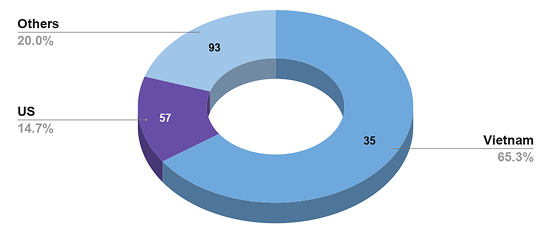
Slice size represents box office revenue share; figures inside indicate number of films released.
Imported films remained comparatively weak. A total of 150 international titles were released during H1 2026, including 57 from the United States and 93 from other territories such as Japan, South Korea, Thailand and China. Collectively, imported films accounted for only 34.7% of total box office revenue. Hollywood continued to lose market momentum, with only a handful of major franchise releases maintaining meaningful audience appeal. The only international title to enter the Top 10 was the Japanese animated feature Doraemon: New Nobita and the Castle of the Undersea Devil, which grossed VND 204 billion to become the second highest-grossing film of the period. Its success further illustrates that only globally established family-oriented franchises currently possess the brand strength to compete with the dominance of Vietnamese productions.
Top 10 Films in Vietnam Box Office (H1 2026)
You can scroll left and right to view the content.
| No. | Title | Director | Country | Genre | Gross (VND) |
Gross (USD) |
Production Company | Distribution Company |
|---|---|---|---|---|---|---|---|---|
| 1 | Thỏ Ơi!!(Bunnie!) | Trấn Thành | Vietnam | Drama, Thriller | 449.5B | 17.28M | HKFilm, Galaxy Studio, Trấn Thành Town | Galaxy Studio |
| 2 | Doraemon: New Nobita and the Castle of the Undersea Devil | Tetsuo Yajima | Japan | Animation | 204.5B | 7.86M | Shin-Ei Animation | CJ CGV |
| 3 | Phí Phông (The Blood Demon) | đỗ Quốc Trung | Vietnam | Horror | 201.0B | 7.73M | Bluebells Studios, CJ HK Entertainment | CJ HK Entertainment |
| 4 | Ma Xó (Forbidden Ritual) | Phan Bá Hỷ | Vietnam | Horror | 146.1B | 5.62M | 856 Pictures, CJ HK Entertainment | CJ HK Entertainment |
| 5 | Quỷ Nhập Tràng 2 (The Corpse 2) | Pom Nguyễn | Vietnam | Horror | 133.9B | 5.15M | AI Media Film, V Pictures | CJ CGV |
| 6 | Heo Năm Móng (Hell Trotter) | Lưu Thành Luân | Vietnam | Horror | 124.4B | 4.78M | F35 Studio, 89s Group | Galaxy Studio |
| 7 | Hẹn Em Ngày Nhật Thực (Meet Me at the Eclipse) | Lê Thiện Viễn | Vietnam | Drama, Romance | 118.7B | 4.56M | Cánh đồng Film | CJ CGV |
| 8 | Tài | Mai Tài Phến | Vietnam | Drama, Action | 113.2B | 4.35M | Green Film, MT Entertainment | CJ CGV |
| 9 | Thiên đường Máu (Bloody Heaven) | Hoàng Tuấn Cường | Vietnam | Drama, Thriller | 112.9B | 4.34M | Mega GS, điện ảnh CAND | Galaxy Studio |
| 10 | Nhà Ba Tôi Một Phòng (A Room Called Home) | Trường Giang | Vietnam | Drama | 110.9B | 4.27M | Truong Giang Film, V Pictures | CJ CGV |
Top 10 Domestic Films in Vietnam Box Office (H1 2026)
You can scroll left and right to view the content.
| No. | Title | Director | Country | Genre | Gross (VND) |
Gross (USD) |
Production Company | Distribution Company |
|---|---|---|---|---|---|---|---|---|
| 1 | Thỏ Ơi!! (Bunnie!) | Trấn Thành | Vietnam | Drama, Thriller | 449.5B | 17.28M | HKFilm, Galaxy Studio, Trấn Thành Town | Galaxy Studio |
| 2 | Phí Phông (The Blood Demon) | đỗ Quốc Trung | Vietnam | Horror | 201.0B | 7.73M | Bluebells Studios, CJ HK Entertainment | CJ HK Entertainment |
| 3 | Ma Xó (Forbidden Ritual) | Phan Bá Hỷ | Vietnam | Horror | 146.1B | 5.62M | 856 Pictures, CJ HK Entertainment | CJ HK Entertainment |
| 4 | Quỷ Nhập Tràng 2 (The Corpse 2) | Pom Nguyễn | Vietnam | Horror | 133.9B | 5.15M | AI Media Film, V Pictures | CJ CGV |
| 5 | Heo Năm Móng (Hell Trotter) | Lưu Thành Luân | Vietnam | Horror | 124.4B | 4.78M | F35 Studio, 89s Group | Galaxy Studio |
| 6 | Hẹn Em Ngày Nhật Thực (Meet Me at the Eclipse) | Lê Thiện Viễn | Vietnam | Drama, Romance | 118.7B | 4.56M | Cánh đồng Film | CJ CGV |
| 7 | Tài | Mai Tài Phến | Vietnam | Drama, Action | 113.2B | 4.35M | Green Film, MT Entertainment | CJ CGV |
| 8 | Thiên đường Máu (Bloody Heaven) | Hoàng Tuấn Cường | Vietnam | Drama, Thriller | 112.9B | 4.34M | Mega GS, điện ảnh CAND | Galaxy Studio |
| 9 | Nhà Ba Tôi Một Phòng (A Room Called Home) | Trường Giang | Vietnam | Drama | 110.9B | 4.27M | Trường Giang Film, V Pictures | CJ CGV |
| 10 | Báu Vật Trời Cho (A Gift From Heaven) | Lê Thanh Sơn | Vietnam | Drama, Romance | 103.6B | 3.98M | Bluebells Studios | CJ CGV |
– Ticket Price Range USD 3.5 (VND 91,000)
Production Landscape
Four consecutive years of box office growth have significantly strengthened industry confidence, resulting in a notable expansion of domestic production. Following approximately 50 Vietnamese theatrical releases in 2025, the industry is projected to release between 70 and 80 films in 2026, with 35 titles already reaching cinemas during the first half of the year.
The defining production trend of H1 2026 was the remarkable rise of horror. Across all domestic and imported releases classified under the genre, horror films generated VND 977 billion, accounting for 30.6% of the total box office and 34.3% of all screenings across 59 titles. It became one of the fastest-growing genres during the reporting period, particularly in the second quarter.
The genre's market share expanded dramatically over the six-month period. Horror accounted for only 10.2% of total box office revenue in January but climbed to 65.6% by June, meaning that nearly two-thirds of monthly theatrical revenue was generated by horror films by the end of the reporting period. This reflects not merely the popularity of individual titles but a broader shift in audience preferences toward locally produced commercial genre films.
More importantly, the genre's success was overwhelmingly driven by Vietnamese productions. Ten domestic horror films generated 71.4% of total horror revenue, while 49 imported titles shared the remaining market. On a per-title basis, Vietnamese horror films substantially outperformed imported counterparts, highlighting the genre's clear competitive advantage in the local market.
The highest-grossing horror films during H1 included Phí Phông, Ma Xó, Quỷ Nhập Tràng 2 and Heo Năm Móng. Two of these titles—Phí Phông and Ma Xó—were produced and distributed by CJ HK Entertainment, which has emerged as one of Vietnam's most active film studios alongside Galaxy Studio. CJ HK has announced plans to develop, finance and release between six and ten films annually over the next three years, while most independent production companies continue to produce only one to three features per year.
The overwhelming commercial success of horror also prompted a policy response. As horror titles increasingly dominated theatrical programming, the Vietnam Cinema Department issued an official notice encouraging producers, distributors and exhibitors to exercise greater caution regarding excessive violence, horror elements and superstitious themes. The statement also called for greater genre diversity and emphasized the industry's social responsibility in contributing to audiences' cultural and aesthetic development. While the notice does not introduce new regulations, it reflects growing institutional concern that commercial success is becoming overly concentrated around a single genre.
Beyond horror, historical cinema is emerging as another significant production trend. Following the strong commercial performance of several historical films in 2025, investment in historical, period and biographical productions has accelerated. Nearly ten projects are currently in development or production, with many strategically scheduled for major national holidays in 2026 and 2027. This suggests that the success of recent historical blockbusters is beginning to reshape investment priorities and diversify Vietnam's commercial production slate beyond horror.
Financing Models
The sustained growth of Vietnam's theatrical market has also strengthened investor confidence, leading to a noticeable increase in both production volume and average investment per project. As commercial returns from domestic films continue to improve, financing has become more accessible for producers with established track records, while larger production companies are gradually increasing their production budgets.
CJ HK Entertainment provides a representative example of the current financing structure in Vietnam's commercial film industry. In 2026, the company's average production budget is approximately VND 25 billion (around USD 1 million) per film, comprising roughly VND 19 billion for production and VND 6 billion for marketing. CJ HK typically finances between 50% and 70% of each project, with production partners contributing the remaining 30% to 50%.
Rather than relying solely on corporate capital, both CJ HK and its production partners usually invest only part of their respective shares—typically between 10% and 50%—while raising the remaining financing from external investors. These commonly include cinema exhibitors, other production and investment companies, project suppliers (such as equipment rental companies, post-production houses and marketing service providers), as well as private shareholders. Independent productions generally follow a similar financing structure, combining investment from producers, distributors, suppliers, private investors and other film companies.
Despite the growing momentum in international co-production, international co-financing has yet to become a meaningful component of Vietnam's commercial production model and is not currently regarded as a short-term strategic priority by major studios. Several factors explain this cautious approach. Domestic theatrical exhibition remains by far the primary source of revenue for Vietnamese films, while overseas distribution generates relatively limited financial returns and promotional value. In addition, international co-productions often involve lengthy legal procedures and complex administrative requirements. Local producers also argue that foreign partners frequently lack sufficient understanding of Vietnamese audiences and market dynamics to create significant commercial value.
Although access to foreign capital remains one of the principal advantages of international partnerships, many producers believe that the administrative burden often outweighs the potential benefits. As a result, companies increasingly prefer collaborating with international partners that already maintain offices or local representatives in Vietnam, allowing projects to proceed through more efficient financing and production processes.
Distribution Climate
Vietnam's distribution sector remained highly concentrated during the first half of 2026, with a small number of major companies continuing to dominate both film distribution and theatrical exhibition. Integrated exhibitors such as CGV and Lotte Cinema retained substantial market influence, while domestic players including Galaxy Studio, BHD and Beta Cinema continued to play a significant role in the distribution of Vietnamese productions.
A defining characteristic of the Vietnamese market is the close integration between distribution and exhibition. The vertically integrated business model—in which major cinema chains also operate as film distributors—allows leading companies to exercise considerable influence over release schedules and screen allocation. While this structure benefits commercially promising titles, particularly high-profile domestic releases, it also creates significant challenges for independent and arthouse films seeking meaningful theatrical exposure.
The continued commercial strength of Vietnamese productions has further reinforced this trend. Compared with imported titles, domestic films are increasingly allocated more screens and more favorable showtimes. During peak holiday periods, particularly the Lunar New Year and the Reunification Day–Labour Day holiday, some major Vietnamese releases were programmed for more than 5,000 screenings per day, demonstrating the industry's growing confidence in the commercial drawing power of local content.
Theatrical Reach
Vietnam's theatrical exhibition sector continued to expand steadily during H1 2026. The country now operates more than 200 cinema complexes with approximately 1,200 screens nationwide, concentrated primarily in its two largest metropolitan areas, Ho Chi Minh City and Hanoi.
CGV remained the country's largest exhibitor, operating around 83 cinema complexes and 480 screens, representing approximately 41% of total market share. Lotte Cinema ranked second with around 45 locations and 210 screens, accounting for roughly 17.5% of the market. Domestic chains Galaxy Cinema and Beta Cinema each operated more than 20 multiplexes and held approximately 10% market share respectively.
In revenue terms, CGV continued to lead the market with a 41.2% box office share despite a relatively modest average occupancy rate of 18.5%. By contrast, lower-priced exhibitors such as Beta achieved significantly higher occupancy, reaching 32%, reflecting a fundamentally different business strategy built around higher audience volume rather than premium ticket pricing.
Taken together, revenue share, occupancy rates and average ticket prices reveal two distinct exhibition models emerging in Vietnam. Premium cinema chains rely on higher ticket prices while operating with comparatively lower occupancy levels, whereas value-oriented exhibitors prioritize affordability and consistently higher seat utilization.
Audience demand remained heavily concentrated during evening hours between 5:00 pm and 9:00 pm, which generated both the highest revenue and strong occupancy levels. Late-night screenings after 9:00 pm, although fewer in number, recorded the highest occupancy rates overall, suggesting additional commercial potential for expanding late-night programming for suitable titles. Morning screenings continued to attract the weakest attendance and primarily served family audiences and animated films during weekends.
Budget-oriented exhibitors such as Beta and Cinestar recorded particularly strong occupancy during evening and late-night sessions, with Beta reaching an exceptional 53.5% occupancy rate for late-night screenings. Premium chains including CGV, Lotte Cinema and BHD Star consistently reported lower occupancy across all time slots, reflecting both higher pricing strategies and different audience demographics. Notably, morning occupancy remained below 16% across all major exhibitors, indicating opportunities to optimize scheduling by reducing underperforming morning sessions or dedicating them to family-oriented programming during weekends.
Technology and Production Services
Vietnam's film technology and production services sector continued to develop steadily during the first half of 2026, although it has yet to reach the scale or industrial sophistication of the region's leading production hubs. Post-production companies, visual effects (VFX) studios and animation houses are increasingly participating in both domestic productions and international projects, reflecting the gradual strengthening of local technical capabilities.
Several Vietnamese companies have demonstrated their ability to deliver services that meet international production standards, particularly in visual effects and animation, contributing to films and series commissioned by global streaming platforms. However, much of this work remains outsourced service production, limiting opportunities for higher value creation and the development of proprietary intellectual property.
From a technical perspective, Vietnam has developed internationally competitive expertise in selected areas, but the overall pool of highly skilled professionals remains limited. The principal constraints are therefore increasingly related to the scale of the professional talent base and production budgets, rather than the absence of technical expertise itself. Vietnamese productions generally operate under tight financial conditions, requiring producers to balance production quality against commercially viable break-even targets. As a result, large-scale virtual production facilities and other capital-intensive production technologies remain relatively uncommon.
Artificial intelligence is gradually being integrated into various stages of the filmmaking process. AI-assisted tools are already being used for previsualization, concept design, character development, storyboard creation, preliminary marketing materials and certain visual effects workflows. Nevertheless, current AI-generated imagery has yet to achieve the technical consistency required for seamless integration with live-action footage in high-end commercial productions. For most producers, AI is therefore viewed primarily as a productivity tool that enhances creative workflows rather than a technology capable of replacing conventional filmmaking processes.
Streaming & Digital Platforms
Vietnam's streaming market continued its steady expansion during the first half of 2026, further establishing itself as a key pillar of the country's audiovisual ecosystem alongside theatrical exhibition. International platforms such as Netflix, iQIYI and Apple TV+ maintained a strong presence, while domestic services including FPT Play, VieON, Galaxy Play and VTV Go continued to compete through locally produced content and strategic partnerships.
One of the most significant developments during the reporting period came from the regulatory front. In May 2026, the Vietnamese Government issued Official Dispatch No. 38, launching a nationwide campaign to dismantle copyright-infringing streaming websites. The intensified enforcement has significantly disrupted illegal content distribution and created new growth opportunities for licensed streaming platforms by encouraging audiences to migrate toward legitimate services.
Investment in Vietnamese content also continued to increase. Both international and domestic platforms expanded their acquisition and commissioning of local feature films, drama series and entertainment programming. This trend is creating additional revenue streams for producers while providing Vietnamese content with greater international visibility through global distribution platforms.
Despite this momentum, theatrical exhibition remains the primary recoupment channel for most feature films. OTT licensing generally occurs only after a film has completed its theatrical run and therefore functions as a secondary revenue source rather than a core financing mechanism during production.
On the consumer side, the continued expansion of smartphone penetration and high-speed internet infrastructure has further accelerated online viewing, particularly among younger audiences. While digital consumption habits continue to evolve, streaming has complemented rather than replaced theatrical moviegoing, with cinemas remaining the preferred venue for major commercial releases.
The regulatory environment for international streaming platforms is also becoming more stringent. Foreign OTT services are facing increasing requirements regarding content compliance, taxation and local legal obligations. Looking ahead, Vietnam's streaming sector is expected to maintain strong growth, gradually reshaping the relationship between filmmakers, distributors and audiences while remaining complementary to the country's expanding theatrical market.
Interview
with Trấn Thành, Director, producer, writer and actor

Originally one of Vietnam's most successful television hosts and comedians, Trấn Thành entered the film industry in 2019 as a producer, writer, actor and director. Since then, all five of his feature films have become major Lunar New Year box-office hits, with each ranking among Vietnam's ten highest-grossing films of all time. His latest film, Thỏ Ơi!!, was the highest-grossing Vietnamese film during H1 2026.
Q. Your latest film, Thỏ Ơi!!, once again became the biggest Lunar New Year release and the highest-grossing film of H1 2026. What is the secret behind maintaining your position as Vietnam's leading commercial filmmaker for the past five years?
A.I honestly don't think there's any secret. I've simply been fortunate enough to receive tremendous support from audiences. I believe the stories I tell are close to everyday life, so people can empathize with the characters and their emotions.
Many people probably imagine that I'm constantly calculating strategies behind every project, but that's really not who I am. Deep down, I'm still just a child who follows what genuinely excites me. I simply go with the flow. I don't try to predict everything in advance. I observe life around me, and whatever fascinates me most in a particular year naturally becomes the subject of my next film.
Q. Your previous Lunar New Year films were largely family dramas rooted in Vietnamese culture. This year, however, you shifted toward a psychological thriller. Why did you decide to change direction?
A.I've often joked that my films are like an omakase menu. You never know what dish the chef will serve next—but I'm confident it will be a good one.
Thỏ Ơi!! wasn't a calculated departure. It was simply the next natural turn in my filmmaking journey. This story arrived at exactly the right moment because, creatively, it was the dish I wanted to serve my audience this time.
Q. This year you also joined the cast of the Korean blockbuster The Sword: Rebirth of the Red Wolf, directed by Kim Han-min. What did you learn from working within the Korean film industry?
A.The Korean film industry is simply far ahead of us. I felt humbled by the level of professionalism I witnessed. Every single person on set remained completely focused on their responsibilities. They were fast, efficient, highly skilled and deeply responsible.
The biggest lesson I took home wasn't about technology—it was about people. Great films require outstanding professionals in every department because every role matters. When everyone shares the same vision and understands exactly what they are trying to achieve together, the entire production becomes far more effective.
I hope Vietnam will continue developing highly skilled professionals across every discipline—from screenwriting and cinematography to costume design, make-up and production design. I truly believe our industry can become significantly more professional over the next five years.
Q. From your experience over the past decade, what do you see as the biggest opportunities and challenges facing Vietnamese cinema today?
A.Vietnamese cinema reminds me of a horse that has just broken free. It's running at a speed that many film industries would envy because of its remarkable growth.
But rapid growth always brings new challenges. When the horse runs this fast, the journey inevitably becomes more difficult to control. Even so, I believe that if everyone in the industry shares the same commitment to building a stronger and more mature film culture, the future will be very promising.
Vietnam has no shortage of stories to tell. Our people and our culture are incredibly rich. We also don't lack audiences—Vietnamese people genuinely love going to the cinema. What we need most is a larger pool of highly skilled professionals and an even stronger sense of responsibility throughout the industry. I'm optimistic because I believe Vietnamese cinema is transforming a little more every day.
Q. Do you already have plans for your next Lunar New Year film? Looking five or ten years ahead, what kind of filmmaker do you hope to become?
A.I may work intuitively, but that doesn't mean I work without direction. I always have long-term goals, even if I prefer to take each project one step at a time.
I don't believe in changing simply for the sake of appearing different. My only goal is that each new film should be different from the previous one, and that I won't repeat the mistakes I've already made. That's enough for me.
If you never change, your work becomes predictable. But if you change too quickly before you're truly ready, the results can be even worse. I try to stay honest about what I do well and avoid putting unnecessary pressure on myself to reinvent everything.
One principle, however, never changes: I will never make a film that I don't genuinely love, and I will never tell a story that I don't truly want to tell.
LÊ Hồng Lâm
Journalist, film critic, independent film researcher
Lê Hồng Lâm is a Vietnamese journalist, film critic and independent film researcher with nearly three decades of experience covering cinema and the creative industries. He is the author of six books on Vietnamese and world cinema, including 101 Best Vietnamese Films (2018; revised edition, 2024) and The Faceless Lover (2020), a historical study of Saigon cinema before 1975.
In 2026, he was appointed Festival Program Consultant for the Asian Cinema Program Team at the Busan International Film Festival (BIFF), where he participates in the pre-selection of feature films from across Asia. He has also served as a collaborator for several international film festivals and industry workshops, and regularly writes on Vietnamese cinema, film policy and the Southeast Asian screen industries.
In 2026, he was appointed Festival Program Consultant for the Asian Cinema Program Team at the Busan International Film Festival (BIFF), where he participates in the pre-selection of feature films from across Asia. He has also served as a collaborator for several international film festivals and industry workshops, and regularly writes on Vietnamese cinema, film policy and the Southeast Asian screen industries.