Title
THE A REPORT
2026 H1
 Vorakorn RUETAIVANICHKUL
Author, Filmmaker &
Vorakorn RUETAIVANICHKUL
Author, Filmmaker & Researcher
Griffith Film School of Griffith University
Updated on 6 Oct 2026
 The Undertaker 2 © Thibaan Studio
Overview
The Post-Purge Equilibrium
The Thai film industry in H1 2026 demonstrated a structurally sound rebound, successfully navigating the aggressive market correction of 2025. Domestic cinema asserted absolute market dominance, capturing a commanding 62.32% share of the Top 10 box office revenue (THB 585.01 million / USD 17.56 million) and effectively marginalizing US imports. Unlike the monopolized revenue distribution of H2 2025, H1 2026 showcased a diversified capital spread, anchored by top-tier blockbusters The Undertaker 2 (Thibaan Studio; THB 324.21 million / USD 9.73 million) and the prestige drama Gohan (GDH 559 / BASK; THB 103.50 million / USD 3.11 million). This validates a solidified shift in consumer demand toward high-value localized IP. Concurrently, the inbound production sector operated as a high-yield macroeconomic engine, with 302 foreign shoots injecting a record THB 4.025 billion (USD 120.75 million) into the domestic ecosystem, marking an all-time H1 high and a more than 40% increase from H1 2025.


9 Temples To Heaven © Kick the Machine Films
Corporate sentiment is currently bullish but heavily hedged against domestic policy risk. While commercial theatrical revenues remain highly lucrative, systemic volatility in state funding apparatuses has generated a severe capital allocation vacuum for independent creators. The political gridlock that halted THACCA’s institutionalization has regressed public capital back into fragmented bureaucratic silos, creating deep structural friction and capital inefficiency. Despite this domestic headwind, the industry aggressively expanded its international footprint. The selection of 9 Temples To Heaven for the Directors' Fortnight at Cannes marked a critical milestone, successfully restoring the industry's reputational equity and international prestige following the administrative mishandling of its 2025 Oscar submission.
This momentum is translating into strategic institutional leverage. The revitalization of the Bangkok International Film Festival (BKKIFF) in September 2026, under the leadership of festival veteran Donsaron Kovitvanitcha, featuring over 150 films and the return of the "Talad Nang" film market, signals a focused effort to centralize regional IP trading. Furthermore, Thailand’s designation as the inaugural Country of Honor for the Asian Contents & Film Market (ACFM) 2026 in Busan represents a significant diplomatic and commercial victory. These developments confirm that while domestic policy remains unpredictable, the Thai film sector is aggressively optimizing its competitive edge and long-term asset valuation on the global stage.
Top 10 Films in Thailand Box Office (H1 2026)
You can scroll left and right to view the content.
| No | Title | Director | Country | Genre | Gross (THB) |
Gross (USD) |
Production Company |
Distribution Company |
|---|---|---|---|---|---|---|---|---|
| 1 | The Undertaker 2 | Thiti Srinual | Thailand | Horror, Comedy, Drama | 324.21M | 9.73M | Thibaan Studio, Serng Music, Satun Production, Movie Partner, Sirimongkol Property | Thibaan Studio |
| 2 | Gohan | Chayanop Boonprakob, Nattawut Poonpiriya, Atta Hemwadee | Thailand | Drama | 103.5M | 3.11M | GDH 559, BASK | GDH 559 |
| 3 | Toy Story 5 | Andrew Stanton, Kenna Harris | USA | Animation, Comedy, Adventure | 86.6M | 2.6M | Pixar Animation Studios | Walt Disney Studios Motion Pictures |
| 4 | Haunted Universities 4 | Chakorn Chaiprecha, Salinee Khemcharas, Puttipong Saisrikaew, Thamuya Thasananukulkij | Thailand | Horror (Anthology) | 81.25M | 2.44M | Sahamongkol Film International | Sahamongkol Film International |
| 5 | Hoppers | Daniel Chong | USA | Animation, Sci-Fi, Adventure | 78.48M | 2.35M | Pixar Animation Studios | Walt Disney Studios Motion Pictures |
| 6 | Pee Nak 5 | Phontharis Chotkijsadarsopon | Thailand | Horror, Comedy | 76.05M | 2.28M | Five Star Production | Five Star Production |
| 7 | Project Hail Mary | Phil Lord, Christopher Miller | USA | Sci-Fi, Drama, Adventure | 53.75M | 1.61M | Metro-Goldwyn-Mayer (MGM), Lord Miller Productions, Pascal Pictures, Open Invite Entertainment, Waypoint Entertainment | Amazon MGM Studios (US), Sony Pictures Releasing (Intl) |
| 8 | The Devil Wears Prada 2 | David Frankel | USA | Comedy, Drama | 45.11M | 1.35M | 20th Century Studios, Wendy Finerman Productions, Sunswept Entertainment | 20th Century Studios, Walt Disney Studios Motion Pictures |
| 9 | Colony | Yeon Sang-ho | Korea | Action, Horror, Sci-Fi | 44.98M | 1.35M | Wow Point, Smilegate, Midnight Studio | Showbox |
| 10 | Lee Cronin's The Mummy | Lee Cronin | USA | Horror, Supernatural | 44.73M | 1.34M | New Line Cinema, Atomic Monster, Blumhouse Productions, Wicked/Good | Warner Bros. Pictures |
- Average Ticket Price: Typically, the price ranges from USD 5 to 10, but during promotions, it can drop to as low as USD 1 to 3.50.
Top 10 Domestic Films in Thailand Box Office (H1 2026)
You can scroll left and right to view the content.
| No | Title | Director | Country | Genre | Gross (THB) |
Gross (USD) |
Production Company |
Distribution Company |
|---|---|---|---|---|---|---|---|---|
| 1 | The Undertaker 2 | Thiti Srinual | Thailand | Horror, Comedy, Drama | 324.21M | 9.73M | Thibaan Studio, Serng Music, Satun Production, Movie Partner, Sirimongkol Property | Thibaan Studio |
| 2 | Gohan | Chayanop Boonprakob, Nattawut Poonpiriya, Atta Hemwadee | Thailand | Drama | 103.5M | 3.11M | GDH 559, BASK | GDH 559 |
| 3 | Haunted Universities 4 | Chakorn Chaiprecha, Salinee Khemcharas, Puttipong Saisrikaew, Thamuya Thasananukulkij | Thailand | Horror (Anthology) | 81.25M | 2.44M | Sahamongkol Film International | Sahamongkol Film International |
| 4 | Pee Nak 5 | Phontharis Chotkijsadarsopon | Thailand | Horror, Comedy | 76.05M | 2.28M | Five Star Production | Five Star Production |
| 5 | Ghost Board | Chanathip Wongpoltree | Thailand | Horror, Thriller | 39.63M | 1.19M | M Studio, Saduak Ratchayothin | M Studio |
| 6 | Art of the Devil: Rebirth (Panor 2) | Puttipong Saisrikaew | Thailand | Horror, Thriller | 38.13M | 1.14M | Five Star Production | Five Star Production |
| 7 | The Stain | Krisda Witthayakhajorndet, Bhanbhassa Dhubthien, Ping Lumpraploeng | Thailand | Romance, Horror, Drama | 35.37M | 1.06M | Be On Cloud | M Studio |
| 8 | The Djinn's Curse 2 | Kriangkrai Monwichit | Thailand | Horror | 26.7M | 0.80M | Monwichit | M Studio |
| 9 | King Keaw | Ekkachai Srivichai | Thailand | Horror, Crime, Drama | 20.03M | 0.60M | Mae Riang Film, M Studio, MI Group | M Studio |
| 10 | Possessed | Kasidej Sundararjun | Thailand | Horror | 11.64M | 0.35M | Thibaan Studio | Thibaan Studio |
- USD conversion is an estimate based on an exchange rate of ~33.33 THB to 1 USD.
- The box-office statistics for each film are collected from the weekly box office report. The data is accurate as of August 18, 2026, and is sourced from ThailandBoxOffice.com, the only provider of nationwide box office estimates and an affiliate of Major Cineplex Group, the largest multiplex chain in Thailand.
- The box-office statistics for each film are collected from the weekly box office report. The data is accurate as of August 18, 2026, and is sourced from ThailandBoxOffice.com, the only provider of nationwide box office estimates and an affiliate of Major Cineplex Group, the largest multiplex chain in Thailand.
Production Landscape
Corporate Syndication, Risk-Averse Slates, and the Labor Squeeze
H1 2026 domestic production was defined by severe market bifurcation. Well-capitalized studios prioritized commercially insulated intellectual properties (IPs), while the independent sector grappled with a tightening liquidity crisis. A total of 24 features were released, sustaining the industry's annualized run rate of 50–60 titles. However, the overarching production thesis favored heavily risk-averse slates: character-driven dramas, high-concept comedies, and localized horror engineered for broad regional distribution and guaranteed floor revenues.
Figures of Released Domestic Feature
Thailand (2022-H1 2026)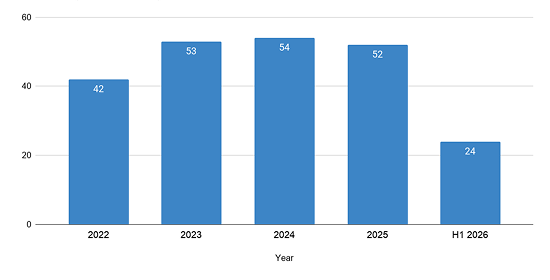
Thailand (2022-H1 2026)
Development slates reflected a definitive pivot toward premium-scale, calculated investments. Industry leader GDH 559 dominated pre-production momentum, initiating its high-budget Untitled Snooker Project leveraging pan-Asian talent Putthipong "Billkin" Assaratanakul alongside the Banjong Pisanthanakun-produced comedy-drama GFF. Concurrently, independent players aggressively leveraged international markets to offset domestic volatility. At the Cannes Film Market, 13 Studio launched the ambitious period action-horror Dawn of Soengsang by Taweewat Wantha (Death Whisperer 1 & 2), while Phontharis Chotkijsadarsopon rolled out the USD 1.4 million horror feature Kijsada Paradise. These moves confirm that high-concept cultural IP remains the most viable blueprint for securing global pre-sales and sustaining long-term asset valuation.
Corporate production models transitioned into a highly institutionalized phase of cross-industry syndication. To mitigate overhead and de-risk theatrical exposure, major houses actively dismantled the traditional sole-investor model. M Studio spearheaded this structural shift, unveiling a massive 17-film slate built entirely on Joint Ventures (JVs). By executing strategic co-productions with major media conglomerates—including BEC World (Channel 3) for Death Whisperer: Saming The Werebeast, MONO Original for Nakee 3, and Workpoint via Karman Line for God Skin—M Studio successfully offset capital risk while guaranteeing secondary broadcast windows and promotional airtime. This aggressive syndication drastically widened the capitalization gap between conglomerate-backed tentpoles and standalone independent producers.


God Skin © Karman Line
On the operational front, local production faced severe macroeconomic headwinds driven by a supply-side labor squeeze. The historic influx of inbound foreign productions triggered intense wage inflation. Top-tier technical directors, crews, and post-production specialists migrated en masse to highly subsidized international sets. While this drove massive macroeconomic employment, the resulting domestic talent deficit caused day rates and equipment rentals to surge. Consequently, independent local productions faced severe cost overruns and operational delays, leaving domestic-scale cinema highly vulnerable to structural inflation. This labor-driven volatility directly precipitated the radical financing pivots and capital reallocation strategies detailed in the subsequent section.
Financing Models
Capital Volatility, Streaming Anchors, and Corporate Syndication
Directly responding to the operational inflation detailed in the production sector, the financing architecture of H1 2026 underwent a brutal, polarized reallocation of capital. Investment volume aggressively concentrated into two highly insulated tranches: high-budget studio tentpoles (THB 50–80 million / USD 1.50–2.40 million) backed by corporate syndication, and mid-budget genre vehicles (THB 25–50 million / USD 0.75–1.50 million) anchored by global pre-sales. Conversely, the sub-THB 10 million (USD 0.30 million) independent sector faced a catastrophic liquidity crunch, effectively freezing the R&D pipeline for non-studio cinema.
This capital starvation at the independent level was compounded by growing uncertainty over predictable state funding. While the political gridlock halted THACCA's institutionalization, it did not erase previously committed public financing: the THB 220 million budget approved in 2025 for 88 projects remained legally protected, providing a crucial funding lifeline across 2025–2026 and supporting projects that achieved major international festival recognition, including Ratchapoom Boonbunchachoke's A Useful Ghost (Cannes Critics' Week Grand Prix) and Sompot Chidgasornpongse's 9 Temples To Heaven (Cannes Directors' Fortnight). However, the institutional halt weakened the predictability of future public support within the hybrid-funding model evident in 2025, leaving independent producers increasingly uncertain about future access to coordinated public capital.
To navigate this institutional uncertainty and de-risk theatrical exposure, private equity drastically recalibrated its return expectations, pivoting away from raw box-office speculation toward guaranteed "Streaming Participation." Global over-the-top (OTT) platforms transitioned from secondary licensing buyers into primary co-financiers. Minimum guarantees and full original commissions became the mandatory baseline for greenlighting projects prior to principal photography.
Simultaneously, alternative equity pooling bypassed traditional structures. Studios aggressively weaponized cross-industry capital, integrating funds from out-of-home media buyers (MI Group for King Keaw) and talent-agency fandoms (Be On Cloud for The Stain) to secure a guaranteed box-office floor and leverage global interfans. M Studio further optimized this model by pooling production resources across its syndicated network for mid-budget co-productions like Ghost Board (produced by Visut Poolvaraluk’s Saduak Ratchayothin) and The Djinn's Curse 2 (Monwichit). While this hyper-institutionalized financing successfully shielded corporate slates, it consolidated immense financial power at the top. This absolute centralization of capital naturally dictates distribution leverage, setting the stage for the multiplex monopolies and theatrical bottlenecks.
Distribution Climate
Multiplex Monopolies, Asset Restructuring, and Alternative Circuits
Flowing directly from the hyper-institutionalized financing, the H1 2026 distribution landscape functioned as a closed, vertically integrated ecosystem. Integrated studio powerhouse M Studio sustained absolute market leadership. This internal distribution dominance was concretely validated by the Stock Exchange of Thailand (SET), which reported that Major Cineplex Group (MAJOR) generated a consolidated H1 2026 revenue of THB 3,147.89 million (USD 94.47 million). This confirms a critical strategic reality: domestic film distribution is no longer a secondary revenue stream, but the primary engine shielding overarching corporate profitability against global import volatility.
However, this deep-seated vertical integration between conglomerate studios and the multiplex duopoly (Major Cineplex and SF Cinema) has engineered severe theatrical bottlenecks. To maximize gross margins and bypass traditional 50/50 revenue splits with Hollywood, exhibitors routinely allowed two or three major local blockbusters to monopolize up to 80% of nationwide screens during opening weekends.
This domestic entrenchment was further accelerated by aggressive asset restructuring. Major Cineplex divested its 69.97% controlling stake in Major Platinum Cineplex (Cambodia) to Sabay Cinema, marking its strategic exit from the Cambodian market, although 33 Cambodian screens remained temporarily included in the group’s reported footprint pending deconsolidation. The divestment, initially framed as a strategic reallocation of capital toward domestic expansion, was accelerated amid escalating regional trade tensions and localized consumer boycotts. The exit ended Major’s 12-year infrastructure presence in Cambodia and redirected capital toward its core domestic operations.
Consequently, Major's domestic Thai footprint, excluding Cambodian and Laotian screens, stood at 806 screens across 180 locations by June 2026, with the company targeting an additional 25–30 screens across eight strategic domestic locations under a THB 400 million CAPEX plan. This reallocation reinforced Major's domestic exhibition footprint and, by extension, its influence over theatrical screen allocation, leaving independent and mid-tier films particularly vulnerable within a system dominated by commercially proven local titles and stringent opening-day performance requirements.
To counteract this systemic screen deficit, alternative distribution circuits are being institutionalized. The Association for the Promotion of Film Culture, backed by the Ministry of Culture, scaled its "Micro Cinemas" pilot infrastructure across five key provinces, decentralizing exhibition away from urban multiplex clusters. By developing dedicated, localized audiences for non-studio content, this scheme actively attempts to establish alternative distribution channels capable of bypassing the multiplex duopoly. This framework will be further formalized via the MicroCinema Training Lab 2026 in September, leveraging international programming expertise from Taiwan to establish sustainable, community-driven theatrical loops. Ultimately, as distribution channels bifurcate between corporate monopolies and independent micro-circuits, theatrical operators are being forced to aggressively rethink their monetization strategies and screen technologies.
Theatrical Reach
Duopoly Dominance, Localism, and Premium Monetization
The exhibition sector remained a tightly consolidated duopoly, compelling operators to optimize their existing infrastructure rather than aggressively expanding screen counts. Major Cineplex Group commanded absolute market dominance with an estimated 70% share of national admissions revenue across its 806 active screens. SF Cinema securely held a 30% market share across its nearly 400 screens.1 To justify ticket pricing (USD 5 to 10 for standard admission) against the convenience of streaming, both exhibitors heavily prioritized maximizing "yield per seat" through Premium Large Format (PLF) and high-tech upgrades. SF Cinema aggressively drove this initiative in January 2026, executing a nationwide infrastructure deal with Christie to deploy advanced CineLife+ Series RGB laser projectors across 14 flagship locations, permanently elevating the baseline visual fidelity of the theatrical experience.
- 1 Note: figures reflect Thailand-only domestic operations; prior-period figures were reported on a group-wide basis.
Audience consumption metrics showcased a definitive surge in "Localism", as domestic IPs comprehensively routed international franchises. The period’s financial anchor, The Undertaker 2 (Thibaan Studio / Serng Music / Satun Production / Movie Partner / Sirimongkol Property; THB 324.21 million / USD 9.73 million), executed a historic statistical rout; its monumental gross easily out-yielded the combined earnings of all five Hollywood imports in the Top 10—which generated a collective THB 308.67 million / USD 9.26 million (32.88%)—including Pixar's highly anticipated Toy Story 5 (THB 86.60 million / USD 2.60 million) and Hoppers (THB 78.48 million / USD 2.35 million). Rather than an anomaly, this confirms a current market preference for relatable regional narratives over imported Western formulas. Furthermore, the domestic box office cash flow was stabilized by a robust portfolio of mid-tier genre offerings—such as the horror anthology Haunted Universities 4 (Sahamongkol Film International; THB 81.25 million / USD 2.44 million) and the horror-comedy Pee Nak 5 (Five Star Production; THB 76.05 million / USD 2.28 million)—which maintained consistent mid-week seat occupancy and provided exhibitors with a diversified risk buffer against tentpole fatigue.


Pee Nak 5 © Five Star Production
Crucially, to combat standard programming gaps and theatrical capacity crises, exhibitors actively monetized the "Fandom Economy." Multiplex chains carved out dedicated screen allocations for premium alternative programming, heavily targeting Boy’s Love (BL) and Girl’s Love (GL) talent-agency fanbases, Japanese anime, and direct-import Indian cinema. These niche screenings yielded highly lucrative, merchandise-tied ticket bundles. The windfall from these alternative revenue streams and dominant local blockbusters was instrumental in stabilizing Major Cineplex's corporate liquidity. This financial health directly enabled the company's strategic capital reduction program finalized in August 2026, which effectively wrote off 75.67 million unsold treasury shares to optimize core shareholder value by nearly 10%. This aggressive capitalization on physical infrastructure and high-yield demographics directly mirrors the technological expansion occurring in the production services sector.
Technology and Production Services
Infrastructure as Capital Expansion and the Generative AI Equalizer
Flowing from the physical capitalization of the exhibition sector, Thailand’s technical service infrastructure underwent an aggressive period of high-tech capital expansion. To sustain the historic influx of foreign capital, local studios were compelled to upgrade physical production assets to meet the rigorous technical standards of global streaming pipelines and Hollywood blockbusters. This expansion was anchored by the continued operation of landmark facilities, most notably Figment Studio’s state-of-the-art ROE Visual and Brompton Tessera ICVFX LED volume in Samut Prakan. This was paralleled by the high-profile operations of Final Pixel Studio in Bangkok—the only ARRI-accredited virtual production facility in Asia—which successfully serviced Disney’s massive Alien: Earth series. To maximize the domestic retention of this wealth generation, the government initiated a major policy review of its 30% cash rebate scheme. Moving forward, the mandate will shift from supporting baseline service roles to strictly prioritizing high-tier local crew employment, ensuring international subsidies yield direct, long-term economic dividends for the domestic labor force.
Beyond physical sets, Thailand’s post-production and VFX ecosystems expanded rapidly to capture broader global market shares. Prominent industry leaders—most notably Chaya Pictures and Triangel—spearheaded local innovation by developing highly sophisticated virtual creatures and complex digital environments. This international competitive edge was concretely validated during the Cannes Film Market in May 2026, where both studios showcased a pioneering hybrid production pipeline—combining live-action stunts with high-end CGI—to render mythical folklore creatures for the period action-horror Dawn of Soengsang. This high-profile deployment leverages Chaya Pictures’ robust global track record, including Academy Award-nominated Marvel Studios titles Iron Man 3, Captain America: The Winter Soldier, and Guardians of the Galaxy, cementing Thailand's transition from a basic outsourcing hub into a premium digital partner.
Concurrently, Generative AI and automation underwent deep structural integration across the production value chain. While these deployments drastically optimized workflows, they triggered intense industry friction. This tension culminated in June 2026 with a public controversy targeting the Thai Film Directors Association (TFDA). The launch of the second edition of Thailand International AI Film Festival (TIAIF) under the 'UnPerfectionist' theme drew severe backlash from the creative community, who accused the regulatory body of legitimizing 'artistic theft' and undermining professional ethics. However, alongside ongoing structural warnings from the Creative Workers Union Thailand (CUT) regarding technological precarity, generative software was simultaneously weaponized as a vital cost-mitigation tool. Independent Thai filmmakers, acutely squeezed by the inflating crew day-rates detailed in the production landscape, increasingly deployed automation and generative tools to streamline production overheads.
Streaming & Digital Platforms
Hyper-Local Hegemony, IP Extraction, and Narrative Sovereignty
The digital streaming landscape in H1 2026 was defined by the structural dominance of global subscription video-on-demand (SVOD) platforms, led overwhelmingly by Netflix. Netflix reported that more than 90% of its members in Thailand watched local content in 2025, while 33 Thai titles have entered its Global Top 10 charts, including 17 Thai Netflix originals. Thai content has generated more than 750 million viewing hours worldwide, demonstrating the growing global value of local-language intellectual properties (IPs). This confirms a critical reality: global OTT platforms increasingly depend on deep investment in local storytelling to achieve scale in Southeast Asia. Yet while they provide crucial liquidity and international reach, their growing role as commissioners and financiers raises a fundamental question of Narrative Sovereignty: when global platforms finance and distribute locally originated stories, who retains the long-term economic value generated by those IPs?
This “liquidity-for-sovereignty” tension was evident in several premium H1 2026 commissions, including Empress of Flames (Plerng Phra Nang), produced by Kantana Motion Pictures, and the forthcoming documentary Chompoo: Lost & Forgotten, produced by Beach House Pictures and Thai Film Works. At the same time, titles such as Girl from Nowhere: The Reset, produced by SOUR Bangkok, directed by Pairach Khumwan and team, shattered streaming records across 67 countries. The Evil Lawyer, produced by underDOC Film and co-directed by Nottapon Boonprakob and Jakkarin Thepvong, topped the #1 spot in Thailand and sparked fierce national debate over legal corruption. This demonstrated the continued international value of locally rooted stories. The shift toward direct commissioning from independent creators and boutique production houses offers greater budgets and access to sophisticated international production systems, but may also limit creators’ ability to accumulate long-term value from newly originated IP when proprietary rights are transferred or substantially constrained.
Girl from Nowhere: The Reset offers a contrasting tactical model. Whereas Season 2 was developed through a partnership between Netflix and GMM Studios International and released exclusively on Netflix, The Reset adopted a more domestically embedded release structure, premiering through Channel One 31 and oneD in Thailand alongside its global Netflix release. This does not by itself establish a particular contractual ownership structure, but it demonstrates that Thai-originated IP can combine global platform reach with continued domestic circulation. The strategic question is therefore not whether Thai producers should engage with global platforms, but how financing, rights, and release windows can be structured to preserve domestic negotiating leverage and long-term IP value.


The Evil Lawyer © Netflix
Regional platforms are also beginning to respond collectively. Viu and iQIYI International announced a unified subscription bundle across Southeast Asian markets, while Canal+ Distribution moved to bring Viu’s Thai Boys’ Love (BL) catalogue to the U.S. market. These developments point toward an emerging Asian strategy built not on matching Western platforms title-for-title, but on bundling, catalogue circulation, and cross-border partnerships.
Ultimately, the challenge for Thailand is no longer simply gaining access to global audiences. It is ensuring that international circulation does not automatically externalise the economic value embedded in locally originated IP. Narrative Sovereignty, therefore, depends not on rejecting global platforms but on developing alternative capital structures, rights strategies, and regional distribution networks that allow Thai creators and producers to retain meaningful stakes in the long-term value of their work. This is driving a broader pivot toward cross-border co-productions and regional IP trading.
Note: Following the formal conclusion of the ADTEB and Nielsen Cross-Platform Ratings project in late 2025, comparable viewership data for local telco-backed platforms such as TrueID and AIS Play was unavailable for this reporting period. Accordingly, this section's analysis shifts focus toward SVOD original production dynamics, IP rights, and narrative sovereignty frameworks.
Co-Production
Transnational Alliances, Sovereign Hubs, and Outbound IP Expansion
Directly addressing the concern of Narrative Sovereignty established in the digital landscape, Thailand's positioning in the international film ecosystem underwent an aggressive structural transition in H1 2026. The industry rapidly evolved from a cost-effective physical filming destination into a highly active Creative Partner and IP Owner. This global ascent was powerfully validated by the Asian Contents & Film Market (ACFM) in Busan, which officially named Thailand its inaugural Country of Honor. This top-tier diplomatic partnership systematically integrates Thailand’s creative talent pool with ACFM’s core infrastructure. The institutional firm was further advanced when the Busan Story Market (BSM) unveiled its newly established "Remake IP" section, selecting an inaugural all-Thai slate of five inventive feature films—Congrats My Ex!, Happy Monday(s), Home for Rent, Midnight Incense, and My Boo—to pitch for cross-border remakes and localized co-productions during the October market event. This formalizes a critical pivot: Thailand is actively institutionalizing its IP trade.
Recent developments in co-production frameworks shifted from informal financial arrangements into institutionalized, multi-party alliances across both mainstream and independent sectors. In the commercial sphere, M Studio spearheaded outbound corporate syndication, leveraging the Cannes Film Market to finalize a landmark tripartite co-production pact with Japan’s Toei Company and South Korea's Showbox for The Long Hair In The Attic, an adaptation of Junji Ito's iconic manga, directed by Sitisiri Mongkolsiri (Hunger). This corporate momentum was further matched by Transformation Films, which launched a USD 2.00 million Asian Genre Slate alongside Taiwan’s GrX Studio and Lots Home Entertainment. These moves prove that local studios are actively bypassing domestic theatrical bottlenecks by building pan-Asian equity alliances from day one.
Building on the outbound momentum established in H2 2025, Common Ground—Shinesaeng Ad.Venture's co-production hub—continued promoting its 2026–2027 international slate (Prasert, No Caller ID, All Forgotten Now, Bua) at major markets including Hong Kong FILMART and the Cannes Marché du Film, securing world sales deals for Prasert (Taiwan's 66cc Company) and Our House (South Korea's K-Movie Entertainment).
Crucially, cross-border capital pooling has become the primary life support for independent, auteur-driven cinema, allowing creators to circumvent the unpredictable domestic public funding vacuum left by THACCA's dissolution. This strategy bore unprecedented artistic fruit during the reporting period. The financing structure of Sompot Chidgasornpongse’s 9 Temples To Heaven—a robust co-production between Thailand, Singapore, France, and Norway—stands as a prime example of successfully leveraging multinational equity to bypass domestic capital limitations and secure premier festival berths. Furthermore, Jakrawal Nilthamrong’s historical drama Rhizome—a complex co-production involving Thailand, South Korea, France, Laos, and Singapore—successfully secured premium funding through the 2026 Asian Cinema Fund (ACF) Co-Production Support Program.
 Rhizome © Mit Out Sound Films
By aggressively cross-subsidizing local technical expertise with international equity, institutionalizing shared-crew models, and establishing dedicated film remake pipelines, Thailand has completely re-engineered its transnational footprint. Entering its landmark Country of Honor showcase at ACFM 2026, the Thai film industry is no longer merely supplying content to global gatekeepers; it is a mature, commercially viable, and strategically sovereign cinematic force, fully prepared to dictate its own terms on the global stage.
Conclusion
The Sovereign Asset
In H1 2026, the Thai film industry ceased asking for permission to scale. Faced with domestic policy gridlock, aggressive theatrical bottlenecks, and the structural extraction of IP value by global streaming platforms, the sector did not contract—it began to fundamentally re-engineer its economic DNA. The aggressive pivot toward transnational equity alliances, premium local monetization, and stronger IP protection is no longer merely a survival tactic; it represents a broader assertion of Narrative Sovereignty. As Thailand prepares to assume its position as the inaugural Country of Honor at ACFM 2026, the direction of travel is increasingly clear. The era of functioning simply as a low-cost physical backdrop or subsidized content factory for global platforms is giving way to a more assertive model in which Thailand seeks to retain greater control over the cultural and economic value it creates. Thailand is no longer simply producing entertainment; it is building sovereign cultural assets. The future of Asian cinema will not just be filmed in Thailand—it will be owned by it.
Vorakorn RUETAIVANICHKUL
Author, Filmmaker & PhD Researcher / Griffith Film School
Vorakorn “billyv◊rr” Ruetaivanichkul is a Thai author, filmmaker, and Australia Awards for ASEAN Scholar whose practice spans regional independent cinema, research-led creative development, and major international productions, most notably serving as Co-Producer on Ron Howard’s Thirteen Lives (2022). A 2024 ArtsEquator Fellow, he developed the critical framework of Mek◊ng Sci-Fi, which has since evolved into his broader creative and intellectual universe, Fut◊rity. Currently pursuing his PhD at Griffith Film School, Vorakorn investigates authorship in AI-assisted long-form narrative development. His work advances questions of narrative sovereignty and creative independence, focusing on architecting new modes of cultural production for Southeast Asia and the Global South. His ongoing research and creative practice are developed through KARMICS at karmics.co.
Source:
- - https://deadline.com/2026/07/billkin-putthipong-gdh-baz-poonpiriya-vanridee-pongsittisak-1237001071/
- - https://www.screendaily.com/news/confessions-of-a-shaman-becomes-thailands-second-biggest-film-of-2026-to-date/5219515.article
- - https://www.mono.co.th/mono-originalthailand-content-market-2026/
- - https://www.screendaily.com/news/thailands-jungka-studio-moves-into-sales-sells-mma-film-god-skin-to-north-america/5219727.article
- - https://thailand.prd.go.th/en/content/category/detail/id/2078/iid/521928
- - https://www.nationthailand.com/business/economy/40068179
- - https://investor.majorcineplex.com/th/financial-information/financial-highlights
- - https://en.moneyandbanking.co.th/2026/228281/
- - https://cambodiainvestmentreview.com/2026/03/06/major-cineplex-exits-cambodia-amid-thai-brand-boycotts-sells-stake-to-cambodias-sabay-digital-for-161-million-baht-5-1-million/
- - https://www.facebook.com/FilmCulturePromotion/posts/เปิดตัววิทยากร-วีนัส-เฉิน-แห่ง-spot-huashan-ไต้หวัน-ในการอบรม-microcinema-traini/122177285840947155/
- - https://www.k9cineblog.com/post/major-plans-open-4-new-imax-thailand-2026-2027
- - https://www.christiedigital.com/press-releases/sf-cinema-chooses-christie/
- - https://au.marketscreener.com/news/major-cineplex-group-public-company-limited-s-equity-buyback-announced-on-november-11-2025-has-exp-ce7f51dadf8ef122
- - https://www.nationthailand.com/business/economy/40068636
- - https://www.roevisual.com/en/news-and-events/news/figment-studio-unveils-southeast-asias-most-advanced-virtual-production-stage-with-roe-visual
- - https://www.facebook.com/ProAVLAsiaMagazine/videos/on-the-global-stage-final-pixel-studio-in-bangkok/2418905511914819/
- - https://www.proavl-asia.com/details/80177-on-the-global-stage
- - https://www.rainmaker.in.th/tiaif2026-cause-drama/
- - https://about.netflix.com/en/news/next-on-netflix-thailand-2026
- - https://www.screendaily.com/news/netflix-launches-ambitious-thai-slate-including-directors-taweewat-wantha-sitisiri-mongkolsiri/5213546.article?referrer=RSS
- - https://variety.com/2026/film/news/becky-armstrong-signs-caa-1236729253/
- - https://www.nationthailand.com/vdo/the-disclosed/40068206
- - https://deadline.com/2026/06/viu-pccw-iqiyi-international-bundle-southeast-asia-1236958104/
- - https://variety.com/2026/tv/news/heated-rivalry-canal-plus-distribution-thai-boys-love-us-1236733229/
- - https://deadline.com/2024/01/amazon-studios-prime-video-layoffs-southeast-asia-1235733743/
- - https://www.facebook.com/thailandprd/posts/according-to-the-thailand-film-office-tfo-alien-earth-which-began-filming-in-tha/1257438726418935/
- - https://press.biff.kr/eng/artyboard/mboard.asp?Action=view&strBoardID=9622_04&intSeq=102479
- - https://press.biff.kr/eng/artyboard/mboard.asp?Action=view&strBoardID=9622_04&intSeq=102546
- - https://www.screendaily.com/news/japans-toei-thailands-m-studio-koreas-showbox-team-for-horror-the-long-hair-in-the-attic/5216723.article
- - https://www.screendaily.com/news/grx-studio-lots-home-entertainment-transformation-films-launch-2m-asian-genre-slate/5210667.article
- - https://www.sorfond.no/film/9-temples-to-heaven
- - https://www.screendaily.com/news/koji-fukada-boo-junfeng-jakrawal-nilthamrong-projects-win-asian-cinema-fund-grants/5219400.article
Reference:
- - H1 Domestic Films tracked from the Bangkok Critics Assembly's Facebook, plus additional arthouse films with limited release.
https://www.facebook.com/BangkokCritics - - Marketeer Online, 2024 The Golden Year of Thai Film
https://marketeeronline.co/archives/396811?fbclid=IwY2xjawMg_hpleHRuA2FlbQIxMABicmlkETFtYVlSOFFMbHlmTEU3dzJ0AR5L8wDNetiZoFIEyocIVz80U0oIaZ54Wp9lWO0-ibz2MB9fAp0JzSMx-a8Ybg_aem_5-RI5lZXfWgNZaV0h4ptDA