Title
THE A REPORT
2026 H1
 REN Hao Jheng
Researcher
REN Hao Jheng
Researcher Taiwan Creative Content Agency
(TAICCA)
Updated on 6 Oct 2026
Overview
Following a robust performance in late 2025, Taiwan’s film market maintained strong momentum into the first half of 2026. The domestic box office, in particular, saw a landmark achievement: driven by the overwhelming success of Sunshine Women’s Choir, the first-quarter domestic total hit TWD 1 billion, a figure that already surpasses the TWD 946 million in domestic box office records for the whole of 2025. By the end of June, the overall box office reached TWD 4.2 billion; with a steady global recovery in theater attendance, the industry expects the full-year box office to break the TWD 9 billion mark.
 Sunshine Women’s Choir © 11CC
During this period, Taiwan premiered 30 domestic films in total, including feature films, documentaries, and animations, keeping output at a steady level. Feature films still make up the majority. Although Sunshine Women's Choir is not counted among them because it opened on the last day of 2025, it is unquestionably the most iconic film. Beyond breaking the domestic box-office record of TWD 530 million set by Cape No. 7 in 2008, it is also the only domestic film among the all-time box-office top ten. Its director, Gavin Lin, specializes in melodrama and has prior success adapting a Korean movie, More Than Blue (2009), released in 2018. Because most Taiwanese film-production companies are small and medium-sized studios with unstable output, whether this success can be developed into a replicable model remains to be seen.
Top 10 Films in Taiwan Box Office (H1 2026)
You can scroll left and right to view the content.
| No | Title | Director | Country | Genre | Gross (TWD) |
Gross (USD) |
Production Company |
Distribution Company |
|---|---|---|---|---|---|---|---|---|
| 1 | Sunshine Women’s Choir | Gavin Lin Hsiao-Chen | Taiwan | Drama | 771M | 23.9M | Star Generation Culture & Entertainment | 11cc Films |
| 2 | The Super Mario Galaxy Movie | Aaron Horvath, Michael Jelenic, Pierre Leduc | USA | Animation | 290M | 9M | Universal Pictures, Nintendo, Illumination Entertainment | Universal Pictures Corporation of China Taiwan Branch (U.S.A.) |
| 3 | Hoppers | Daniel Chong | USA | Animation | 289M | 9M | Walt Disney Pictures, Pixar Animation Studios | The Walt Disney Company (Taiwan) |
| 4 | The Devil Wears Prada 2 | David Frankel | USA | Drama | 239M | 7.4M | 20th Century Studios, Wendy Finerman Productions, Sunswept Entertainment | The Walt Disney Company (Taiwan) |
| 5 | Colony | Yeon Sang-ho | Korea | Horror | 221M | 6.9M | Wow Point, Smilegate, Midnight Studio | GaragePlay |
| 6 | Avatar: Fire and Ash | James Cameron | USA | Sci-Fi, Action | 191M | 5.9M | 20th Century Studios, Lightstorm Entertainment, TSG Entertainment | The Walt Disney Company (Taiwan) |
| 7 | Toy Story 5 | McKenna Harris, Andrew Stanton | USA | Animation | 172M | 5.3M | Pixar Animation Studios, Walt Disney Pictures | The Walt Disney Company (Taiwan) |
| 8 | Project Hail Mary | Phil Lord, Christopher Miller | USA | Sci-Fi | 172M | 5.3M | Pascal Pictures, General Admission, Lord Miller Productions | Sony Pictures Releasing Taiwan Corporation Taiwan Branch (U.S.A.) |
| 9 | Zootopia 2 | Jared Bush, Byron Howard | USA | Animation | 113M | 3.5M | Walt Disney Pictures, Walt Disney Animation Studios | The Walt Disney Company (Taiwan) |
| 10 | Michael | Antoine Fuqua | USA | Biopic | 108M | 3.4M | Lionsgate, GK Films, Optimum Productions | Universal Pictures Corporation of China Taiwan Branch (U.S.A.) |
Top 10 Domestic Films in Taiwan Box Office (H1 2026)
You can scroll left and right to view the content.
| No | Title | Director | Country | Genre | Gross (TWD) |
Gross (USD) |
Production Company |
Distribution Company |
|---|---|---|---|---|---|---|---|---|
| 1 | Sunshine Women’s Choir | Gavin Lin Hsiao-Chen | Taiwan | Drama | 771M | 23.9M | Star Generation Culture & Entertainment | 11cc Films |
| 2 | HERO! HITO! | Lungnan Isak Fangas | Taiwan | Documentary | 94M | 2.9M | Wonderful Time Film Production | Activator |
| 3 | Double Happiness | Joseph Chen-Chieh Hsu | Taiwan | Drama | 86M | 2.7M | Splash Pictures | Universal Picture Corporation of China Taiwan Branch (U.S.A.) |
| 4 | Kung Fu | Giddens Ko | Taiwan | Action | 47M | 1.5M | Machi Xcelsior Studios | Machi Xcelsior Studios |
| 5 | A Foggy Tale | Yu-Hsun Chen | Taiwan | History, Family | 34M | 1.1M | Mandarin Vision | Activator |
| 6 | The Island and the Trees | Hsiang-Hsiu Lee | Taiwan | Documentary | 22M | 0.7M | Summer Chronicle Audio-Visual Culture | Summer Chronicle Audio-Visual Culture |
| 7 | Dead End | Chun-Hao Chan | Taiwan | Action | 15M | 0.5M | inJECT Films | Machi Xcelsior Studios |
| 8 | Hold to Death: HAND in HAND | Alex Wang | Taiwan | Horror | 15M | 0.5M | Wanin International Visual Enterprise, Monkey Cultural and Creative | Vie Vision Pictures |
| 9 | Unsung Heroes: Rise Again | Charlie Chu | Taiwan | Documentary | 12M | 0.4M | Studio Gene Young, 3D Image | Activator |
| 10 | The Tao Exorcist | Hau-Jou Chiou | Taiwan | Thriller | 12M | 0.4M | Star Shine Film | Vie Vision Pictures |
Production Landscape
Taiwan maintains a stable production output of approximately 50 domestic films annually, and the 2026 release schedule reflects this consistency. Looking ahead to the second half of 2026, a notable release is Granny and Magic Sprout. As the direct sequel to the 1998 classic Grandma and Her Ghosts, a cornerstone of Taiwanese animation, this project represents a significant effort to revitalize original Taiwanese IP after a 28-year gap, making it a notable animated release this year despite limited domestic animation production.
The Rope Curse 4: Kuntilanak, the fourth installment of the long-running horror franchise, completed production in H1 2026 and was released in late August 2026 (after the reporting period). The film expands the existing horror universe by integrating Zhong Kui folklore with Indonesia's well-known Kuntilanak legend. To enhance its cross-border appeal, the production filmed on location in Indonesia and cast high-profile talent, including veteran Indonesian actor Ferry Salim, content creator Andovi Da Lopez, and JKT48 member Yessica Tamara, directly targeting the horror-loving Indonesian film market.
Incalculable Youth, a feature film produced by Gavin Lin, finished shooting this year. Adapted from a Japanese campus-romance novel, the project benefits from a high-profile creative team, including producer Gavin Lin, lead actress Man Xi Ho, and screenwriter Hermes Lu, who collectively carry the pedigree of the record-breaking Sunshine Women's Choir team. Concurrently, the romantic action film Bad Girl also commenced production during the same period. While the project is not derived from the popular Gatao franchise, it leverages the series' core production infrastructure and cast to capitalize on established audience recognition and ensure market traction.
Wanin International, moving aggressively into the film and television sector, also reflects the focus on cross-border casting and talent integration. Its fantasy comedy Don’t Father Me, the inaugural winner of its screenplay competition, stars Hong Kong actor Aaron Kwok. The casting of a famous Hong Kong star in a Taiwanese film signals Wanin’s intent to position itself within the broader Chinese-language film market.
In addition, Thunder Entertainment’s recent slate illustrates deeper structural integration in financing and co-production: Arrested Memory is a Taiwan–Japan action collaboration directed by SABU, a two-time Berlin Film Festival competitor, and has already completed production with international distribution rights secured. The Ancient Tree, a Taiwan–France fantasy romance, is helmed by Singing Chen, who won the Immersive Grand Prize at the Venice Film Festival last year for The Clouds Are Two Thousand Meters Up, and currently remains in post-production.
The push for wider appeal through international casting and collaboration is further evidenced by other projects currently in the pipeline. Haru and Tae, a Taiwan–Japan collaboration, marks the first Taiwanese feature to star Japanese icon Joe Odagiri, while the thriller The Cave, developed by leading production house Mandarin Vision, pairs top-tier Taiwanese leads Alice Ko and Roy Chiu. By capitalizing on their respective success in the hit series Someday or One Day and the 2021 domestic box-office champion Man in Love, the production aims to leverage their significant regional popularity. These projects demonstrate a clear industrial shift toward international collaboration and star-driven models as primary vehicles for ensuring commercial viability in an increasingly crowded and competitive market.
Financing Models
Because most Taiwanese film-production companies are small in scale, beyond their own capital they rely mainly on joint investment from corporate or private funds, as well as on government subsidies and investment from TAICCA. As labor and material costs rise, the capital invested in Taiwanese domestic films is bound to increase over the long term. While the average production scale currently stands at around TWD 50 million, consistently achieving sufficient box-office returns to scale up production remains a significant challenge for the industry.
A noteworthy shift in current film financing is the establishment of joint investment funds between TAICCA and partners such as telecom carriers, television networks, and entertainment groups. These funds leverage aggregated capital to scale production budgets. For instance, the Far EasTone Creative Entertainment Fund (established December 2025) and the Taiwan–Korea Entertainment and Cultural Content Fund (announced at TCCF in 2025 and formally established June 2026 by TAICCA, Far EasTone, CJ ENM, and TVBS) possess a combined capital scale exceeding TWD 1.5 billion. Similarly, the Chunghwa Digital Cultural and Creative Fund, a partnership with Chunghwa Telecom established in May 2026, operates with an initial scale of TWD 1 billion. By creating these structured, cross-industry investment vehicles, the industry is securing substantial, reliable funding sources beyond traditional project-by-project investment.
Government subsidies remain a vital pillar of the financing ecosystem, with established frameworks from the Ministry of Culture and local authorities continuing to provide essential baseline support. To attract production teams, local governments provide venue subsidies paired with access to specialized facilities, such as Tainan’s Annei Film Studio, tailored for period and historical settings, and the Central Taiwan Film Studios, which offer advanced virtual production and water-tank capabilities. Moreover, Taiwan has recently encouraged virtual production at the policy level: beyond the Ministry of Culture's virtual-production subsidy for feature films, the Kaohsiung City Government also offers subsidies for using LED studios on short films of up to 15 minutes, boosting the application of the relevant technologies.
Beyond these new investment vehicles, tax deductions under the “Development of the Cultural and Creative Industries Act” remain a vital pillar of the financing ecosystem. These fiscal measures continue to lower the barrier for private and corporate capital, forming a complementary layer of support that reinforces the stability of the domestic film investment environment.
Distribution Climate
Broken down by country of origin, the top three by box-office market share in the first half of 2026 were, in order, the United States, Taiwan, and Japan; measured by number of films screened, Japan ranked first, followed by the United States and Taiwan. Korea ranked fourth in both box-office market share and number of films screened. Taiwanese domestic films posted a combined total box-office revenue of nearly TWD 1.2 billion, a 27.85% market share; 58 local films were screened (including re-releases and carryover titles) during H1 2026, roughly level with H1 2025. Overall, the structure of Taiwan's film-distribution industry has not changed much, with Hollywood distributors still dominating the market as a whole.
Market Share by Countries, H1 2026
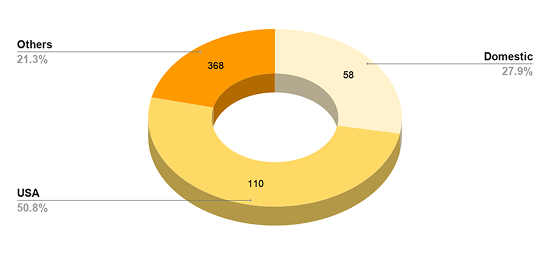
- Slice size represents box office revenue share; figures inside indicate number of films released.
- Source: Bureau of Audiovisual and Music Industry Development, MOC
- Note: Box office market share includes 2026 releases, ongoing 2025 releases, and re-releases (excluding festival screenings).
- Source: Bureau of Audiovisual and Music Industry Development, MOC
- Note: Box office market share includes 2026 releases, ongoing 2025 releases, and re-releases (excluding festival screenings).
11CC, the Taiwan distributor of Sunshine Women's Choir, captured over 18% of the box-office market share with this single title, despite its limited release volume. Notably, both 11CC and the film's investor, 16CC, are subsidiaries of Hong Kong producer Jeffrey Chan. This structure reflects the project-based investment-distribution models occasionally seen in the Taiwanese industry. Among Taiwanese domestic distributors, on the strength of Colony's TWD 221 million box office plus its established high-volume distribution strategy, GaragePlay turned in the most striking box-office performance in the first half. Meanwhile, Activator Marketing, which focuses on distributing domestic documentaries, also posted an outstanding showing on the strength of the baseball documentary HERO! HITO!'s TWD 94 million and cross-year releases such as A Foggy Tale.
Overall, Japanese films accounted for about one-third (33.21%) of films screened, reaching 178 titles and surpassing the United States' 110 (20.52%). The increase in Japanese films screened is linked to distributors' strategy of rolling out theatrical anime versions in relay fashion—for example, GaragePlay bringing in the classic Japanese anime The Garden of Sinners. In addition, last year's box-office champion Demon Slayer: Kimetsu no Yaiba Infinity Castle was released this year in a SCREENX version and re-released in a 4D version, also reflecting the characteristics of Japanese anime distribution in Taiwan. With no standout box-office performer, Japanese films nonetheless maintained about a 10% (10.1%) box-office market share on the strength of the above distribution strategies.
Top 5 Distributors' Market Share, 2025
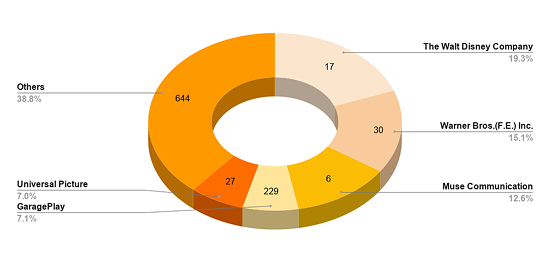
- Slice size represents box office revenue share; figures inside indicate number of films released.
The number of American films screened fell from the same period in 2025, but their aggregate box-office figures of nearly TWD 2.2 billion accounted for 50.84% of total box office, still making the United States the top country of origin by market share. Disney was undoubtedly the main contributor: among the top 10 box-office films of the first half of 2026, five were from Disney—Hoppers, The Devil Wears Prada 2, Toy Story 5, and the cross-year releases Avatar: Fire and Ash and Zootopia 2—together grossing over TWD 1 billion. For the past two years Disney has been Taiwan's highest-market-share distributor, reflecting the market strength of its powerful animation and live-action film IP.
Theatrical Reach
The number of cinema screens in Taiwan continued its downward trend, falling from 932 in 2025 to 896 as of May 31, 2026. Key contributors to this decline include the closure of the low-foot-traffic Century Asia Cinemas A19 and the 62-year-old in89 Cinemax Ximen. The closure of the latter leaves LUX Cinema as the sole remaining theater on what was once Taipei’s bustling 'Cinema Street' in Ximending. However, in89 plans to open a new cinema at Dali Art Plaza in Taichung in the fourth quarter of this year, and the Taichung Cinema and Pop Culture Center is scheduled to open at year-end. With Taiwan's cinema leader Vieshow Cinemas moving in to operate a venue there, the number of screens is expected to rebound.
No. of Domestic Feature films and Screens (2019-H1 2026)
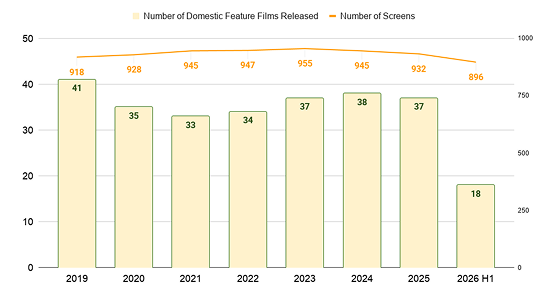
- The data include only domestic feature films first released during the respective reporting period.
- The number of screens in 2026 H1 was counted as of May 31.
- The number of screens in 2026 H1 was counted as of May 31.
Currently, chain cinemas dominate the market, accounting for 78.76% of screens in 2025. Theaters are mainly concentrated in metropolitan areas, with nearly 40% of screens in the more populous Taipei and surrounding area. Taiwan's cinema chains continue to develop premium-format screens, notably with Vieshow Cinemas planning to progressively renovate the IMAX auditoriums at its Hsinchu, Taichung, and Tainan sites starting in the second half of this year to enhance the viewing experience.
The average ticket price in H1 2026 dipped slightly to TWD 290.13 from TWD 293.46 in 2025, likely reflecting the higher market share of domestic films, which typically screen in standard, lower-priced auditoriums. Regarding the May 2026 amendment to the “Amusement Tax Act”—which permanently exempts film admissions from amusement tax—this policy relief is expected to primarily serve to bolster cinema operators' margins against rising operational costs and inflationary pressures, rather than precipitating a broad reduction in ticket prices or driving immediate shifts in consumer behavior.
Taiwan's total admissions reached nearly 14.6 million, up more than 40% from 10.3 million in the same period last year. This recovery was primarily driven by domestic-film admissions, which surged to 4.3 million, largely catalyzed by the breakout success of Sunshine Women's Choir. The film had a modest opening of approximately TWD 10 million, but gained significant momentum through word-of-mouth, surpassing the TWD 100 million threshold on its 20th day of release. In fact, this pattern is not unique: Cape No. 7, whose box-office record Sunshine Women's Choir surpassed, saw a similar trajectory back in its day. Relying on word-of-mouth marketing is also the core approach of Taiwanese domestic-film promotion.
For a long time, the Taipei City theatrical performance has been the bellwether indicator for nationwide trends. Generally, the city accounts for roughly one-quarter to one-third of the national total; by contrast, Sunshine Women's Choir's Taipei share was below one-fifth of its national box office, showing that its blend of local pop music and heartwarming elements has strong mobilizing power in regions outside of Taipei—setting a top benchmark case for the planning of future domestic films.
Technology and Production Services
In recent years, the share of post-production and visual effects in overall production budgets has risen to 10–20%. Active government support for post-production, visual effects, and virtual production has further positively influenced the increasing budget share for these areas. Moreover, whereas in the past post-production and visual effects only started after shooting, in recent years, as the number of film genres requiring visual effects has grown, VFX teams increasingly participate as early as the pre-production planning stage so that VFX planning fits the film's style and needs. Some works are produced via virtual production and the application of previsualization (previs), which has also blurred the traditional boundary between production and post-production and VFX.
TWR Entertainment recently shared at a talk that it has deployed over 200 AI agents across its production workflow, ranging from pre-production tasks like script parsing, casting, and storyboarding to post-production camera tracking and scene generation. This comprehensive integration enables the company to complete complex projects with 80% less manpower.
Streaming & Digital Platforms
Streaming-platform licensing fees are a key source of income for Taiwanese films, and for some domestically produced films with moderate box office performance, streaming-platform licensing income may even exceed theatrical box-office revenue. On another note, top domestic streaming platforms such as Hami Video, friDay Video, and MyVideo are backed by parent groups that are Taiwan's three largest telecom companies, and these carriers also invest in films, forming a connected upstream-downstream ecosystem.
International platforms acquire Taiwanese films exclusively through licensing. While some deals involve domestic-only or non-exclusive rights, global or regional licensing is typically reserved for films with standout box-office performance. Notable recent examples include 96 Minutes and Mudborn (each grossing over TWD 100 million in 2025) and A Foggy Tale (over TWD 100 million cumulatively across 2025 and 2026), as well as Double Happiness (over TWD 85 million); all were listed as Netflix global exclusives.
Co-Production
Taiwan's international co-productions have increased remarkably; for example, the aforementioned high-profile domestic titles The Ancient Tree, Arrested Memory, and Haru and Tae are all cross-border co-productions, while The Rope Curse 4: Kuntilanak, though purely domestically financed, also collaborated with several Indonesian actors. This trend is underpinned by robust policy support, including the Ministry of Culture’s cash rebate of 30% on local spending (with a maximum limit of TWD 10 million) for overseas production companies shooting in Taiwan, alongside strategic investment programs such as TAICCA’s Taiwan International Co-funding Program (TICP).
 The Rope Curse 4 © 11CC
Through the TICP 2.0 investment scheme, TAICCA invests in international co-produced films whose content and production feature Taiwanese elements; both The Ancient Tree and Haru and Tae are works funded under this program. In addition to TICP 2.0, TAICCA also supports international co-productions through investments from the National Development Fund—for example, SAYANG, a Taiwan–Malaysia co-production, is slated for release in October 2026. TAICCA has also launched key development initiatives, such as the 'Taiwan Stories on the World Stage Program' (now in its second year), and the 'BUBBLE: Teen Romance Feature Co-Development Program,' partnered with Korea’s Studio Dragon, both of which are designed to incubate projects with significant international commercial potential.
REN Hao Jheng
Researcher / Taiwan Creative Content Agency (TAICCA)
Ren Hao Jheng is a researcher at the Taiwan Creative Content Agency (TAICCA), specializing in film and television industry analysis and policy development insights.
This article was written by Ren Hao Jheng, Department of Research and Strategy, TAICCA, with contributions from:
- Sam Tzu-hsiang Yuan, Secretary General, New Media Entertainment Association
- Shawn Chuang, General Manager, My Story Entertainment
- Note: Figures reflect box office earned during the reporting period only. Films released in 2025 show only their 2026 revenue, not cumulative totals.