Title
THE A REPORT
2026 H1
 Jeremy CHUA
Executive Director
Jeremy CHUA
Executive Director Singapore International Film Festival
Updated on 6 Oct 2026
Overview
The publication in April 2026 of the Singapore Film Commission's official 2025 admissions data arrived quietly as part of a national statistics report. It changes the analytical framing and outlook for the Singapore film industry. The previous report, covering July to December 2025, was written against estimates suggesting a modest market recovery, but the market contracted further. The closures of Cathay Cineplexes and The Projector did not result in an observable redistribution sufficient to offset the decline in total admissions. Total admissions fell to 7.67 million, screen count fell from 267 to 228, and seating capacity shrank from approximately 35,000 to 30,000 seats. The estimated total market gross for 2025, applying the SGD 10.50 mean ticket price from 2024 to the official admissions figure, is approximately SGD 80.5 million, lower than 2024's SFC-published SGD 88.2 million and well below the SGD 100 million reached in 2023. However, because this estimate holds the average ticket price at its 2024 level, it would understate gross if prices rose in 2025 (or overstate it if average prices fell).
Screens, Admissions, Box Office (2019–2025)
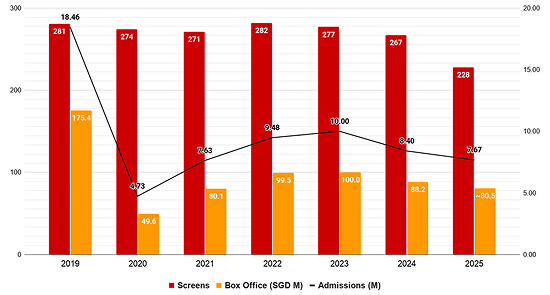
The SFC dataset (data.gov.sg, updated 8 April 2026, covering 1998 to 2025) is the primary source for market-level figures in this report. However, the scope of coverage differs from year to year. For 2025, the dataset confirms only screens, seating capacity, and admissions on an annual basis. Total gross, sub-annual breakdowns, and country-of-origin market shares are not available as official figures for 2025 and are estimated or omitted where noted.
The revised 2025 figures require updating three specific claims from the previous report. First, the theatrical market did not recover in 2025; it declined. The +16.3% figure visible in Box Office Mojo's Hollywood-tracked USD gross reflects stronger performance among BOM-tracked titles. The two datasets measure different things and should not be read as a single narrative. Second, the per-screen admissions average in 2025, approximately 33,640, is marginally above 2024's 31,461, but this is not evidence of improved efficiency; it reflects fewer screens following venue closures. Third, the 2019 per-screen gross was approximately SGD 624,200 (281 screens, SGD 175.4 million total gross), similar to the SGD 624,000 cited in the previous report, although the previous calculation was based on incorrect figures. The decline from 2019 to 2024's SGD 330,000 is about 47%.
These corrections do not change the previous report's qualitative conclusions about the industry's structural pressures. They make those conclusions more grounded.
What makes the revision analytically useful is that it sharpens the terms of the paradox at Singapore cinema's centre. H1 2026 produced the most concentrated international festival achievement in Singapore's film history: an Annecy Cristal, a Berlinale main competition entry, a Sundance Special Jury Award, films at HKIFF, Cannes Competition and Directors' Fortnight, and distribution deals across more than thirty territories for a single Singapore title. And yet the domestic theatrical market is in its second consecutive year of decline, after the post-pandemic recovery peaked in 2023.
This is not a contradiction. It is the structural reality of Singapore's film industry: a creative ecosystem that has learned to produce internationally competitive work, operating in a domestic market too small and too disrupted to generate the commercial returns that would make that creativity self-sustaining. The question H1 2026 raises is whether the Talent Accelerator Programme (TAP) and the Digital Content & Capability Development (DCCD) together can begin to close that gap, or whether Singapore's film culture will remain divided between a prestige pipeline consumed abroad and a mainstream theatrical market increasingly dominated by two Hollywood studios' output.
One event from the period complicates that frame productively. The Dear You phenomenon, a Teochew-language film that sold out its initial dialect screenings, subsequently received approval for expanded screenings, and prompted a parliamentary debate about language classification policy, is not evidence of a recovering theatrical market. It is evidence that the theatrical market has an audience it has not been reaching, and that the regulatory and programming conditions in which cinema operates may have been leaving genuine demand unserved.
Top 10 Films in Singapore Box Office (H1 2026)
You can scroll left and right to view the content.
| No | Title | Director | Country | Genre | Gross (SGD) |
Gross (USD) |
Release Date |
Production Company |
Distribution Company |
|---|---|---|---|---|---|---|---|---|---|
| 1 | Toy Story 5 | Andrew Stanton | USA | Animation, Adventure | 3.29M | 2.54M | June 2026 | Pixar Animation Studios, Walt Disney Pictures | Walt Disney Pictures |
| 2 | The Super Mario Galaxy Movie | Aaron Horvath, Michael Jelenic | USA, Japan | Animation, Adventure | 3.12M | 2.41M | April 2026 | Illumination, Nintendo, Universal Pictures | Universal Pictures Intl. |
| 3 | The Devil Wears Prada 2 | David Frankel | USA | Comedy, Drama | 2.77M | 2.14M | April 2026 | 20th Century Studios, Wendy Finerman Productions, Sunswept Entertainment | Walt Disney Pictures |
| 4 | Hoppers | Daniel Chong | USA | Animation, Adventure | 2.73M | 2.11M | March 2026 | Pixar Animation Studios | Walt Disney Pictures |
| 5 | Michael | Antoine Fuqua | USA | Biography, Drama | 2.50M | 1.93M | April 2026 | GK Films, Lionsgate | Universal Pictures Intl. |
| 6 | Avatar: Fire and Ash | James Cameron | USA | Action, Adventure | 2.03M | 1.57M | December 2025 | 20th Century Studios, Lightstorm Entertainment, TSG Entertainment | Walt Disney Pictures |
| 7 | Star Wars: The Mandalorian and Grogu | Jon Favreau | USA | Action, Adventure | 1.42M | 1.10M | May 2026 | Lucasfilm, Golem Creations, Ian Bryce Productions | Walt Disney Pictures |
| 8 | Zootopia 2 | Jared Bush, Byron Howard | USA | Animation, Adventure | 0.92M | 0.71M | November 2025 | Walt Disney Animation Studios | Walt Disney Pictures |
| 9 | Disclosure Day | Steven Spielberg | USA | Sci-Fi, Drama | 0.73M | 0.57M | June 2026 | Universal Pictures, Amblin Entertainment | Universal Pictures Intl. |
| 10 | Back Rooms | Kane Parsons | USA | Horror | 0.56M | 0.43M | June 2026 | A24, North Road Films, 21 Laps Entertainment | Shaw Organisation |
- Films ranked by 2026 Singapore calendar gross reported by Box Office Mojo (BOM). For films released in 2025, figures show 2026 carryover gross only.
- BOM data for May and June 2026 is incomplete, so titles released in those months reflect partial runs, and this table should not be considered a complete H1 ranking. BOM coverage of local Singapore and regional Asian films is limited; some local releases weren’t included.
- USD figures are sourced from BOM, with SGD figures converted at USD 1 = SGD 1.2943.
- BOM data for May and June 2026 is incomplete, so titles released in those months reflect partial runs, and this table should not be considered a complete H1 ranking. BOM coverage of local Singapore and regional Asian films is limited; some local releases weren’t included.
- USD figures are sourced from BOM, with SGD figures converted at USD 1 = SGD 1.2943.
Production Landscape
What H1 2026 confirmed is that Singapore's international co-production ecosystem has reached a level of maturity at which it generates results systematically. The recognitions themselves are set out in ‘Co-Production’. The more instructive observation is what the films that earned them have in common structurally, and what that reveals about where Singapore cinema is heading.
The most significant trend is that Singapore is increasingly valuable to international projects not as a source of stories or directors but as a financing and packaging node. Several of the period's most celebrated titles were led by international filmmakers; Singapore companies such as Potocol, Momo Films, E&W Films, Giraffe Pictures, and Akanga Film Asia contributed co-production financing, institutional credibility, and the kind of international network access that brought projects to market. That shift from originator to enabler is not a diminishment. It reflects a more sophisticated and commercially durable form of participation in global film culture, and it is the role that TAP is explicitly designed to formalise and expand.
The domestic slate visible in the period was small by comparison: Liang Po Po vs Ah Beng, Dream Stall, Kong Tao, Amoeba and The Old Man and His Car, spread across genre comedy, digital-native debut, regional horror co-production and arthouse. Their commercial outcomes are discussed in ‘Commercial vs Independent Balance’. KUNGFULAND, the first scripted feature treaty co-production between Singapore and Canada, entered principal photography in June 2026, and the production infrastructure behind it is covered in ‘Technology and Production Services’.
Financing Models
IMDA's two major policy instruments, the SGD 200 million TAP launched in December 2025 and the SGD 48 million DCCD launched in June 2026, were designed against a diagnosis of the industry's structural limitations. The revised SFC admissions data makes that diagnosis more pressing.
TAP's logic rests on the observation that Singapore's domestic market cannot underwrite most commercial productions, and that co-production scale is the route to commercial sustainability. The 2025 admissions figure of 7.67 million across 228 screens, producing an estimated market gross of SGD 80.5 million, confirms that the domestic theatrical market cannot support the investment the industry needs to compete internationally.
TAP's emphasis on international co-production, global distribution, and commissioner relationships is IMDA's policy response to that arithmetic. The DCCD addresses a complementary concern, and the two instruments are best read as a single financing proposition: theatrical and platform-native production funded in parallel rather than in competition.
Distribution Climate
Distribution in H1 2026 ran on two tracks with very different momentum: an international sales market that has begun to treat Singapore titles as commercial propositions, and a domestic release pattern that is quietly becoming more flexible.
The clearest commercial signal of the period is that international recognition is beginning to translate into commercial consequence. We Are All Strangers closed distribution deals across more than thirty territories at or immediately after its Berlinale world premiere, with theatrical buyers in France, the UK, Germany, Spain, South Korea, and North America. Most Singapore films that reach the festival circuit return with limited foreign theatrical commitments. A sale of that breadth and speed indicates that the international market is beginning to treat Singapore arthouse output as a commercially viable proposition. Ah Girl, whose nine-year-old lead became the youngest Best Actress winner in HKIFF history, is tracking toward a China theatrical release in H2 2026 with multiple mainland distributors competing for rights. If these releases perform, they will generate returns that might stimulate the domestic market, and will provide the clearest real-world test yet of TAP's financial logic.
Domestic release patterns are loosening as well. Michael Kam's The Old Man and His Car took a more modular approach to distribution, using intermittent weekend screenings and community sessions over seven months in place of the usual theatrical window. The independent venues discussed in ‘Theatrical Reach’ are what make that pattern possible.
That flexibility sits at the edges of a mainstream that remains highly concentrated. Within the BOM-tracked top 10 (SGD 20.07 million combined), Disney-distributed titles account for roughly 66% of gross and Universal-distributed titles roughly 32%; the only other distributor, Shaw Organisation (Back Rooms), accounts for under 3%. Given the BOM data gaps noted under the table, these shares are indicative rather than definitive.
Theatrical Reach
The domestic theatrical market has contracted to a new structural baseline. However, at 7.67 million admissions and 228 screens, there is little evidence yet that 2025 represents a trough from which recovery is imminent. The venues that closed are not reopening and overall admissions have not recovered.
GV Tiong Bahru closed on 29 March when its lease expired. Shortly after the H1 reporting period, GV announced that its Plaza Singapura outlet would close on 16 August as its mall undergoes major redevelopment. New outlets opened at Downtown East (November 2025) and Century Square (February 2026), but the net trajectory is clear: GV is retreating from legacy high-footfall city-centre sites toward suburban residential catchments.
The two new independent venues represent a recovery of institutional function rather than market capacity. Filmhouse at Golden Mile Tower, programming in partnership with Anticipate Pictures, sold out its opening run of Amoeba in March and has established itself as Singapore's primary arthouse venue since The Projector's closure. SFS Somerset at GV Cineleisure's Hall 6 operates as a 66-seat community cinema with weekly filmmaker Q&As, filling a curatorial role the multiplex circuit has never attempted. Neither will register in SFC admissions data, but both demonstrate that curated exhibition finds an audience when the programming is right.
The Golden Mile Tower cinema space on levels 3 and 4, four auditoriums and 2,000 seats currently occupied partly by Carnival Cinemas, was listed for sale in June at SGD 31 million, with the EOI closing 4 August. The sale sits directly below Filmhouse's fifth-floor tenancy. The two arrangements are legally separate, but the future use of the lower floors will determine whether Golden Mile Tower continues to function as Singapore's cinema precinct. An outcome had not been confirmed at the time of this report.
The Dear You episode is the period's most structurally revealing event for theatrical exhibition. The film, a Chinese family drama spoken primarily in Teochew, had grossed more than CNY 1.8 billion in China before its Singapore release on 18 June. Under IMDA's guidelines supporting the Speak Mandarin Campaign, it opened primarily in a Mandarin-dubbed version. The initial eight Teochew screenings sold out within two hours. By 7 July, shortly after the H1 reporting period, IMDA had approved 272 Teochew-language screenings and organised 30 additional community screenings with grassroots organisations. A March-to-June survey found 95% of respondents favoured loosening dialect restrictions and 92% preferred undubbed dialect content. Senior Minister of State Tan Kiat How confirmed a formal review of the film classification framework with respect to dialect use.
Read against two years of declining admissions, the episode raises a supply-side question the industry has not previously had to answer: how much of the theatrical decline is streaming substitution, and how much is the market consistently failing to programme content the audience actually wants? A broadened framework would also create a realistic path to theatrical release for Singapore-produced dialect-language films without mandatory Mandarin dubbing. This would likely enable new audience demographics to form, for example retirees or seniors, and even cultivate intergenerational movie-going as a social habit.
The SFC's next annual data release will confirm whether 2026's mix of a Hollywood slate and the Dear You Teochew surge produced stabilisation or further decline.
The dialect review, the Golden Mile Tower sale, and GV's network retreat are the exhibition sector's three open questions for H2 2026. Their convergence in a single reporting period reflects the degree to which Singapore's cinema infrastructure is under simultaneous pressure from regulatory, property, and consumer behaviour forces. TAP and DCCD address the production side of that pressure. The exhibition side has no equivalent policy instrument, and the SFC data makes it increasingly clear that finding a solution requires thinking outside the box.
Technology and Production Services
Virtual production moved from investment to active production in H1 2026. Jacen Tan’s KUNGFULAND, the first scripted feature treaty co-production between Singapore and Canada, began principal photography at AUX Infinite Studios in June, using ICVFX LED wall technology for 1999 Chinatown period sets. AUX is Singapore's only NC25-rated soundstage. Singapore Institute of Technology's (SIT) virtual production curriculum launches in August 2026, backed by IMDA apprenticeship funding. The alignment of an active production, a training institution, and statutory board funding in a single reporting period marks virtual production as operationally embedded rather than an aspirational goal.
Streaming & Digital Platforms
The DCCD's focus on micro-drama, AI-assisted production, and platform-native content targets the audience the theatrical market is not reaching: the 87% of Singaporeans aged 15 and above who access social video platforms weekly, per IMDA's own cited data. If the theatrical market is contracting because audiences are consuming content through other channels, the targeted policy response is to invest in those channels alongside theatrical, which is perhaps what the two programmes together attempt.
The IMDA-Tencent institutional partnership, formalised in May 2026 under a digital wellbeing framing, is worth watching for what it may become: at a moment when IMDA is deepening Singapore's Chinese-language content ambitions, a formalised relationship with the owner of Tencent Video and WeChat has implications that extend well beyond the initial agreement's stated scope.
Digital growth is not only a substitute for theatrical; it can also feed it. Annette Lee's Dream Stall, discussed in ‘Commercial vs. Independent Balance’, is the period's clearest evidence that an audience built on social platforms can be converted into cinema ticket buyers.
This brings back a core question that admissions data cannot settle on its own: how much of the two-year theatrical decline is audiences substituting streaming for cinema, and how much is a market that has not been programming what its audience wants. The DCCD is primarily a bet on the first reading. The Teochew screenings of Dear You are the strongest available evidence for the second. Both can be true at once, and the policy response differs sharply depending on the mix.
Commercial vs Independent Balance
The domestic commercial picture in H1 2026 is best understood not as a series of individual results but as a stress test of the models available to Singapore filmmakers who want to reach a paying local audience. The SFC's 7.67 million admissions figure for 2025 establishes that the market is still contracting. With official H1 2026 admissions data unavailable, there is not yet sufficient evidence to establish a reversal. What it did produce were three distinct commercial approaches, each with a different logic and a different ceiling.
The most reliable model remains the one that has always worked: culturally specific genre content, released at Lunar New Year, with regional distribution across Singapore and Malaysia and a proven creative name attached. Matt Lai’s Liang Po Po vs Ah Beng crossed SGD 1 million in Singapore in under two weeks while simultaneously surpassing MYR 8 million in Malaysia in its first week, a result that follows a pattern Jack Neo has established for six consecutive years. Its commercial logic is coherent and repeatable. Its limitation is that it has not produced others. Available box office data indicates that one filmmaker (Jack Neo) has directed the top-grossing Singapore film for six consecutive years, and the gap between his commercial standing and everyone else's has not narrowed. A domestic commercial market that rests on a single creative franchise is structurally fragile, and no amount of festival success changes that.
The more interesting signal from H1 2026 is what happened outside the Lunar New Year window. Annette Lee’s Dream Stall, a debut feature by a director who built her following through digital-native comedy content on SGAG and social media, completed a seven-week theatrical run in May and June. That run is longer than most local films achieve outside the peak slot, and it points toward a model the DCCD is, in effect, subsidising at a different level: the conversion of platform audiences into cinema ticket buyers. That conversion is not yet systematic, but the evidence that it is possible without a Jack Neo franchise is meaningful. Peiji Goh and Yong Choon Lin’s Kong Tao, a Singapore-Malaysia-Thailand supernatural horror co-production, offered a third data point: viable regional returns in Malaysia, with limited domestic spillover. The model appears commercially stronger across borders than in Singapore's domestic theatrical market.
Taken together, what H1 2026's commercial results reveal is a market that rewards cultural specificity, regional thinking, and audience relationships built before a film is released, and punishes anything that relies on general theatrical footfall the SFC data confirms is no longer there. TAP's genre IP emphasis and the DCCD's digital audience investment could be effective responses to that diagnosis.
Co-Production
Singapore & Made-with-Singapore Films on the World Stage
Prizes came from Annecy for Ervin Han and Raúl García’s The Violinist, Rotterdam for Ang Geck Geck’s Ah Girl, and Sundance for Rafael Manuel’s Filipiñana. Berlinale, Cannes and Cannes Directors' Fortnight selections followed, among them Anthony Chen’s We Are All Strangers, Rima Das’ Not A Hero, Edwin’s Sleep No More, Fukada Koji’s Nagi Notes, and Sompot Chidgasornpongse’s 9 Temples to Heaven.
The international distribution pipeline has produced commercially meaningful results for the first time at scale. Accomplishments in multiple sales territories and festival awards are a qualitative shift from prestige to market validation, and the H2 2026 theatrical releases in China and North America will be the clearest test yet of whether Singapore's arthouse output can generate returns that justify sustained co-production investment.
- Note: Unless otherwise stated, all approximate USD figures in the report are converted from SGD using the Monetary Authority of Singapore (MAS) exchange rate as of 30 June 2026 (USD 1 = SGD 1.2943).
Jeremy CHUA
Executive Director / Singapore International Film Festival
Jeremy Chua is the Executive Director of the Singapore International Film Festival. He is also an independent film producer who founded his label Potocol in 2014. Recent films include Filipiñana by Rafael Manuel (Special Jury Award Sundance 2026), Some Rain Must Fall by Qiu Yang (Encounters Jury Prize Berlinale 2024), and Inside the Yellow Cocoon Shell by Pham Thien An (Camera d’Or 2023). In 2023, he was awarded the FIAPF Award for Outstanding Contribution to Asia Pacific Cinema.
Note:
- Screen counts, admissions, and box office figures are official SFC figures, except for the 2025 box office figure. Since the official box office figure wasn’t published for 2025, the amount was estimated by applying the SGD 10.50 mean ticket price (SFC, 2024) to official admissions.
- The table does not include H1 2026 data, as the figures have yet to be confirmed. It reflects updated figures for 2019–2025.