Title
THE A REPORT
2026 H1
 Patti LAPUS
Producer
Patti LAPUS
Producer
 Dodo DAYAO
Writer, Director, Producer
Dodo DAYAO
Writer, Director, Producer
Updated on 6 Oct 2026
Overview
Perhaps the most significant industry development in 2026 was the institutional restructuring and expanded operations of the revitalized Film Academy of the Philippines (FAP). Where its previous iteration was tasked primarily with deciding the country’s Oscar entry, the revamped FAP expanded its scope to prioritize worker welfare and guild inter-activity.
A grievance portal has been activated and a permanent legal team put in place, for starters and among others, and since January, meetings with various accredited guilds have taken place to plan out activities and programs for their members, some of which have already taken place, and these include training and workshops and regional summits that gathered filmmakers and film practitioners from each of the three regions in the country.
In terms of rehabilitating and eventually re-energizing the industry, the FAP has been off to a very promising start.
Box office, meanwhile, in terms of domestic cinema, remains unpromising and continues to be a challenge. The 2025 Metro Manila Film Festival or MMFF, the annual festival where producers and their films stand to make significant revenue more than any other time of year, did spill over into the first few weeks of 2026 with an extended run, albeit with a greatly reduced number of theaters. Despite this, the festival still under-performed, as compared to its pre-pandemic numbers, and certainly to the 2023 edition where revenue reached up to PHP 1 billion.
At the core of this report is that push and pull. While the continuing struggle of films to achieve commercial and cultural traction may have contributed to the reduction in the number of projects in production, the rehabilitation of industry processes and protocols is moving slowly but surely.
One may ask what good is a rehabilitated industry if there is no work, but what this report would like to posit is that these could very well be the necessary growing pains from being on the cusp of a significant transformation.
Production Landscape
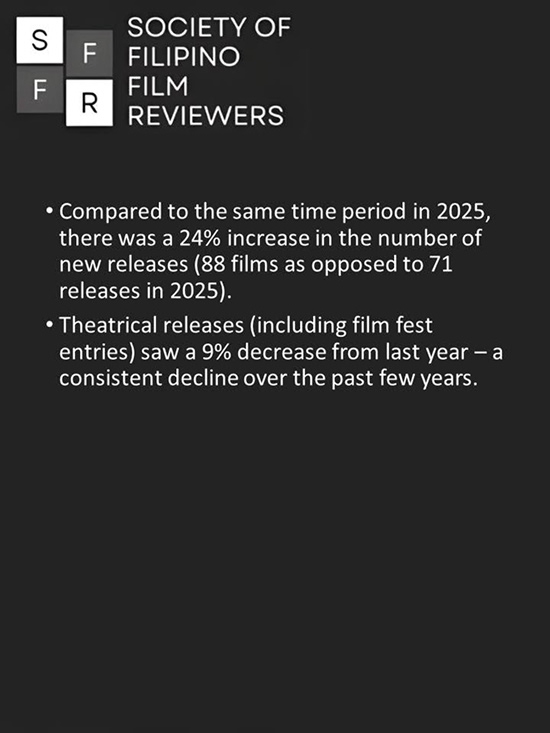
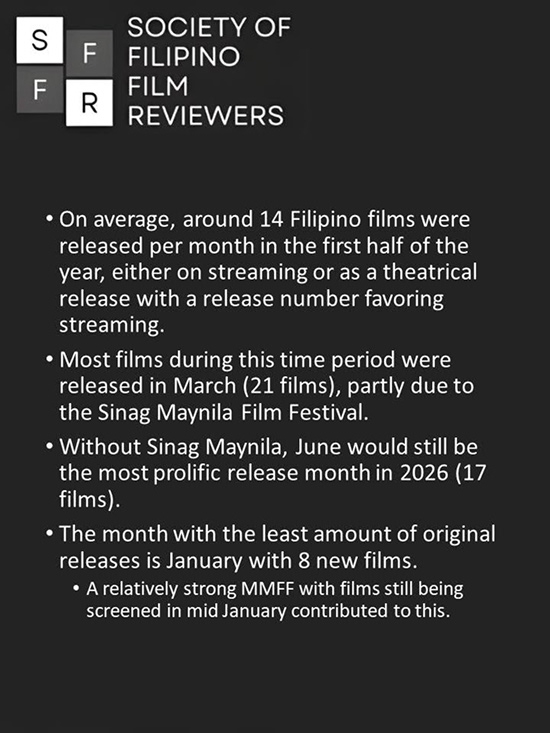
According to writer and film critic John Tawasil of the Society of Filipino Film Reviewers, in his annual overview of the year’s first half, compared to the same time period in 2025, there was a 24% increase in films released, from 71 to 88. Of the 88 films released in the first half of 2026, 56 were released via streaming services, accounting for 63.6% of the total.
This number does not include the aforementioned extended run of the previous year’s Metro Manila Film Festival nor does it include films that were released in 2025 that had a theatrical run in 2026, like Nigel Santos’ Open Endings and Dustin Celestino’s While The Hydra Devours History, both of which were part of the 2025 Cinemalaya Film Festival, and Jun Lana’s Sisa, following its world premiere at the 2025 Tallinn Black Nights Film Festival.
While the increased volume of releases may suggest that there was also an increased volume of production, it does not necessarily translate into an increase in revenue, even if it means more production work.
According to data provided by the Film Development Council of the Philippines (FDCP), the observation among local consumers that the local film industry is dying, especially post-pandemic, is two-pronged: on one side is production, and on the other is consumption.
The indifference of consumers hinges on a perceived dip in quality, although affordability concerns highlighted in the previous reporting period may also contribute to audience disengagement. This, in turn, contributes to greater risk aversion among producers and investors, leading to reduced budgets and production values, and ultimately the sort of mediocre product that would provoke indifference among audiences.
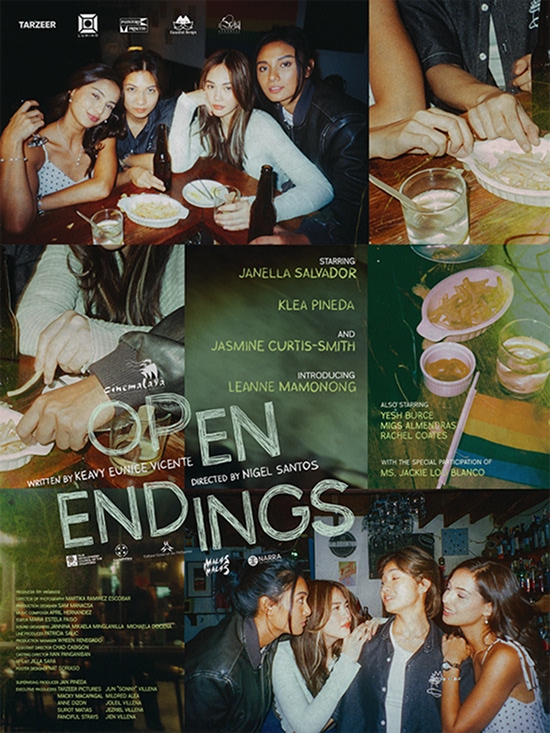
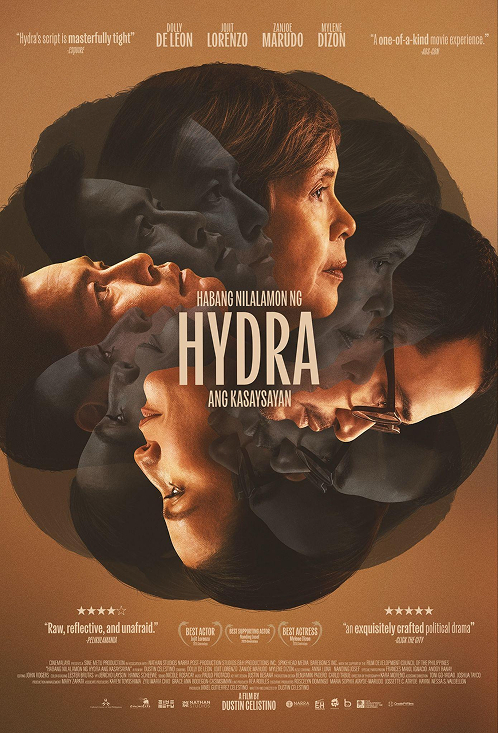
Used with permission from Tin Velasco and Dustin Celestino
Financing Models
Since there was no new data available, this section reflects the previous reporting period's structure. Private equity investment remains limited. Risk capital is still absorbed primarily by television and streaming while studio financing continues to contract. But the system continues to adapt through soft-money interventions and government grants.
The FDCP continues to offer its range of funding support mechanisms and programmes, for both international and domestic productions. Among these are the International Co-Production Fund (ICOF) and the ASEAN Co-Production Fund (ACOF), as well as production incentives like the Film Location Incentive Program (FLIP) and the CreatePHFilms Funding Program. Sine Kabataan, NCCA and QCinema continue to offer grants, with QCinema increasing the amount of their production grants for short films to PHP 750,000 (roughly USD 12,000) from their previous PHP 500,000 (roughly USD 8,000) but instead of seven grantees like before, only five were awarded the grant this year.
The silver lining is that while theatrical attendance may be dropping more and more each year, at least as far as local films on regular release are concerned, high-profile festivals like QCinema as well as Cinemalaya and Cine Panalo, both of which provide seed grants to jump-start the film projects on their slate, continue to bring in crowds that, during the festival’s brief run, fill up theaters to maximum capacity and sometimes sell out screenings.
As far as empirical data is concerned, and in keeping with the thrust of the article, that the year and all it brings with it is a prerequisite for a transformation, these two sides of the coin are worthy of further and elaborate study, to map not only audience behavior and consumption dynamics but also possible directions for the industry to collectively gauge its future and its sustainability.
Distribution Climate
With streaming becoming more and more the norm rather than the alternative, fewer and fewer films are being released theatrically, and the few that do get released will have to face the last hurdle in domestic cinema’s theatrical woes: prohibitive ticket prices.
In fact, the majority of the films released (56) during the first half of 2026 were via streaming services, a significant portion of which were from Vivamax/VMX, while the rest was divided between Netflix, Bisayaflix, Star Sinemax and iWant TFC PPV.
On the other end of the spectrum, both Philippine films and filmmakers continue to gain significant cultural traction and recognition in international film festivals. E Del Mundo’s Yellowfin became the first Southeast Asian film to be part of the Immersive competition at Cannes. Rafael Manuel’s feature film version of Filipiñana was part of the Berlinale Perspectives Section and won the World Cinematic Special Jury Award for Creative Vision at Sundance, and will have a brief theatrical run in the second half of the year.
Four films were part of Rotterdam: P.R. Patindol’s I Grew An Inch When My Father Died, Isabel Sandoval’s Moonglow, Jerrold Tarog’s Quezon and Carl Papa’s animated documentary 58th, which was also screened at Annecy International Animation Film Festival, together with another animated feature, Avid Liongoren’s Zsazsa Zaturnnah.
Short films also made a showing internationally, most prominently, Arvin Belarmino and Kyla Romero’s Agapito, which screened at the New York Asian Film Festival and Landshut Short Film Festival, where it won the Best International Short Film Award. Four other short films from previous years were programmed at the Clermont-Ferrand International Short Film Festival: Sam Manacsa’s Cross My Heart Hope To Die, Carlo Manatad’s Junylyn Has, Don Eblahan’s The Headhunter’s Daughter and Stephen Lopez’ Hito.
Theatrical Reach
Of the 88 films released in the first half of the year, only 32 films were released theatrically, both as regular first-run releases and as part of a festival. This marks a 9% decrease in theatrical releases, from approximately 35 in H1 2025 to 32 in H1 2026, continuing the decline seen over the last few years.
According to Box Office Mojo, domestic cinemas during the first six months of 2026 were dominated primarily by English-language Hollywood films. With the exception of the Metro Manila Film Festival, of course, which runs for two weeks and shows nothing but new Filipino films, the Philippines has hardly had any protectionist guardrails, and the profusion and dominance of Hollywood films over any other kind of foreign film has become the default setting for decades, familiar to the point of normal.
What has been missing over the last few years, and particularly during the first half of 2026, is the prevalence of locally-produced tentpoles, which are mostly romantic comedies, and which have for many years dominated the domestic box office to such a formidable degree that they could go head to head with Hollywood tentpoles. The last major local tentpole to generate significant revenue was the 2024 romance Hello, Love, Again, which grossed PHP 1.6 billion worldwide and remains the highest-grossing Filipino film of all time. But in recent years, despite the studios churning them out on a regular basis, romantic comedies, and to be fair, all other genres, have seen a significant downturn in general audience interest.
But, despite this seeming indifference to the genre, the most successful Filipino films of the year so far remain rom coms, or at least rom com-adjacent love stories, Irene Villamor’s The Loved One, which was released in February, and according to both Box Office Mojo and its Wikipedia entry, has since grossed PHP 311 million worldwide (approx. USD 5.0 million), surpassing the approximately PHP 260 million worldwide gross of Meet, Greet & Bye cited in the previous report. Cathy Garcia Sampana’s Tayo Sa Wakas (Us In The End), released in May, has, according to its studio ABS CBN Films, grossed around PHP 110 million (approx. USD 1.8 million). However, there were hardly any other local tentpoles released during the first half of the year.
Technology and Production Services
There is very little new data on the current state of the production infrastructure, as it continues to be dominated by a few key players (studios, post-production facilities and equipment rental vendors) and continues to face the same challenges, particularly in how limited purpose-built production infrastructure has been restricting the full potential of the industry, with ABS-CBN Studios currently the only high-quality, purpose-built sound stage facility in the country.
But in March 2025, Hollywood-based production equipment provider Birns & Sawyer announced an initial USD 17 million investment to build additional soundstages, the first of which would be in Clark City, with expansive plans to build additional soundstages across the Philippines, with a total investment pipeline of USD 50 million, in a bid to decentralize production from Metro Manila, where most productions have been concentrated, creating a dependency that has limited regional growth and reduced opportunities. The development is currently in progress but it bodes well for a profound shift in the current landscape and climate.
Meanwhile, despite a significant chunk of filming in the Philippines being done on location, and subsequently reducing the demand for sound stages, smaller studio spaces such as Shooting Gallery, The Factory and Bigfoot Studios, continue to cater to a clientele of smaller-scale projects, which include independent films, television and vertical series and commercials.
Interview
with Avid LIONGOREN, Filmmaker
Bleak But Hopeful
“It is anxiety inducing” is filmmaker Avid Liongoren’s brutally honest summation of the current production landscape and climate, from his vantage point as an independent animator and filmmaker.
Liongoren’s Zsazsa Zaturnnah is his third film, an animated queer superhero fantasy-comedy based on a very popular graphic novel that has previously been adapted into a live-action film and a stage musical.
Liongoren took six years to achieve completion with the help of production grants from the FDCP and various local co-producers, and had its world premiere at the Annecy International Animation Film Festival. “It looked very promising in the beginning. We were selected in all the important project markets, even won a couple of market prizes, but we barely raised any money outside the Philippines. It’s animation but not for kids, its comedy is accessible but its queerness automatically excludes it from large markets like China. It’s not for the mainstream and it is also too silly for the art house. The film would not have survived had it not been for the FDCP production grant & the later contributions of Filipino co-producers. I am very thankful we have these. This literally did not exist before 2020.”
Even as Zsazsa Zaturnnah begins its festival rollout, Liongoren remains skeptical about his future as a filmmaker and the future of the film industry in general. “The films I make are made by hand, very slowly, over a long period. I honestly don’t know what our place is in this new world, and if we could even survive.”
But Liongoren is not completely without hope. “While finishing a film is already like climbing a mountain naked, selling a film is like trying to cross an ocean on a paper plane. Metaphors aside, it is much harder to make a living out of making films but it’s easier to make stuff because of the affordable tech, the available grants, plus, the access to free learning, and what kids today are able to make are astounding.”
Institutional Progress vs Market Realities
Ultimately, the state of the Philippine film industry in 2026 reflects a necessary period of structural realignment rather than terminal decline. The current tension—between an underperforming domestic box office and accelerating institutional reform—underscores an ecosystem in transition. While commercial theatrical distribution faces persistent economic pressures, the simultaneous expansion of labor protections, planned expansion of decentralized studio infrastructure, and state-backed international co-production frameworks provides a more resilient foundation for future growth. The friction experienced by contemporary filmmakers represents the inevitable friction of an industry rebuilding its operational architecture; if sustained, these institutional and infrastructural investments could provide a stronger foundation for Philippine cinema to emerge not only culturally recognized on the global stage, but structurally viable at home.
Note: USD equivalents are approximate and use an exchange rate of PHP 62.5 = USD 1.
Patti LAPUS
Producer
Patti Lapus, a Filipino producer and alumna of the University of the Philippines Film Institute, is the Co-Founder and CEO of Monsoon Projects Inc., a boutique film production company she established with filmmaker Dodo Dayao.
Her career began in 2016 as a freelance line producer, notably contributing to the Philippine casting for the Palme d’Or winner, Triangle of Sadness. She then served as COO and Head of Production at Epicmedia from 2020 to 2024.
Patti has a strong commitment to industry development and welfare. She is a founding member and former Co-Chairperson of Inter-Guild Alliance, which pioneered COVID protocols for the Philippine audiovisual industry. She also served as President of the New Asian Producers Network (Napnet) in 2025.
Academically, she is a graduate of programs such as NAFF Fantastic Film School, Full Circle Lab, and Busan Asian Film School’s International Film Business Academy, where she was awarded the Busan Film Commission Award. She is also a certified Intimacy Coordinator (IPA, Los Angeles) and a Film Industry Consultant for the Film Academy of the Philippines.
Her career began in 2016 as a freelance line producer, notably contributing to the Philippine casting for the Palme d’Or winner, Triangle of Sadness. She then served as COO and Head of Production at Epicmedia from 2020 to 2024.
Patti has a strong commitment to industry development and welfare. She is a founding member and former Co-Chairperson of Inter-Guild Alliance, which pioneered COVID protocols for the Philippine audiovisual industry. She also served as President of the New Asian Producers Network (Napnet) in 2025.
Academically, she is a graduate of programs such as NAFF Fantastic Film School, Full Circle Lab, and Busan Asian Film School’s International Film Business Academy, where she was awarded the Busan Film Commission Award. She is also a certified Intimacy Coordinator (IPA, Los Angeles) and a Film Industry Consultant for the Film Academy of the Philippines.

Dodo DAYAO
Writer, Director, Producer
Dodo Dayao is a filmmaker and screenwriter primarily known for his expertise in Philippine genre cinema. His debut feature, Violator (2014), and his second feature, Midnight in a Perfect World (2020), garnered international acclaim at festivals such as Karlovy Vary, Neuchâtel, and Fantasia. A prolific collaborator, Dodo has penned scripts for directors like Khavn, John Torres, and Dan Villegas (Cattleya Killer). His work is characterized by a haunting blend of horror, surrealism, and sharp sociopolitical undercurrents. He is currently in post-production for his short She’s Leaving home, and developing his third feature, Dear Wormwood.
Dodo is the Co-Founder and Chief Creative Officer of Monsoon Projects Inc., a boutique film production company he founded with producer Patti Lapus.
Dodo is the Co-Founder and Chief Creative Officer of Monsoon Projects Inc., a boutique film production company he founded with producer Patti Lapus.