Title
THE A REPORT
2026 H1
 Tanveer Hossain
Producer, Writer
Tanveer Hossain
Producer, Writer
 Mamun Sobhani
Producer, Director and Writer
Mamun Sobhani
Producer, Director and Writer
Updated on 6 Oct 2026
Overview
H1 2026 produced two contrasting pictures of Bangladesh cinema. Commercially, the market regained momentum through event films, advance booking, wider multiplex programming and star-led releases. Structurally, the sector remained dependent on a narrow holiday calendar, a small modern exhibition network and incomplete revenue information. The market’s strongest signal was audience willingness to attend when films were positioned as culturally specific, communal events; its weakest signal was the inability to distribute that attendance evenly through the year.
The year began quietly. January and February produced only three domestic theatrical releases. March then delivered five Eid-ul-Fitr films on the same day. April had no newly identified domestic feature, although March titles continued their runs and foreign studio films occupied multiplex screens. May produced eleven domestic releases, including eight Eid-ul-Adha films. The result was a release calendar that repeatedly shifted from scarcity to congestion.
The political and economic environment also mattered. A national election in February and a change in government affected administrative continuity, including the film-grant process. Inflation, currency weakness and high borrowing costs continued to raise the cost of imported cameras, lenses, storage, software, foreign travel, overseas post-production and specialist crews. The same pressures constrained discretionary consumer spending and made premium cinema tickets less affordable outside higher-income urban audiences.
Despite these constraints, the market’s cultural position improved. International festival selections showed that Bangladesh was producing films capable of entering high-profile competition sections rather than only diaspora or national showcases. OTT platforms also moved closer to theatrical production and post-theatrical exploitation, creating a hybrid market in which a project could combine cinema, overseas Bengali territories, television and subscription streaming.


Bonolota Express, Domm, Roid, Rakkhosh, and Rockstar
© The Daily Star
Top 10 Films in Bangladesh Box Office (H1 2026)
You can scroll left and right to view the content.
| No. | Title | Director | Country | Genre | Gross (BDT, Approx.) |
Gross (USD, Approx.) |
Production Company | Distribution Company |
|---|---|---|---|---|---|---|---|---|
| 1 | Bonolota Express | Tanim Noor | Bangladesh | Comedy, Drama | 200M | 1.62M | Buriganga Talkies; Hoichoi Studios; Dope Productions | Buriganga Talkies (Ban), Swapna Scarecrow (USA, Canada), BongOz Films (Aus), Riverie Films (UK) |
| 2 | Michael | Antoine Fuqua | United States | Biographical Music Drama | 56M | 0.45M | Lionsgate Films, Universal Pictures, GK Films, Optimum Productions | Lionsgate Films (US), Universal Pictures (Ban) |
| 3 | Domm: Until the Last Breath | Redoan Rony | Bangladesh | Drama, Thriller | 48M | 0.39M | SVF Entertainment; Alpha-i Studios; Chorki | Alpha-i Studios (Ban), SVF (int), Bioskope Films (US) |
| 4 | Roid | Mejbaur Rahman Sumon | Bangladesh | Drama | 35M | 0.28M | Bongo; Facecard Production | Bongo & Facecard Production (Ban), Bioskope films (US), Screenxcope (Aus) |
| 5 | Rockstar | Azman Rusho | Bangladesh | Musical, Romance | 32M | 0.26M | Sun Motion Pictures Limited | Sun Motion Pictures (Ban), Swapna Scarecrow (US) |
| 6 | Rakkhosh | Mehedi Hasan Hridoy | Bangladesh | Drama, Thriller | 30M | 0.24M | Real Energy Production | Real Energy Production (Ban), Galaxy Media & Entertainment (Int) |
| 7 | Pressure Cooker | Raihan Rafi | Bangladesh | Drama | 20.6M | 0.17M | Impress Telefilm; Kanon Films | Kanon Films (Ban), IndeFilm (UK), Bioskope Films (US) |
| 8 | Prince: Once Upon a Time in Dhaka | Abu Hayat Mahmud | Bangladesh | Crime, Action | 19.4M | 0.16M | Creative Land Films | Jaaz Multimedia, Action Cut Entertainment |
| 9 | Project Hail Mary | Phil Lord, Christopher Miller | United States, United Kingdom | Sci-Fi | 16M | 0.13M | Metro-Goldwyn-Mayer, Lord Miller Productions, Pascal Pictures, Open Invite Entertainment, Waypoint Entertainment | Amazon MGM Studios (US, Canada), Sony Pictures Releasing International (Int) |
| 10 | The Devil Wears Prada 2 | David Frankel | United States | Comedy, Drama | 8.6M | 0.07M | Wendy Finerman Productions | 20th Century Studios |
- Gross represents each film’s total reported box office gross across domestic and international markets.
Top 10 Domestic Films in Bangladesh Box Office (H1 2026)
You can scroll left and right to view the content.
| No. | Title | Director | Country | Genre | Gross (BDT, Approx.) |
Gross (USD, Approx.) |
Production Company | Distribution Company |
|---|---|---|---|---|---|---|---|---|
| 1 | Bonolota Express | Tanim Noor | Bangladesh | Comedy, Drama | 162.9M | 1.32M | Buriganga Talkies; Hoichoi Studios; Dope Productions | Buriganga Talkies (Ban), Swapna Scarecrow (USA, Canada), BongOz Films (Aus), Riverie Films (UK) |
| 2 | Domm: Until the Last Breath | Redoan Rony | Bangladesh | Drama, Thriller | 40M | 0.32M | SVF Entertainment; Alpha-i Studios; Chorki | Alpha-i Studios (Ban), SVF (int), Bioskope Films (US) |
| 3 | Roid | Mejbaur Rahman Sumon | Bangladesh | Drama | 30M | 0.24M | Bongo; Facecard Production | Bongo & Facecard Production (Ban), Bioskope films (US), Screenxcope (Aus) |
| 4 | Rakkhosh | Mehedi Hasan Hridoy | Bangladesh | Action, Romance | 25M | 0.20M | Real Energy Production | Real Energy Production (Ban), Galaxy Media & Entertainment (Int) |
| 5 | Rockstar | Azman Rusho | Bangladesh | Musical, Romance | 20M | 0.16M | Sun Motion Pictures Limited | Sun Motion Pictures (Ban), Swapna Scarecrow (US) |
| 6 | Prince: Once Upon a Time in Dhaka | Abu Hayat Mahmud | Bangladesh | Crime, Action | 19.2M | 0.16M | Creative Land Films | Jaaz Multimedia, Action Cut Entertainment |
| 7 | Pressure Cooker | Raihan Rafi | Bangladesh | Family, Drama | 18M | 0.15M | Impress Telefilm; Kanon Films | Kanon Films (Ban), IndeFilm (UK), Bioskope Films (US) |
| 8 | Bonolota Sen | Masud Hasan Ujjal | Bangladesh | Drama | 6.4M | 51,688 | Red October Films | Red October Films |
| 9 | Malik | Saif Chandan | Bangladesh | Action, Drama | 4.9M | 39,573 | Divine Multimedia | Divine Multimedia |
| 10 | Masud Rana | Saikat Nasir | Bangladesh | Action | 1.6M | 12,921 | Jaaz Multimedia; Impress Telefilm | Jaaz Multimedia |
- Exchange reference: BDT 123.82 / 1 USD, 30 July 2026.
- Gross represents box office earnings in Bangladesh only.
- Gross represents box office earnings in Bangladesh only.
Production Landscape
Share of First Run Theatrical Releases by Origin, H1 2026
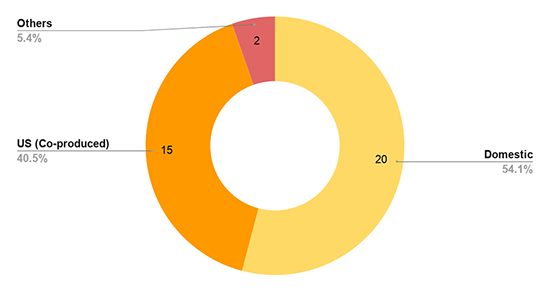
The domestic release database contains 20 features. Genre labels varied by source, but the visible slate included political satire, crime, action, romance, family drama, horror, ensemble comedy-drama and literary or character-driven films. Documentary, short-film and animation activity was more visible in festivals, cultural centres, universities and digital exhibitions than in commercial feature distribution.
Bangladeshi feature films commercially released in Bangladesh from 1 January through 30 June 2026.
You can scroll left and right to view the content.
| No. | Date | Film | Director | Release Pattern | Production Company |
|---|---|---|---|---|---|
| 1 | 16 Jan |
Ekhane Rajnoitik Alap Joruri | Ahmed Hasan Sunny | Regular release | Talking Trees Cinema |
| 2 | 30 Jan |
Moynar Char | Mostafizur Rahman Babu | Regular release | Bangladesh Govt and Sami Banichitra |
| 3 | 13 Feb |
Borisailla Pori | Salman Jasim | Regular release | Munna Bhai Film Production |
| 4 | 21 Mar |
Bonolota Express | Tanim Noor | Eid-ul-Fitr | Buriganga Talkies, Dope Productions and Hoichoi Studios |
| 5 | 21 Mar |
Prince: Once Upon a Time in Dhaka | Abu Hayat Mahmud | Eid-ul-Fitr | Creative Land |
| 6 | 21 Mar |
Domm: Until the Last Breath | Redoan Rony | Eid-ul-Fitr | SVF, Chorki and Alpha-i |
| 7 | 21 Mar |
Rakkhosh | Mehedi Hasan Hridoy | Eid-ul-Fitr | Real Energy Production |
| 8 | 21 Mar |
Pressure Cooker | Raihan Rafi | Eid-ul-Fitr | Impress Telefilm, Kanon Films |
| 9 | 1 May |
Atar Bibi Lane | Mijanur Rahman Labu | Regular release | Times Media |
| 10 | 1 May |
Manushtike Dekho | Gazi Rakayet | Regular release | Centre for the Rehabilitation of the Paralyzed – CRP |
| 11 | 8 May |
Sardar Barir Khela | Rakhal Sabuj | Regular release | Mrittika Chobighor |
| 12 | 28 May |
Rockstar | Azman Rusho | Eid-ul-Adha | Sun Motion Pictures Limited |
| 13 | 28 May |
Roid | Mejbaur Rahman Sumon | Eid-ul-Adha | Facecard, Bongo |
| 14 | 28 May |
Bonolota Sen | Masud Hasan Ujjal | Eid-ul-Adha | Red October Films |
| 15 | 28 May |
Malik | Saif Chandan | Eid-ul-Adha | Divine Multimedia |
| 16 | 28 May |
Masud Rana | Saikat Nasir | Eid-ul-Adha | Jaaz Multimedia, Impress Telefilm |
| 17 | 28 May |
Pinik | Zahid Jewel | Eid-ul-Adha | Euro Bangla Entertainment |
| 18 | 28 May |
Tochhonchh | Badiul Alam Khokon | Eid-ul-Adha | Munna Khan Multimedia |
| 19 | 28 May |
Officer | Badiul Alam Khokon | Eid-ul-Adha | SG Production |
| 20 | 12 Jun |
The University of Chankharpul | Akash Haque | Post-Eid | Bee Team |
Production increasingly relied on multi-company packaging. Roid linked Facecard and Bongo, Domm linked SVF, Chorki and Alpha-i. Bonolota Express linked Buriganga Talkies, Dope Productions and Hoichoi Studios. Pressure Cooker involved Impress Telefilm and Kanon Films. These combinations joined theatrical producers with television, streaming, marketing or regional corporate partners and reduced the likelihood that a single company would carry every stage of finance, production and distribution.
The project scale remained polarised. The Eid titles used established stars, broad advertising and overseas schedules, while smaller off-season films often opened with limited publicity and a handful of shows. Prince and Rakkhosh moved production activity to Sri Lanka, and film Soldier completed a schedule in Bangkok.
Labour and facilities remain difficult to measure because no public dataset was located for film employment, daily rates, union negotiations or production days. Public reporting did not identify a sector-wide strike or formal guild stoppage either. The more persistent challenge was professional capacity: inconsistent DCP preparation, limited high-end sound and VFX infrastructure, shortage of modern stages and reliance on other countries for specialist post-production.
Films designed for multiplex, overseas and OTT exploitation have shown more disciplined development, production design, sound and post-production. Yet the middle-budget independent producer remains vulnerable: too large for grant-only financing, too small to command star-driven presales, and exposed to the same congested release windows as major commercial films.
Financing Models
Financing remained project-specific and opaque, with private producer equity, sponsor support, distribution advances, overseas rights, star-led commercial assumptions and later OTT licensing forming the most visible structure. Formal private equity, venture-capital participation and bank-backed slate financing were not publicly documented at a meaningful scale.
A hybrid model with streaming-linked participation continued to reduce dependence on a single theatrical window. Chorki, Hoichoi and television-connected companies appeared in production, commissioning, marketing or post-theatrical rights. OTT therefore functions as an important recoupment route without being a publicly measurable guarantee. Bongo's participation in financing Roid marked a notable move into arthouse theatrical production.
Government support remained the only transparent public financing pillar, but the FY2025-26 National Film Grant became a case study in administrative delay. The government invited full-length and short-film proposals on 8 January. The deadline was extended from 1 March to 1 April. By the extension announcement, 189 feature proposals and 140 short-film proposals had reportedly been submitted in three phases. Following the February election, the selection committee was not formed and evaluation had not begun by 30 June. Bangladesh normally publishes the selected grant projects by June, but the February election and subsequent change in government interrupted committee continuity.
Distribution Climate
And Foreign Film Imports
Bangladesh’s distribution market remained fragmented. Production companies arrange their own bookings or work through project-specific distributors, and no complete public revenue ledger identifies distributor market share.
H1 foreign-film database contains 17 first-run titles with traceable Bangladesh opening dates. Fifteen were US-led or US co-productions, one was a Turkish horror, and one was the Spanish-led animated feature, produced across Spain, Germany and India. No separately imported Indian commercial feature released.
Foreign programming was concentrated in multiplexes and premium urban venues.
| Month | Number of Foreign Titles Released |
Titles |
|---|---|---|
| January | 1 | Sultana’s Dream |
| February | 5 | 28 Years Later: The Bone Temple; Mercy; Primate; Crime 101; Scream 7 |
| March | 0 | - |
| April | 5 | Project Hail Mary; The Super Mario Galaxy Movie; Lee Cronin’s The Mummy; Michael; The Strangers: Chapter 3, They will kill you |
| May | 4 | The Devil Wears Prada 2; Mortal Kombat II; Siccin 9; Star Wars: The Mandalorian and Grogu |
| June | 2 | Disclosure Day; Supergirl |
| H1 TOTAL | 17 |
The import and exhibition process is formally mediated by government permissions and censor / certification requirements. The Ministry of Information and Broadcasting maintains a service for foreign-film import no-objection certificates, while the Bangladesh Film Certification Board specifies documentation for imported films. In practice, the public-facing release trail is stronger at the exhibition-company level than in a consolidated government release database.
Vertical integration is partial rather than complete. Multiplexes exert strong programming power, but they do not control all domestic production. OTT platforms and production companies increasingly coordinate production, marketing and later digital exploitation. The fairness problem is primarily capacity and information asymmetry: independent producers face limited screens and little audited data with which to negotiate show allocation, holdovers or settlement.
Theatrical Reach
Exhibition and Box Office
The exhibition expanded at the premium end while remaining unstable at the traditional end. Star Cineplex announced three new facilities for 2026, including Narayanganj and Bogura. The Narayanganj branch opened in April with three screens, strengthening the modern network outside central Dhaka. Other new or planned district cineplex projects suggested investor confidence in multiplex formats even as single-screen cinemas continued to close or operate seasonally.
Screen-count reporting is inconsistent because the “active screens” are variable as there are “temporarily reopened Eid venues” during H1. A pre-Eid report referred to around 120 operating halls, while the eight Eid-ul-Adha films were reported across 181 halls. Earlier commentary cited around 170 active screens. A notable H1 2026 fact was the decline in operating single screens comparing H1 & H2 2025. Beyond political uncertainty, the weaker-than-expected Eid performance of Shakib Khan’s Prince and Rockstar affected some single screens that traditionally depend on his Eid releases to reopen and sustain seasonal cinemas.
Number of Domestic Films and Screens H1 2026
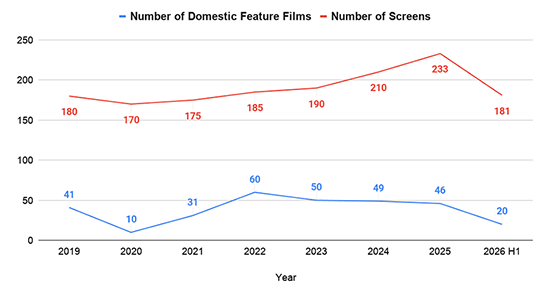
Note: The 2026 H1 figure is based on Eid operating figures and may not be directly comparable with previous full year figures. 2026 data covers H1 only, while previous years represent full year totals.
The Eid calendars exposed technical and logistical fragility. Star Cineplex reported late or missing DCP files for major releases and reminded producers that defective files require recreation and delay schedules. During Eid-ul-Fitr, Prince experienced opening disruptions linked to encrypted digital delivery.
Audience behaviour was event-led. The five Eid-ul-Fitr films generated sustained multiplex attendance into April, while the eight Eid-ul-Adha films brought younger viewers back to halls.
Bonolota Express led the domestic box office in H1. Roid and Pressure Cooker also crossed the break-even threshold, while the remaining local releases reportedly failed to recoup their investments. Reporting on the box-office performance of foreign films was even more limited.
Top Five Distributors' Market Share, H1 2026
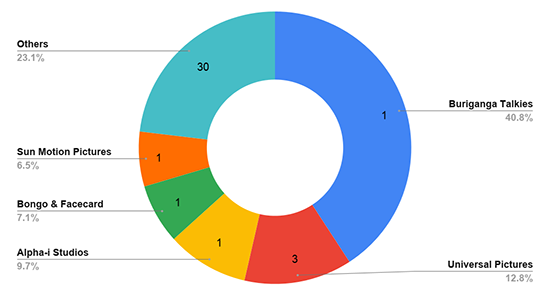
Note: Based on the total revenue of approx. BDT 490 million, percentages represent revenue share and the numbers on the slices indicate the title count.
Technology and Production Services
Animation and AI
No major new Bangladeshi soundstage, LED-volume or virtual-production facility was facilitated during H1. The period’s technology story was instead about digital-cinema delivery, incremental production-service development, overseas dependence, animation IP incubation and the early institutionalisation of generative AI.
Animation remained small but active. DIFF screened the ten-minute animation Porinam, while The Second Studio presented the pilot and production ecosystem of Best Show Everest at Alliance Française de Dhaka in June, combining animation, games, comics, concept art and original-IP development. The model suggests that local animation may grow first through cross-media properties, pilots and digital distribution rather than capital-intensive theatrical features.
AI-assisted filmmaking became publicly visible. Rashed Hasan’s short Ardhangini (The Wife) was reported as receiving selections at AI-focused festivals in Korea and France. The work was described as AI-assisted rather than a fully automated film: concept, writing and creative direction remained human-controlled while generative tools supported image creation and production.
The government-linked banAI 2026 initiative opened a national AI filmmaking competition around “Localizing Visual Models.” Its rules called for two-to-five-minute films, minimum 1080p delivery and disclosure of prompts and AI tools. The National AI Policy 2026-2030 Draft V2.0 was also released for public consultation, which ended on 8 February. The draft had not become a binding final policy by the end of H1.
Streaming & Digital Platforms
The domestic OTT market remained centred on Chorki, Bongo, Hoichoi Bangladesh, iScreen and other local or telecom-linked services. Global platforms remained important for audience access to international catalogues but did not publicly announce a comparable volume of Bangladesh originals during H1. Subscriber numbers, viewing hours and platform market shares were not publicly available on a consistent basis.
A title-by-title audit found a conservative minimum of 16 new originals or platform-exclusive productions across the four requested services: eight on Chorki, five on Bongo, one on Hoichoi Bangladesh and two on iScreen. The count includes original films, web films, flash-fiction titles and a new series or season. It excludes old catalogue additions and theatrical films merely transferred to OTT.
Theatrical-to-OTT windows also shortened. Domm moved to Chorki, Bonolota Express to Hoichoi, Prince to Utshob and Rakkhosh appeared on both Utshob and iScreen in the late-May period. These transfers show that theatrical release and streaming are increasingly sequential parts of one rights plan rather than opposing markets.
Payment access improved when fintech “bKash” supported subscription purchase for several OTT services. Local mobile-payment integration can lower friction for viewers without international cards. Nonetheless, piracy, password sharing, low average revenue per user and the absence of disclosed viewing metrics continue to make producer recoupment difficult to evaluate.
No clearly enacted H1 OTT-specific statute was identified. Platforms continued to operate under general cyber, telecommunications, taxation and content-control frameworks. The most consequential market development was therefore industrial integration: streaming companies increasingly functioned as commissioners, producers, marketers and post-theatrical distributors.
Co-production
And International Film Festivals, Workshops
H1 2026 saw two major Bangladeshi independent features with international co-production enter production: Robiul Alam Robi’s Suraiya, and Nuhash Humayun’s Moving Bangladesh. Suraiya received Bangladesh’s National Film Grant and a production grant from Berlinale’s World Cinema Fund, following earlier participation in Busan’s Asian Project Market and the Tasveer Film Market. Its co-production network has included Lightsource Film Productions in Norway, Made in Baniyalulu in Bangladesh and, at the production stage, Germany’s Niko Film Productions. Moving Bangladesh was developed as an international co-production with partners from Dissidenz Films France and Flash Forward Entertainment Taiwan and received funds from Taipei Film Commission, ScreenCraft Film Fund, Sloan support through Sundance and Film Independent.
The strongest highlight of H1 was the International Film Festival Rotterdam. Three Bangladeshi features entered three separate IFFR sections: Roid in Tiger Competition as a world premiere, Master in Big Screen Competition as a world premiere, and Delupi in Bright Future as an international premiere. This was important because the films were not bundled into a single country focus; each was selected through a different curatorial or competition pathway. Master won the 2026 Big Screen Award.


Team Roid, Director Rezwan Shahriar Sumit winning the Big Screen Award with Master, Team Delupi
© Tanveer Hossain
In H1, ANNiE Opens a New International Route. Abdullah Mohammad Saad, whose Rehana Maryam Noor premiered in Cannes’ Un Certain Regard, returned with the limited series ANNiE. It became the first Bangladeshi series selected for Seriencamp Festival, Germany, where it had its world premiere, and was later named one of The Hollywood Reporter’s “5 Hidden Gems at Seriencamp 2026.” The achievement opens a new pathway for Bangladeshi audiovisual work to enter international series-specific festivals, beyond the traditional film-festival circuit.
 ANNiE © Tanveer Hossain
Ali continues to deliver the period’s most concentrated short-film success. Filmfest Bremen awarded it Best Short Film - Diversity 2026. Kathmandu International Mountain Film Festival awarded it Best Short Fiction. Balinale named it the Short Narrative winner. SXSW London awarded it the Short Film Prize.
Other highlights included Mamun: In Praise of Shadows winning Best Documentary Film at the UK Asian Film Festival.
At home, the 24th Dhaka International Film Festival (DIFF), held from 10–18 January, screened 246 films from more than 70 countries and was widely noted for the scale of its programme and strong Bangladeshi participation.
A further H1 highlight was the fourth West Meets East Screenplay Lab, held from 11-14 January within DIFF. The lab received 167 submissions and selected 10 feature-fiction projects from eight Asian countries. The three development-prize winners were She Stands Still in Drifting Water by Oates Yinchao of China, receiving BDT 500,000; The Husband by Aizada Bekbalaeva of Kyrgyzstan, receiving BDT 300,000; and Mountain of Spirits by Ritesh Gurung of Nepal, receiving BDT 200,000. These were screenplay-project awards rather than completed-film awards.
 Photo Courtesy: Dhaka International Film Festival
Other H1 2026 Labs, Workshops and Training
You can scroll left and right to view the content.
| Date | Programme | Organiser | Focus | Verified scale / outcome |
|---|---|---|---|---|
| 16, 17, 23 & 24 Jan | Proud Bangladesh Mobile Filmmaking Workshop | DIMFF / ULAB / Infinix | Four-day hands-on mobile filmmaking: ideas, scripting, shooting and editing | 20 participants in five teams selected from 70+ applicants across 13 universities |
| 17 Jan | DIFF Masterclass | Dhaka International Film Festival | Filmmaking and production-design sessions | Speakers included Swiss editor Theresa Vena, Croatian filmmaker Aleksandra Markovic and Bangladeshi filmmaker / production designer Liton Korr |
| 11-12 Jan | International Conference on Women in Cinema | DIFF / ActionAid-linked programme | Professional barriers, representation and pathways for women filmmakers | International conference rather than a project lab; included as professional-development infrastructure |
| 22 Apr | Masterclass on AI Filmmaking | AIUB, JMC Animation Track | AI tools and creative-production workflows | Held at AIUB Animation Lab for students and practitioners |
| 30 Apr onward | banAI 2026 | Brain Lab / government-linked AI initiative | National AI filmmaking competition themed Localizing Visual Models | Registration opened in H1; an original June workshop roadmap was later revised, so completed H1 bootcamps are not claimed |
| 13 May | Underwater Photography and Filming Workshop | University of Dhaka, Television, Film and Photography Department | Theory and practical underwater image-making | Reported as Bangladesh's first university-level workshop of its kind; 100 students attended and 20 took part in hands-on practice |
| 5 Jun onward | Forced to Flee Mobile Filmmaking Workshop | UNHCR Bangladesh / DIMFF / ULAB | Ethical storytelling, displacement and mobile filmmaking | Five university teams selected from 22 institutions |
| 10 Jun | Medical Filming Workshop | BCTI / National Institute of Cardiovascular Diseases | Documenting medical procedures and special-category film production | Connected filmmakers and physicians around realistic documentary practice |
| 27 Jun | Documentary and Multi-platform Course Completion | Bangladesh Cinema and Television Institute | 6th Documentary Filmmaking Course and 1st TV Programme and Multi-platform Content Production Course | Certificates awarded; illustrates formal public-sector training for film, television, OTT and digital content |
Interview Ⅰ
with Rezwan Shahriar SUMIT, Filmmaker

Rezwan Shahriar Sumit is a Bangladeshi filmmaker and NYU Tisch alumnus whose work explores politics, society and contemporary Bangladesh. His debut feature, The Salt in Our Waters, received seven National Film Awards. His sophomore feature, Master, won the Big Screen Award at the International Film Festival Rotterdam in 2026.
Q. How has winning IFFR’s Big Screen Award changed the journey of Master?
A.Master is my sophomore feature, a political thriller set in a remote, forested part of Bangladesh. We wanted the film to remain very close to the people, politics, landscape and culture it comes from. Seeing such a specific Bangladeshi story connect with audiences in Rotterdam was deeply encouraging. Winning the Big Screen Award made me believe even more strongly that local stories do not need to lose their identity to travel internationally.
Q. How is Bangladesh’s political uncertainty affecting independent filmmaking today?
A.Political uncertainty affects everything around us, and cinema is no exception. When the economy suffers, private investment becomes difficult and independent films are often the first to feel it. Over time, talented people are forced to find other ways to make a living. There is also always the concern that unstable political environments can create greater pressure on freedom of expression.
Q. How do you see streaming and distribution changing for Bangladeshi films?
A.Our theatrical infrastructure remains extremely limited. Because of this, filmmakers are looking beyond conventional releases. Streaming, diaspora audiences, impact distribution and international platforms are becoming increasingly important for giving our films a longer life.
Q. What is the biggest opportunity and challenge for Bangladeshi cinema now?
A.The talent is already here. What we lack is consistent institutional support, proper training, infrastructure and resources. I helped design and operate a talent development program called the PostPro TalentLab. It was a World Bank initiative, funded by the Korea-World Bank Partnership Facility (KWPF) trust fund, aimed at upskilling post-production professionals in Bangladesh. It showed me how quickly meaningful training and international exchange can strengthen an industry.
Interview Ⅱ
with Wahid Ibn REZA, Writer-Director

Wahid Ibn Reza is a Production Manager for the upcoming untitled Simpsons movie by day. And by night he is the Writer-Director for the National Film Board of Canada. His award winning animated short film After Us produced by the NFB is currently playing in festival circuits around the globe.
Q. What did working on Marvel Movies, Game of Thrones and major animation projects teach you that Bangladesh can adopt?
A.Every role matters. It’s a team effort and you can’t do it alone. Help each other. Build ground up by putting a good team together. And respect each other.
Q. How do you see technology helping our local stories reach global audiences?
A.Technology is supposed to be the assist. It’s the bow that makes it look pretty. Only the story matters. If local stories are being true to themselves, and you plan your shoot intelligently, you can create massive global success. Recent films such as Flow and Godzilla Minus One are a great example for that.
Q. How will AI change animation and visual effects in the next five years?
A.How AI has been used so far is disappointing. You want it to come to you as a blank set that you can teach your skills and then use it to expedite your own process. You absolutely shouldn’t train it with skills that other people have developed for years.
Q. What must Bangladesh build now to create a globally competitive animation and VFX industry?
A.We need long term plans. What to do 20-30 years down the road. Build infrastructure and training that support interested talents. Build a pipeline that can attract international work. And as we work on them we develop skills so that we can later use them in our local productions. The government needs to give subsidies and tax incentives to attract global and local investors.
Tanveer Hossain
Producer, Writer
Tanveer Hossain is a Bangladeshi film producer and storyteller working across fiction, documentary, and animation. A graduate of the Busan Asian Film School and BAFA. An alumnus of Berlinale Talents, EAVE, APostLab, APN etc. He has produced award-winning projects showcased at festivals such as Cannes, Rotterdam, Busan, Melbourne, Seminci, SXSW, Hanoi etc. Passionate about discovering unique voices, Tanveer bridges artistic vision with production expertise, connecting local narratives to global audiences. He serves as Executive Director of Green Screen and recently co-founded Katalog, a boutique production company championing Asia-Asia collaborations.
Mamun Sobhani
Producer, Director and Writer
Mamun Sobhani is an emerging film producer, director and writer from Bangladesh. He is the CEO of Sangu Films, a film production company based in Dhaka. And founder of the South Asian School of Visual Arts. He received the Bangladesh Government Short Film Grant 2024. Sobhani worked as a member of the preview committee in the 12th Liberation Docfest Bangladesh 2024. He was a participant in the Clinik. Kathmandu Documentary Residency Program, under Docskool, Nepal. He is a graduate of the Bangladesh Cinema and Television Institute (BCTI).
- Disclaimer on Data Reliability: In the absence of a centralized box office system, or a comprehensive industry database, exact figures for production volume, revenue, and audience reach remain unavailable in Bangladesh. Given the lack of standardized reporting, data is often adjusted or interpreted differently by concerned parties. The information in this report has therefore been compiled through direct communication with filmmakers, producers, and industry professionals, supplemented by cross-referencing social media market research pages and press coverage till 30 June 2026. While every effort has been made to ensure accuracy, the findings should be considered approximately 95% reliable, reflecting the limitations of a fragmented and largely undocumented Bangladeshi film industry landscape (H1 2026).
RELIABLE VERBAL CONTRIBUTORS:
- Khaled Ahmed Shammi | Executive Director | Star Cineplex
- Rebecca Sultana | AGM | Star Cineplex
- Habibur Rahman Tareq | Producer | Runout Films
- Shimul Chandra Biswas | Producer | Facecard Productions
- Raihan Rafi | Director, Producer | Kanon Films
CONSOLIDATED SOURCE DIRECTORY:
- Bangladesh Film Certification Board
- Blockbuster Cinemas archive
- Box Office Mojo - Bangladesh 2026
- Daily Star - Eight Eid-ul-Adha films
- Daily Star - DCP concerns before Eid-ul-Adha
- Daily Star - Government film grant deadline
- Prothom Alo - Grant committee delay
- Daily Star - Grant committee formed
- IFFR - Bangladesh programme
- National AI Policy Bangladesh